Felt Coasters: Round and Hexagon Sets With a Stitched Edge
Sew a set of four double-layer felt coasters, round or hexagon, from one paper circle. Includes cutting sizes, edge stitching, thickness advice and care notes.
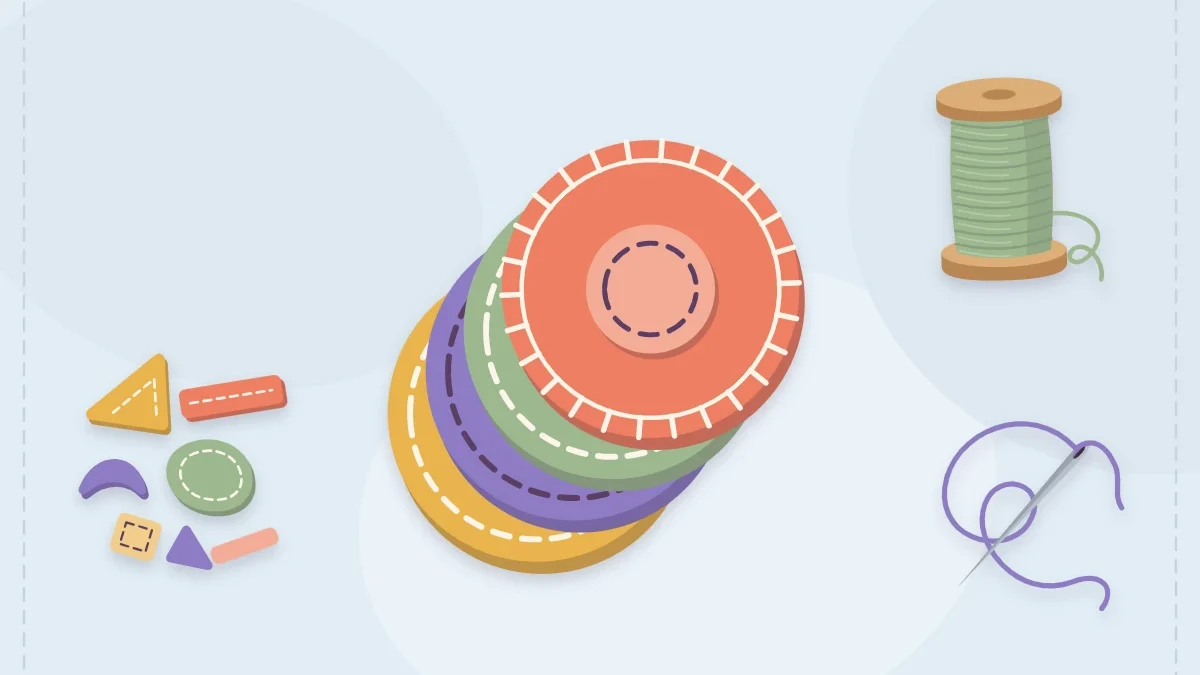
Project kit
Materials
- Wool-blend felt in 2 colors
- Embroidery floss, 1 skein
- Embroidery needle
- Sharp fabric scissors
- Glass or mug about 4 in (10 cm) across for tracing
- Paper, pencil and ruler
- Pins
- Erasable fabric pen (optional)
Two circles of felt and a line of stitching make a coaster that protects a table, soaks up the ring of moisture under a cold glass and stays quiet when a mug is set down. Felt coasters are also one of the best first sewing projects, since the whole job is a single seam around an edge with no turning, no stuffing and no closure.
The set described here has four double-layer coasters, in a round version and a hexagon version. Both come from the same paper circle, so one template covers either shape.
What You Need
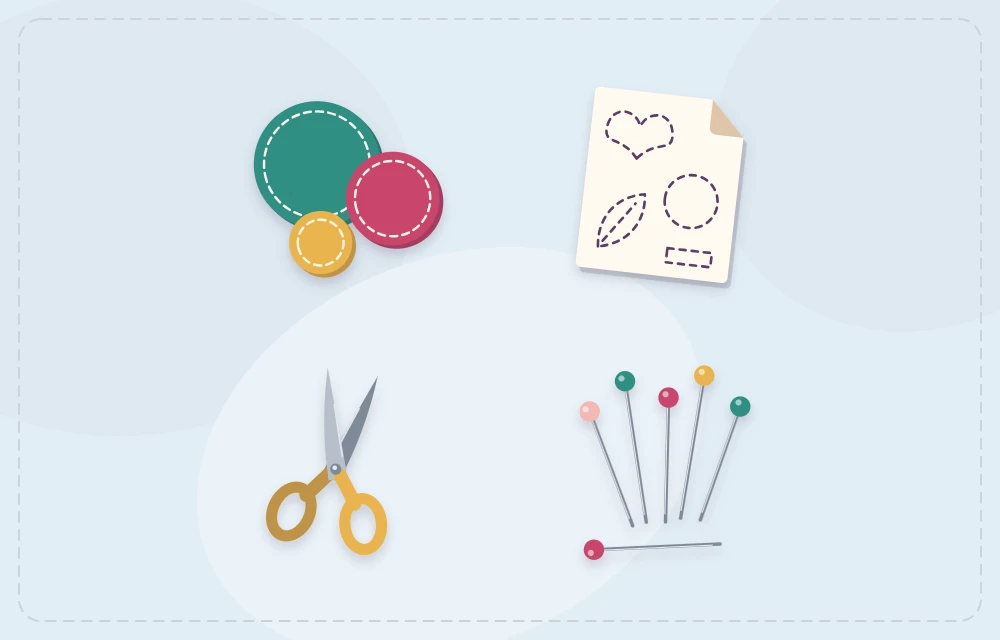
- Wool-blend felt in two colors, one sheet 9 x 12 in (23 x 30 cm) of each
- Embroidery floss in a matching or contrasting color, one skein
- Embroidery needle
- Sharp fabric scissors
- A glass or mug about 4 in (10 cm) across, for tracing
- Plain paper, pencil and ruler
- Pins
- Erasable fabric pen (optional)
Choosing Felt and Thickness
Most craft sheets are thin, so a single layer feels flimsy under a mug and lets moisture through quickly. Two layers stitched together give enough body to lie flat and enough thickness to absorb condensation. Wool-blend felt is denser than acrylic craft felt and keeps a crisper edge, which matters on a piece that is all edge. Extra-thick felt, about 1/8 in (3 mm), can be used as a single layer with a decorative stitched border instead of a joining seam.
Watch out
Felt coasters are for cups, mugs and glasses. They are not trivets. Do not set pots, pans or dishes straight from the stove or oven on them, and keep them away from candles. Acrylic craft felt is made from synthetic fibers and can melt under high heat.
Cutting Round and Hexagon Felt Coasters
Round
Trace the glass onto paper and cut out the circle. Fold it in half to check it is symmetrical and trim if needed. A finished size of about 4 in (10 cm) suits most mugs. Pin the template to the felt and cut around it with long, smooth closes of the scissors, turning the felt rather than the hand. Cut four circles from each color, eight in all. One sheet holds six circles of this size in two rows of three. Tips for smooth curves are in the guide on how to cut felt.
Hexagon
Start with the same paper circle. Fold it in half, then fold that half circle into three equal wedges, like a paper fan, so the curved edges line up. Cut straight across from one end of the curved edge to the other, removing the curve. Unfolded, the paper is a six-sided shape with equal sides, measuring 4 in (10 cm) from point to point. Use it to cut eight felt hexagons. The straight sides are quicker to cut than curves and make it easy to line up two layers.
How to Sew the Coasters
- Pair the layers. Stack one piece of each color, edges matched, and hold them with two pins placed well inside the edge.
- Prepare the floss. Cut about 30 in (75 cm) and separate out three strands. That length goes around a 4 in (10 cm) coaster with some to spare. Knot one end.
- Hide the knot. Slide the needle between the two layers and bring it out through the top layer, 1/8 in (3 mm) from the edge. The knot stays inside.
- Stitch around the edge. Sew through both layers all the way around, keeping each stitch 1/8 in (3 mm) from the edge and about 3/16 in (5 mm) long. Running stitch gives a neat dashed line. Blanket stitch wraps the edge and looks more finished. The basics of both are covered in the guide to hand sewing felt.
- Handle the hexagon corners. On a hexagon, plan the spacing so a stitch lands on each of the six points. With blanket stitch, work one stitch on either side of the point and one into the point itself.
- Close the round. When the stitching meets its starting point, adjust the last two or three stitches so the gap matches the rest.
- End off. Take the needle between the layers, make a small knot around the last stitch and pull it inside. Run the needle about 1 in (2.5 cm) through the middle of the coaster, bring it out and snip the tail flush.
- Finish the set. Trim any place where one layer overhangs the other, then repeat for the other three coasters.
Tip
For even spacing on a circle, mark the edge lightly with the fabric pen at the 12, 3, 6 and 9 o’clock positions, then count the same number of stitches into each quarter.
Variations
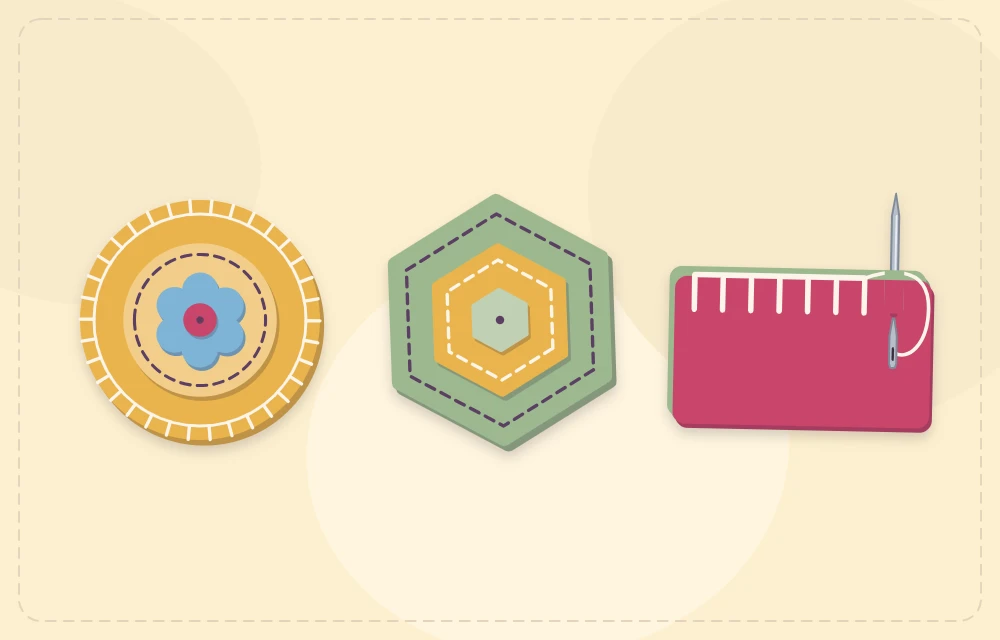
- Reversible set: with two colors per coaster, each one can be flipped. Stitch in a third color that suits both sides.
- Applique center: sew a smaller shape, such as a 1 1/2 in (4 cm) circle or a leaf, to the top layer before joining the two layers, so its stitches are hidden inside.
- Concentric rings: add one or two extra circles of running stitch inside the edge seam. They quilt the layers together and keep the coaster flatter.
- Scalloped edge: cut the bottom layer 1/4 in (6 mm) larger all around and trim it with pinking shears for a zigzag border.
- Larger mats: trace a small plate about 6 in (15 cm) across for a mat that fits a teapot or a plant pot saucer.
Care and Everyday Use
Felt absorbs moisture, which is useful under an iced drink but means a coaster left wet will stay damp. Stand damp coasters on edge to air dry. For spills, blot at once with a cloth, then spot clean with cool water and a drop of mild soap. Wool-blend felt can be washed gently by hand in cool water, pressed in a towel without wringing and dried flat. Hot water and rough handling can shrink or distort it.
Dark drinks such as coffee can stain pale felt, so mid-tone and darker colors stay presentable longer. Lint and fuzz lift off with a piece of tape pressed over the surface.
Making a Set to Give
Four coasters stacked and tied with a ribbon make a tidy present that takes an evening to sew. Choose two colors that suit the room they are going to, or make each coaster a different top color with a shared backing so guests can tell their drinks apart. More projects of a similar size are gathered under felt gift ideas.
Frequently asked questions
How thick should felt coasters be?
Two layers of standard craft-weight felt stitched together work well. A single layer is only sturdy enough if the felt is extra thick, around 1/8 in (3 mm).
Can felt coasters handle hot mugs?
Yes, they are fine under mugs of tea or coffee. They are not trivets, so keep pots, pans and oven dishes off them, especially acrylic craft felt, which can melt under high heat.
How do you clean felt coasters?
Blot spills right away and spot clean with cool water and a little mild soap. Wool-blend felt can be hand washed gently in cool water and dried flat.
What size is a standard coaster?
About 4 in (10 cm) across suits most mugs and glasses. Trace a larger object for oversized mugs or small teapots.