Seasonal Felt Crafts: A Year of Project Ideas
Felt project ideas for spring, summer, fall and winter, with color palettes, shapes to draw at home and the base methods each one adapts, plus tips for planning ahead.
A handful of basic methods covers almost every holiday and season on the calendar. The stuffed shape that makes a heart in February makes an egg in April and a star in December; only the outline and the colors change. Seasonal felt crafts are less about learning new techniques than about re-dressing the ones already practiced.
This guide walks through the year season by season, with colors, simple shapes that can be drawn at home, and the base tutorial each idea adapts. A planning section at the end helps with the one thing seasonal projects always need: an early start.
Four Base Methods for Seasonal Felt Crafts
Nearly every idea below is a variation on one of four constructions.
- Cut-and-string garland. Flat shapes threaded or sewn onto cord. The method in the felt garland tutorial works for any outline that can be cut from a 3 in (7.5 cm) square.
- Stuffed two-layer shape. Cut two, stitch, stuff, close, add a loop. The core steps come from felt ornaments.
- Layered flat piece. Shapes stacked and stitched or glued to a backing, for banners, hoops, tags and coasters.
- Gathered or rolled form. A circle gathered into a ball or a strip rolled into a coil, for pumpkins, berries, roses and acorns.
Choose the construction first, then the season decides the shape and palette.
Spring: Soft Colors and Rounded Shapes
Colors: pale yellow, mint, blush pink, lilac, sky blue, with white and a fresh leaf green.
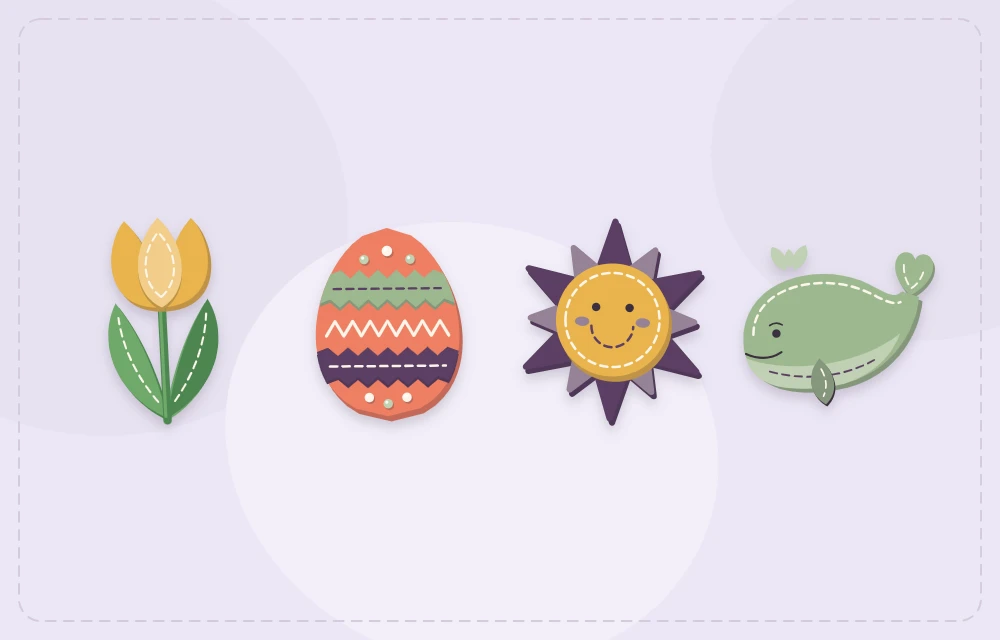
- Egg garland. Draw an egg by tracing a glass and stretching the top into a gentle point, about 2.5 in (6 cm) tall. Decorate each one with stitched zigzags, narrow felt strips or French knots before stringing.
- Stuffed bunny or carrot. A bunny is an oval body with two long leaf-shaped ears; a carrot is a narrow triangle with rounded corners and a tuft of green strips. Both use the stuffed two-layer method.
- Tulips and daisies. A tulip is a cup shape with three points cut along the top. Layered daisies and other blooms from the felt flowers tutorial make a spring wreath when glued around a ring of stiff felt.
- Raindrop and cloud mobile. One stuffed cloud with five or six flat raindrops hanging below on thread.
Summer: Bright Colors and Flat, Light Pieces
Colors: coral, turquoise, sunny yellow, lime, navy and white.
- Sun coasters. A round double-layer coaster in yellow with a ring of straight stitches radiating from the center. Felt coasters suit cold glasses well because the fibers absorb condensation.
- Whale or fish keychain. A teardrop body with a notched tail, lightly stuffed, with stitched eyes rather than beads.
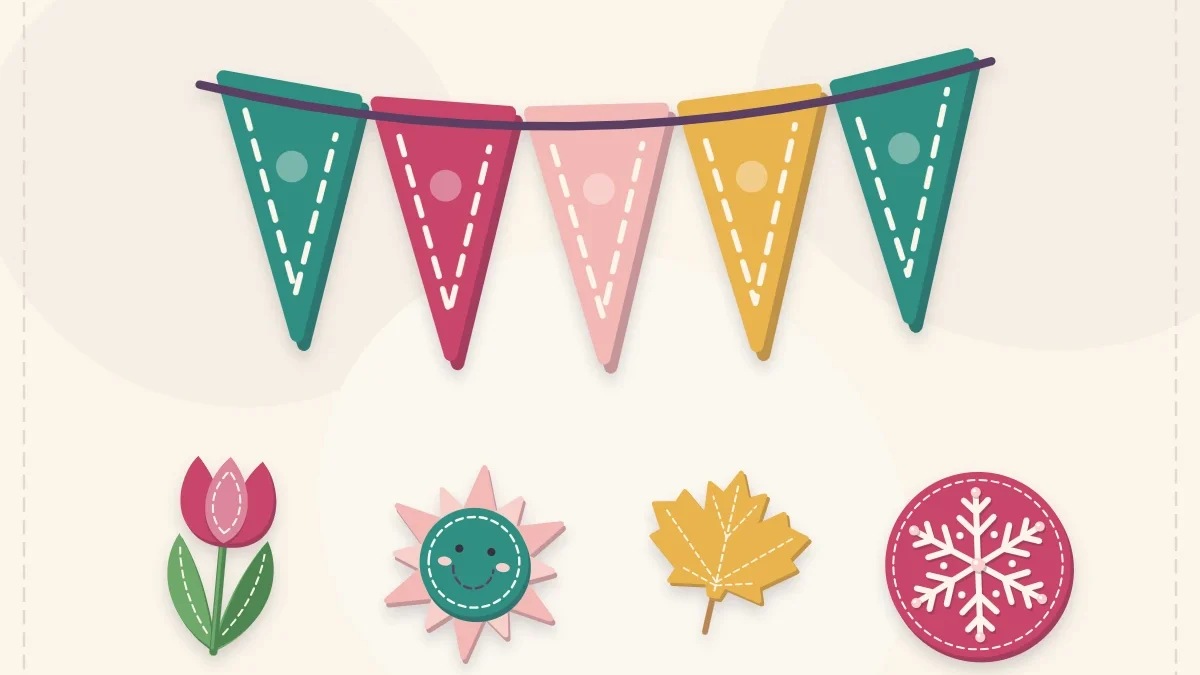
- Pennant bunting. Triangles 3 in (7.5 cm) wide and 4 in (10 cm) tall in alternating brights, stitched along the top edge to cord or ribbon. Felt bunting is for covered, dry spots; rain and strong sun are hard on it.
Fall: Warm Tones and Gathered Shapes
Colors: rust, mustard, pumpkin orange, deep red, olive, chocolate brown and cream.
- Leaf garland. Fold a paper rectangle in half, draw half a leaf against the fold and cut, so both sides match. Stitch a center vein in backstitch, then pinch the base of each leaf and take one stitch to hold the pinch for a curled, natural look.
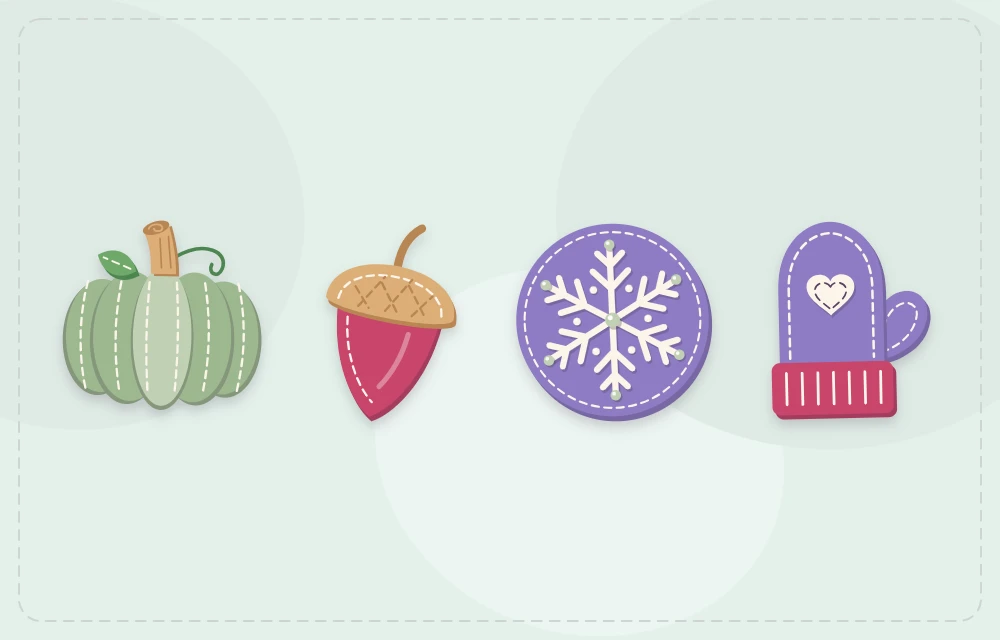
- Pumpkins in three sizes. Gathered circles tied into segments with floss and topped with a rolled stem; the full method is in the felt pumpkins tutorial.
- Acorns. A small stuffed oval in tan with a darker cap, cut as a half-circle and wrapped over the top, held with whip stitch.
- Ghost garland. For the end of October, a white rounded arch with a wavy lower edge and two stitched eyes. Alternate with small orange circles.
Winter: Deep Colors, White and a Little Sparkle
Colors: deep red, forest green, navy, charcoal, white and soft gray, with metallic or pale blue floss as an accent.
- Stuffed stars, trees and mittens. A tree is a tall triangle with a small square trunk; a mitten is a rounded rectangle with a thumb bump. All three hang from ribbon loops.
- Snowflake circles. Cutting a real snowflake outline from felt is fiddly. Instead, stitch one in white floss on a blue circle: three long crossing stitches, with a small V near the end of each arm.
- Gingerbread figures. Draw a circle head on a simple body with rounded arms and legs, about 4 in (10 cm) tall, in cinnamon brown. Add white running stitch near the edge to suggest icing.
- Mini stockings. Two boot shapes stitched along the sides and base, left open at the top, with a contrasting cuff. Sized at 4 to 5 in (10 to 13 cm), they hold a small treat or a gift card.
- Heart garland for February. Fold paper, cut half a heart on the fold, and string flat hearts in red and pink.
The Year at a Glance
| Season | Shapes | Palette | Base method |
|---|---|---|---|
| Spring | Egg, bunny, carrot, tulip, raindrop | Pastels and leaf green | Garland, stuffed shape, layered flowers |
| Summer | Sun, whale, fish, pennant | Brights with navy and white | Coaster, bunting, flat layered piece |
| Fall | Leaf, pumpkin, acorn, ghost | Rust, mustard, olive, brown | Garland, gathered circle, stuffed shape |
| Winter | Star, tree, mitten, snowflake, stocking, heart | Red, green, navy, white | Stuffed shape, embroidered circle, garland |
Planning Ahead
Handmade decorations take longer than expected, and the busiest seasons are the ones with the least spare time. A little planning keeps the making enjoyable.
- Start one season early. Begin winter projects in early fall and spring projects in midwinter. A garland of twenty shapes is easier at three or four shapes an evening than in one sitting.
- Cut in batches. Trace and cut every piece for a project in one session, then keep them in an envelope with the floss and a needle. Stitching can then happen anywhere, a few minutes at a time.
- Keep one template set. Card templates for a circle, heart, star, leaf and egg in two sizes cover most of the year. Store them flat in a labeled folder.
- Buy felt by palette. Four or five sheets per season is plenty. White, cream and a mid green work in every season and are worth keeping in stock.
- Use scraps for the next season. Orange offcuts from fall become spring carrots; red winter scraps become February hearts.
Tip
Store finished decorations flat between sheets of tissue in a lidded box, away from damp and direct sunlight. Stuffed pieces keep their shape best when nothing heavy rests on them.
Seasonal decorations with buttons, beads or other small parts are not suitable for children under 3, and all felt pieces should be displayed well away from candles and other heat sources.
Frequently asked questions
When should seasonal felt projects be started?
About one season ahead is comfortable. Starting winter decorations in early fall leaves time to make them a few pieces at a time.
Can felt decorations be used outdoors?
Only in covered, dry places and for a short time. Rain makes felt sag and prolonged sun fades the colors.
How should felt decorations be stored between seasons?
Lay them flat between sheets of tissue in a lidded box kept somewhere dry and out of direct sunlight, with nothing heavy on top of stuffed pieces.
Which felt colors are useful all year?
White, cream and a mid green appear in every season's palette, so they are the most practical colors to keep on hand.