
Best Pickleball Paddles for Seniors to Keep the Fun Going at Any Age
Why the Right Pickleball Paddle for Elderly Players Changes Everything
The best pickleball paddle for elderly players combines lightweight construction, a soft core, and a comfortable grip — here’s a quick look at what matters most:
| Feature | What to Look For |
|---|---|
| Weight | 7.3–7.8 oz (avoid over 8.5 oz) |
| Core material | Polymer honeycomb for vibration dampening |
| Grip size | 4–4.25 inches for most seniors |
| Paddle face | Wide body for a larger sweet spot |
| Surface material | Fiberglass or carbon fiber for control |
Pickleball is booming — and seniors are leading the charge. Over 60% of core pickleball players are aged 55 and above, making this one of the most age-embracing sports in the country.
It’s easy to see why. The court is small. The ball moves slower than tennis. And you can get a solid workout without hammering your joints.
But here’s something many new players overlook: the paddle you choose matters just as much as how you play.
The wrong paddle — too heavy, too stiff, wrong grip size — can turn a fun morning on the court into sore wrists and a tired shoulder. The right one feels almost invisible in your hand, letting you focus on the game.
This guide walks you through exactly what to look for, which paddles are worth your money, and how to get the most out of every match.
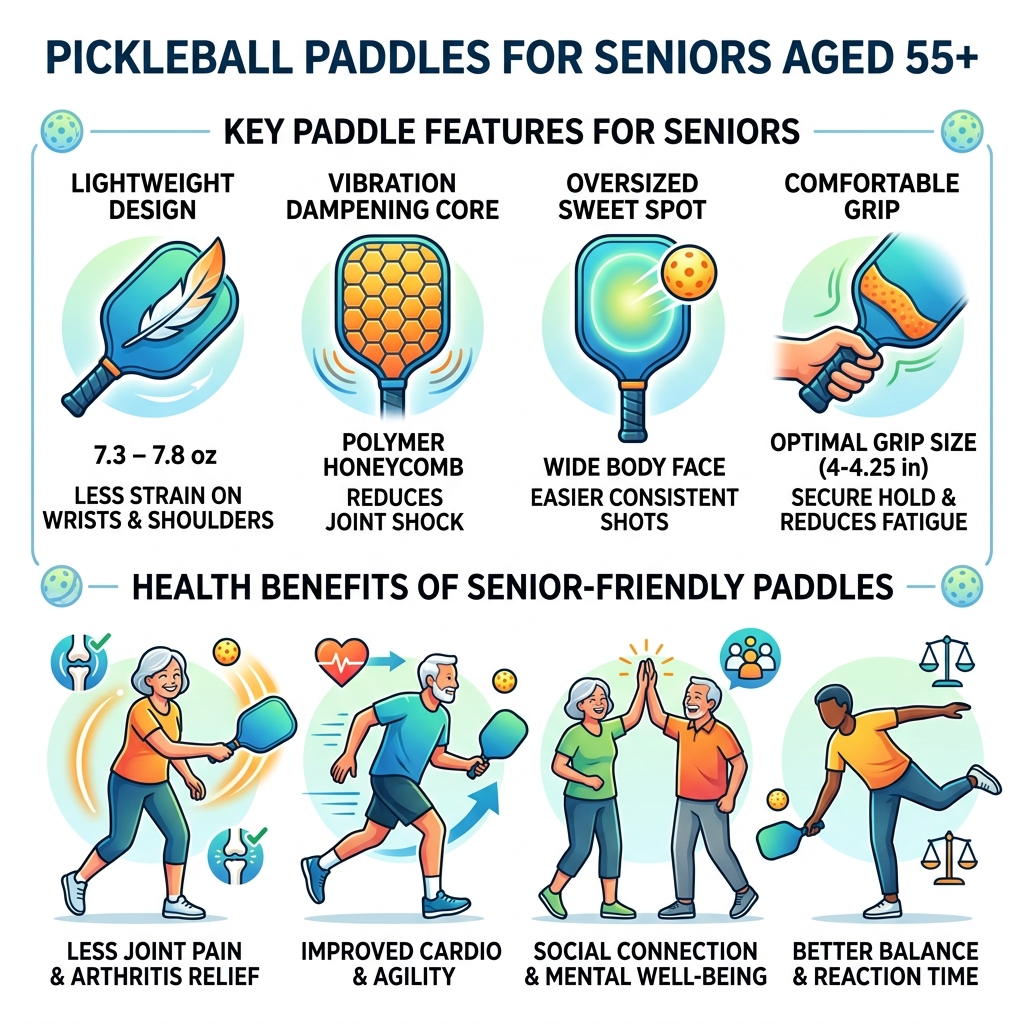
Key Features of a Pickleball Paddle for Elderly Players
When we talk about finding the perfect pickleball paddle for elderly players, we aren’t just looking for something that looks good on the court (though a little style never hurts!). We are looking for equipment that acts as a partner in injury prevention and performance.
The foundation of a senior-friendly paddle is its core. Most modern paddles use a polymer honeycomb core. We recommend this specifically for seniors because it offers the best vibration dampening. When the ball hits the paddle, the honeycomb structure absorbs the energy, preventing that “stinging” sensation from traveling up your arm and into your elbow or shoulder. This is a game-changer for those of us managing arthritis or general joint sensitivity.

Another vital feature is the sweet spot. As we age, our hand-eye coordination might need a little extra grace. A wide-face shape paddle provides a larger hitting surface, which means even if you don’t hit the ball perfectly in the center, the paddle still provides a consistent response. This “forgiveness” helps keep rallies going and reduces the frustration of “mishits.”
Surface materials also play a huge role. You’ll often see carbon fiber and fiberglass. Carbon fiber is incredibly lightweight and offers a “soft” feel for better control, while fiberglass provides a bit more “pop” or power. For most seniors, we suggest prioritizing control. You can learn more about these differences in our guides on decoding paddle materials for seniors and our broader look at paddle materials.
Ideal Weight Range for a Pickleball Paddle for Elderly Beginners
If there is one statistic you should memorize, it’s this: the ideal paddle weight for seniors is between 7.3 and 7.8 ounces.
Why is this range so specific? It’s the “Goldilocks” zone. A paddle in this range is light enough to reduce fatigue during a long morning of play but heavy enough to provide stability when you’re blocking a hard shot. Once you start using paddles over 8.5 ounces, the risk of injury increases significantly. Heavy paddles require more force to swing and stop, which puts unnecessary strain on the rotator cuff and wrist tendons.
We’ve seen many players struggle with “pickleball elbow” (similar to tennis elbow) simply because they were swinging a paddle that was too heavy for their current strength level. By staying in the lightweight category, you ensure that you can play three or four games in a row without feeling like your arm is made of lead. For a deeper dive into how weight affects your game, check out our article on navigating paddle weights for seniors and our lightweight paddle guide.
Choosing the Best Pickleball Paddle for Elderly Women with Small Hands
For many of our senior female players, especially those with petite builds, standard paddle grips can feel like holding a baseball bat. This leads to “over-gripping”—squeezing the handle too hard just to keep it from twisting. Over-gripping is a direct ticket to hand fatigue and can aggravate arthritis.
We recommend looking for a grip circumference of 4 inches to 4.25 inches. A smaller grip allows you to wrap your fingers comfortably around the handle, giving you better “feel” for the ball. If you find a paddle you love but the grip is a tiny bit too small, you can always add an overgrip to customize the fit. However, you can’t make a large grip smaller!
Finding that perfect fit is essential for hand comfort and long-term playability. We’ve put together some expert tips on understanding grip size for seniors and optimizing your grip to help you find that “just right” feeling.
Top-Rated Lightweight and Control-Oriented Paddles for Seniors
Selecting a paddle can be overwhelming with hundreds of options on the market. Based on our research and player feedback, we’ve narrowed down the top contenders that balance weight, comfort, and price.
| Paddle Model | Weight (Avg) | Core Thickness | Key Benefit |
|---|---|---|---|
| JOOLA Agassi Champion | 7.8 oz | 12mm | Forgiving Sweet Spot |
| Diadem Hush | 8.1 oz | 18mm | Ultra-Quiet & Soft |
| JOOLA Seneca FDS 14 | 8.0 oz | 14mm | Vibration Reduction |
| JOOLA Essentials | 8.2 oz | 12mm | Great Value/Beginner |
| Hudef Sport (Various) | 7.0-7.8 oz | Variable | Lightweight Carbon Fiber |
The JOOLA Agassi Champion 12mm is a standout for those transitioning from tennis. Designed with input from Andre Agassi and Steffi Graf, it features a shape that extends the sweet spot into the upper edges. It’s incredibly forgiving, which is exactly what a senior player needs when learning the nuances of the “dink” game.
For those who play in communities with strict noise rules, the Diadem Hush Pickleball Paddle is a miracle. It’s “USA Pickleball Quiet Certified,” meaning it doesn’t make that loud “pop” that can sometimes bother neighbors. More importantly for seniors, its thick 18mm core and eTPU surface provide an exceptionally soft feel, absorbing almost all the vibration from the ball.
If you are looking for a paddle that helps you “level up” your accuracy, the JOOLA Seneca FDS 14 uses a Response Honeycomb Polymer Core specifically designed to reduce vibration. For those just starting out who want a reliable, all-around performer without breaking the bank, the JOOLA Essentials Pickleball Paddle is a fantastic entry point.
Lastly, for players who need the absolute lightest options, the Senior paddles by Hudef Sport offer several thermoformed carbon fiber models that prioritize comfort and ease of swing. You can find more detailed thoughts in our review of top-rated senior paddles.
Health Benefits of Choosing the Right Equipment
Using the right pickleball paddle for elderly players isn’t just about winning points; it’s about investing in your health. Pickleball is a powerhouse for active aging.
Research shows that regular play can improve VO2 max (oxygen uptake) by 12% in seniors over just six months. But the benefits go far beyond the heart. Seniors who play racquet sports like pickleball have a 47% lower risk of dementia compared to their sedentary peers. The combination of physical movement and the strategic “chess match” of a pickleball rally keeps the brain sharp and builds new neural pathways.
One of the most critical benefits is fall prevention. One in four Americans aged 65+ falls each year, but pickleball players show 23% better balance scores and 35% better agility. By using a lightweight, control-oriented paddle, you are able to stay in the game longer, building the core stability and lower body power necessary to stay upright and independent.
Furthermore, pickleball helps combat sarcopenia (age-related muscle loss), which affects 45% of adults over 60. Playing three times weekly has been shown to enhance grip strength by 20% and upper body strength by 18%. For more on the science behind these numbers, read our summary of scientific research on senior sports benefits.
Essential Accessories and Modifications for Senior Comfort
Sometimes, the paddle itself is only half the story. A few simple modifications can take a “good” paddle and make it “great” for your specific needs.
Overgrips are our favorite low-cost upgrade. They add a layer of cushioning that absorbs sweat and provides extra vibration dampening. If you have arthritis, a thicker, “tackier” grip allows you to hold the paddle with less hand pressure. You might also consider paddle bands or color-coded name bands. These aren’t just for style; they help you identify your paddle in a crowded “paddle saddle” at the local courts and can provide a small amount of extra weight balance at the throat of the paddle.
For those who want to fine-tune their equipment, lead tape or tuning weights can be used to increase the sweet spot of a lightweight paddle. However, be careful not to exceed that 8.5 oz limit we discussed! Check out our guides on tuning tapes and customizing with weight tape for step-by-step instructions.
Beyond the paddle, don’t forget your feet. Court shoes with lateral support are non-negotiable to prevent ankle rolls. We also strongly recommend protective eyewear and staying hydrated. A 10-15 minute dynamic warm-up before you hit your first ball can prevent 90% of common pickleball strains.
Frequently Asked Questions about Senior Pickleball Gear
What is the best weight for a senior pickleball paddle?
As we’ve highlighted, the sweet spot is 7.3 to 7.8 ounces. We strongly advise avoiding anything over 8.5 ounces, as the increased mass puts too much strain on the tendons in the elbow and shoulder. If you are a beginner, starting on the lighter end of this scale (7.3-7.5 oz) will help you develop your swing without getting tired. You can find more beginner-specific tips in our guide for senior beginners.
How do I know if a paddle is USAP approved?
If you plan to play in any local tournaments or sanctioned events, your paddle must be USA Pickleball (USAP) Approved. Look for a “USAPA Approved” seal or logo printed directly on the face of the paddle or near the handle. This ensures the paddle has been tested for fair play, including surface roughness and “trampoline effect.” Most reputable brands like JOOLA, Diadem, and Hudef are fully approved. For more help, see our ultimate guide to picking your first paddle.
Why should seniors avoid power-focused paddles?
Power paddles, like the Selkirk Vanguard Power Air, are often designed with very stiff cores and aerodynamic holes to increase swing speed. While great for young, aggressive players, these paddles often have a smaller sweet spot and transmit high levels of vibration to the arm. For seniors, control is king. A control-oriented paddle with a softer polymer core allows you to place the ball accurately, which is how most senior games are won anyway! Learn more about choosing the right ball and paddle combination in our article on choosing your first pickleball.
Conclusion
At Voce Economia, we believe that age should never be a barrier to enjoying the “pop-pop-pop” of a great pickleball match. By choosing a pickleball paddle for elderly players that prioritizes a lightweight feel, vibration dampening, and a forgiving sweet spot, you aren’t just buying a piece of sports equipment — you’re investing in years of active, social, and healthy living.
Remember to start slow, listen to your body, and don’t be afraid to test out a few different paddles before making your final choice. Whether you’re aiming for the National Senior Games or just want to “dink” around with your grandkids, the right gear makes all the difference.
Ready to gear up? Explore more senior-friendly gear and equipment on our site and we’ll see you on the court!
