
The Best Pickleball Paddle Weight Tapes at a Glance
The best pickleball paddle weight tape options for most players are:
- Enhance Pickleball Lead Tape – Pre-cut 3g strips, easy to apply, great for beginners
- Pickleball Effect Tungsten Tape – Non-toxic, 0.5g-1g per inch, ideal for precise tuning
- Selkirk Tungsten Tape – High-density, tour-level performance, slim profile
- Pickleball Central Lead Tape (Tourna) – 72-inch roll, 0.7oz total weight, budget-friendly
- CRBN Lead Tape Strips – Pre-cut strips, professional grade, consistent weighting
A few strips of tape can completely change how your paddle performs. More power on drives. Better stability on off-center hits. A bigger sweet spot. All for around $13.
And yet most beginners never try it.
Weight tape is one of the simplest, cheapest gear upgrades in pickleball. You don’t need a new paddle. You just need to know which tape to buy and where to put it.
There are two main types: lead tape (affordable, widely available) and tungsten tape (safer, denser, increasingly popular). Both work. The right choice depends on your priorities.
One coach described fixing his severe tennis elbow not by switching paddles — but by adding tape to the throat and bottom corners of his existing one. That’s how much weight placement matters.
This guide covers the top-rated options available right now, who each one is best for, and exactly how to use them.
Why Use the Best Pickleball Paddle Weight Tape?
We often see players looking for a “magic” new paddle when their current one feels a bit hollow or lacks “oomph.” Before you drop $200 on new gear, we suggest looking into the best pickleball paddle weight tape. This simple modification acts like tuning a racing car; it allows you to customize the physics of your swing to match your unique playing style.

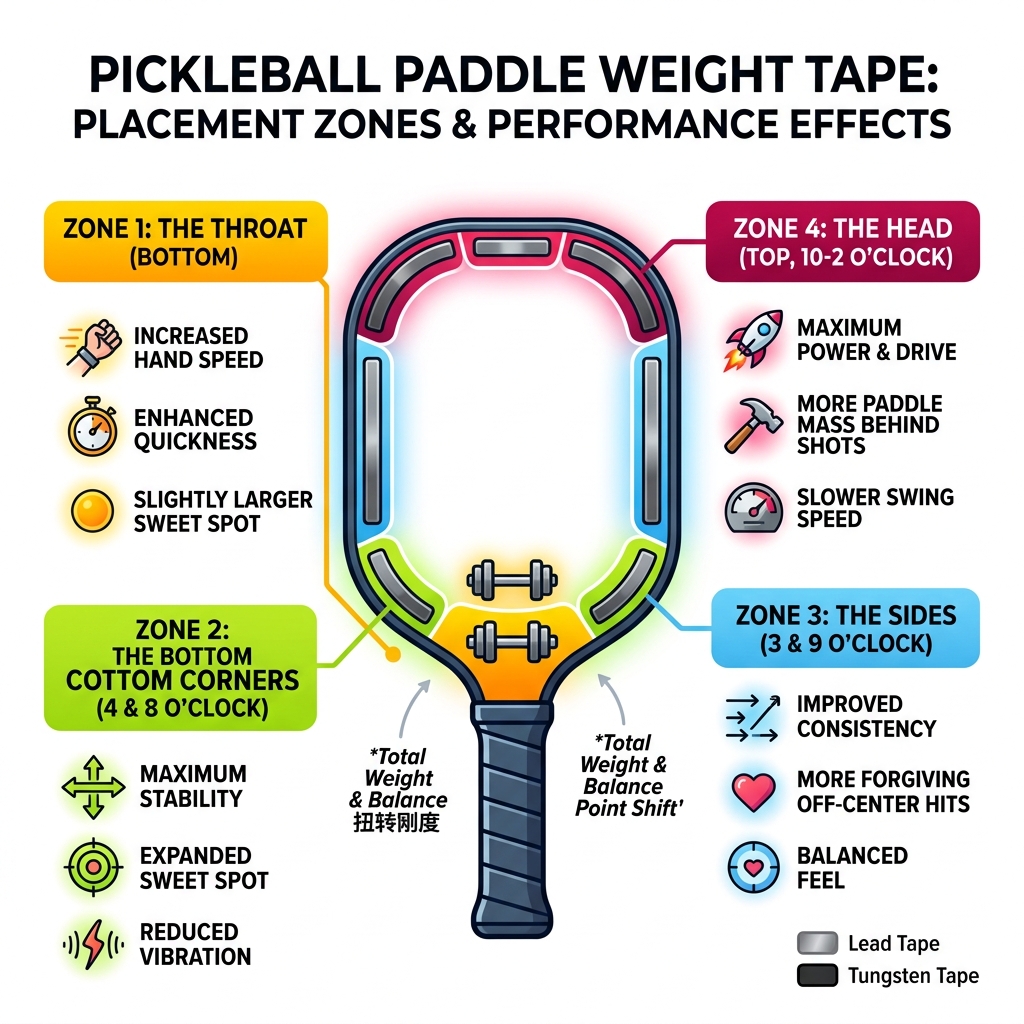
When we add weight to a paddle, we aren’t just making it heavier; we are changing its performance characteristics in several key ways:
- Power Increase: Adding weight to the head of the paddle increases its “swing weight.” This creates more momentum during your swing, leading to deeper serves and more punishing drives.
- Stability and Twist Weight: Have you ever hit a ball off-center and felt the paddle rotate in your hand? That’s called “twisting.” Adding weight to the sides (the 3 and 9 o’clock positions) increases the “twist weight,” making the paddle more resistant to turning and much more stable during fast resets at the kitchen.
- Sweet Spot Expansion: By adding mass to the perimeter of the paddle, you effectively widen the area where the ball responds consistently. This extra forgiveness is a game-changer for intermediate players.
- Vibration Dampening: Extra mass helps absorb the shock of impact. This “plow-through” effect makes the paddle feel more “solid” and less “pingy.”
- Tennis Elbow Relief: It sounds counterintuitive, but a slightly heavier paddle can actually help with arm pain. Many players suffer from pickleball injuries related to weight distribution. If a paddle is too head-heavy or too light, it can cause the wrist and elbow to overcompensate. Strategic weighting at the throat can balance the paddle and reduce strain.
Lead vs. Tungsten: Choosing Your Material
When shopping for the best pickleball paddle weight tape, you’ll primarily choose between lead and tungsten. While both serve the same purpose, they have distinct differences in safety, density, and cost.
| Feature | Lead Tape | Tungsten Tape |
|---|---|---|
| Safety | Toxic if handled improperly; requires gloves/covering | Non-toxic and eco-friendly |
| Density | High | Very High (denser than lead) |
| Flexibility | Extremely easy to mold to curves | Slightly stiffer but still pliable |
| Cost | Budget-friendly | Premium pricing |
| Adhesive | Usually 3M or high-bond | High-quality acrylic or 3M |
The Case for Lead
Lead has been the standard in racket sports for decades. It is incredibly affordable and very easy to layer. However, because lead is a toxic metal, we always recommend wearing gloves during application and covering the finished product with electrical tape or an edge guard. If you are decoding paddle materials as a beginner, lead is the most “old school” but effective method.
The Rise of Tungsten
Tungsten is the modern, premium alternative. It is non-toxic, making it much safer to handle frequently. Because tungsten is denser than lead, you can achieve the same weight increase with a smaller, slimmer strip of tape. Brands like Selkirk have popularized tungsten because it offers a cleaner look and peace of mind for health-conscious players.
Strategic Placement for Performance Goals
Where you put the weight is just as important as how much you add. We like to use the “clock” system to describe placement on the paddle face.
10 and 2 o’clock: The Power Zone
Placing weight at the upper corners increases the swing weight significantly. This is ideal for singles players or those who want more “pop” on their overheads and drives. Be careful, though—too much weight here can make your “hands” feel slow during fast volleys at the net.
3 and 9 o’clock: The Stability Zone
This is the most popular placement for most players. Adding weight to the sides increases the sweet spot and prevents the paddle from twisting on off-center hits. If you use lightweight paddles for senior beginners, this placement can make a 7.5oz paddle feel as stable as an 8.2oz model without sacrificing too much speed.
4 and 8 o’clock (or the Throat): The Control Zone
Adding weight near the handle or the “throat” of the paddle increases the overall static weight without drastically changing the swing weight. This makes the paddle feel more “solid” and balanced, providing excellent control for dinks and resets without making your arm tired.
Shape Matters
- Elongated Paddles: These have a longer lever arm. Adding weight to the tip of an elongated paddle will feel much heavier than adding the same weight to a widebody paddle.
- Widebody Paddles: These already have high twist weight. They often benefit from a little extra weight at the top (12 o’clock) to help with “plow-through.”
Top Rated Paddle Tuning Tapes for Every Player
Finding the best pickleball paddle weight tape depends on whether you prefer the convenience of pre-cut strips or the surgical precision of a roll.
Best Pickleball Paddle Weight Tape for Precision: Enhance Pickleball
Enhance Pickleball has become a favorite in the community, trusted by over 51,000 players. Their lead tape typically comes in pre-cut 3g strips (though some older versions were 1.5g).
- Why we love it: The 3g increments make the math easy. You don’t need a scale to know you’ve added exactly 6g to your paddle.
- Performance: It features a very strong adhesive that stays put, though we still recommend a layer of electrical tape if your paddle has a textured edge guard.
Best Pickleball Paddle Weight Tape for Safety: Pickleball Effect
If you want to avoid lead entirely, the Paddle Tuning Tape from Pickleball Effect is our top recommendation.
- The Details: It is a non-toxic tungsten tape that usually comes in a roll, providing about 1g per inch (or 0.5g per inch for micro-tuning).
- The Benefit: It is black, sleek, and matches almost any paddle design. It’s the “pro” choice for players who are constantly tweaking their setup and don’t want to worry about lead exposure.
Professional Grade High-Density Strips
For those who want the absolute best, CRBN Lead Tape Strips and Selkirk Tungsten offer tour-level performance. These options are designed to be ultra-slim so they don’t interfere with your peripheral vision or catch on the ground during low dinks.
How to Apply and Fine-Tune Your Setup
Applying weight tape is a simple process, but doing it correctly ensures the tape doesn’t fly off mid-match.
- Clean the Surface: Use a cotton ball with rubbing alcohol to wipe down the edge guard of your paddle. Any oils from your hands will prevent the adhesive from sticking.
- Measure and Cut: If using a roll, measure your strips. A common starting point is two 3-inch strips.
- Symmetrical Application: This is crucial. If you put 3g at the 3 o’clock position, you must put 3g at the 9 o’clock position. Asymmetry will make your paddle feel “wobblily” and unpredictable.
- Press Firmly: Apply the tape and press down hard. Use the edge of a credit card to smooth out any bubbles.
- Cover the Tape: For lead tape, this is a safety requirement. For tungsten, it’s just good practice. Use electrical tape or a dedicated edge guard tape to wrap over the weights. This protects the weights from scraping the ground and keeps them secure.
Legality and Warranties
Is it legal? Yes! Under USA Pickleball rules, adding lead or tungsten tape to the edge guard or the handle is perfectly legal as long as it doesn’t change the hitting surface or exceed the size limits.
Regarding warranties: Most manufacturers allow edge guard tape. However, if you remove the edge guard to place weight underneath it, you will almost certainly void your warranty. Stick to the outside of the edge guard to stay safe.
Frequently Asked Questions about Paddle Weighting
Is adding weight tape legal under USA Pickleball rules?
Yes, it is completely legal. Players are allowed to add “lead tape or other weight-adjusting tape” to the edge of the paddle. You just cannot place it on the actual hitting face of the paddle, as that would alter the ball’s flight and surface grit.
How much weight should a beginner start with?
We recommend starting small. A good “starter kit” is 4 to 6 grams total (2-3g on each side). Place them at the 3 and 9 o’clock positions. This provides an immediate boost in stability without making the paddle feel like a brick. Play a full session before deciding to add more.
Can weight tape help with tennis elbow?
Yes. Many players find that a slightly heavier, better-balanced paddle reduces the “jarring” sensation on impact. By moving the balance point toward the throat (the 5 and 7 o’clock positions), you can create a more stable hitting platform that requires less grip pressure, which is often the root cause of tennis elbow.
Conclusion
At Voce Economia, we believe that gear optimization shouldn’t be reserved for the pros. The best pickleball paddle weight tape is a low-cost, high-impact way to make your paddle work for you rather than against you.
Whether you choose the convenience of Enhance Pickleball’s pre-cut strips or the safety of Pickleball Effect’s tungsten, the key is experimentation. Start with a small amount of weight on the sides, test it out on the court, and listen to how the paddle feels. Does it sound more solid? Is it easier to block hard drives?
If you’re looking for more ways to improve your setup, be sure to check out our other guides on pickleball equipment. Tuning your paddle is just the first step toward a more consistent, powerful game. Happy hitting!
