
How to Hit the Perfect Third Shot Drop Every Time
The Shot That Changes Everything: Your Third Shot Drop Guide
The pickleball third shot drop is a soft, arcing shot hit by the serving team from the baseline, designed to land gently in the opponent’s kitchen (non-volley zone) — making it nearly impossible to attack.
Here’s what you need to know at a glance:
- What it is: The third shot in a rally (after the serve and the return), hit softly so it lands in the opponent’s kitchen
- Why it matters: It neutralizes the returning team’s advantage at the net and buys you time to move forward
- How it works: Use a relaxed grip, a short backswing, and a smooth low-to-high lifting motion
- When to use it: When both opponents are set at the kitchen line and the return is deep and low
- When to skip it: If the return is short and sitting up high — drive it instead
If you’ve ever served, watched the return come back deep, and then had no idea what to do next — you’re not alone. That moment is exactly where most beginners lose the point.
The serving team starts every rally at a real disadvantage. Your opponents are already up at the kitchen line. You’re stuck at the baseline. Hit the ball too hard, and they’ll punish it. Stand still, and you’ll never get into the point.
The third shot drop is how you solve that problem.
Think of it less like a power shot and more like a chess move — a soft, controlled arc that forces your opponents to hit up instead of down, giving you just enough time to move forward and get into position.
It’s not the flashiest shot in pickleball. But it might be the most important one to learn.
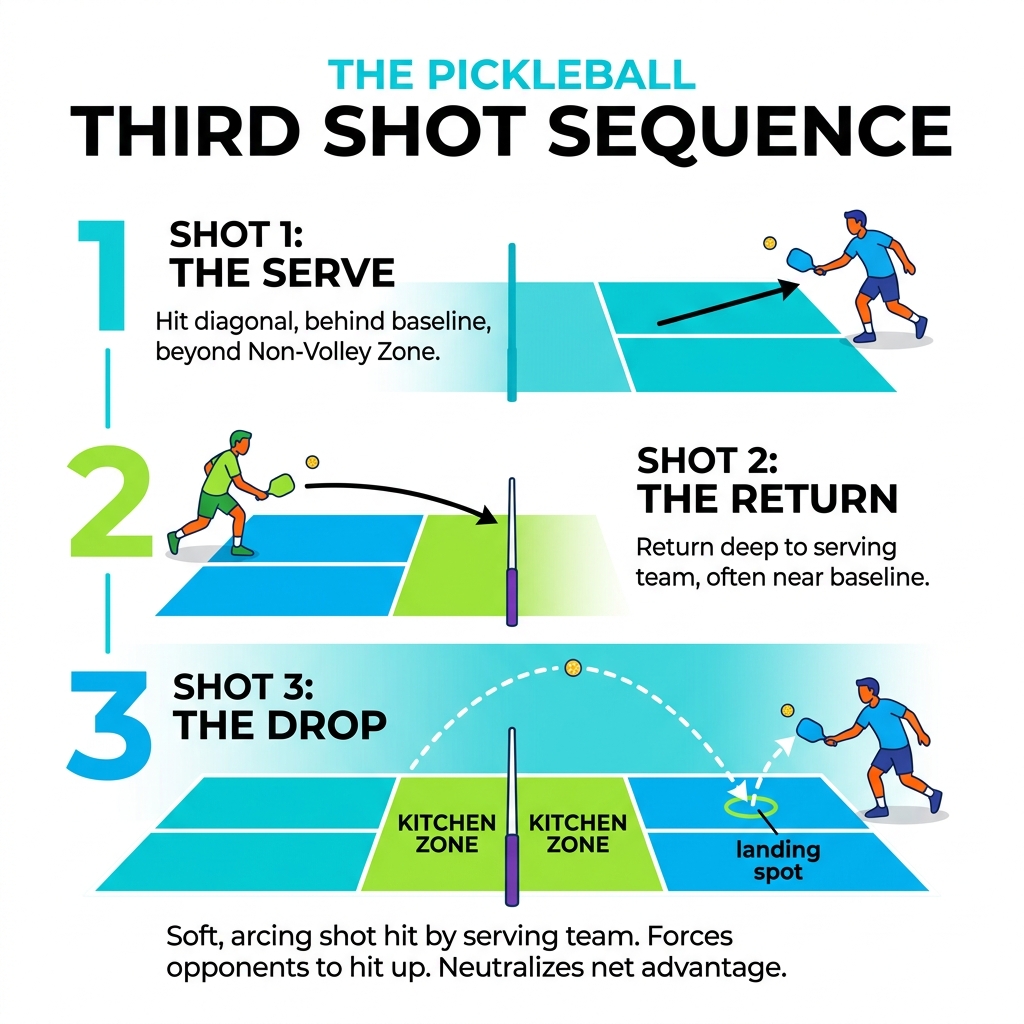
Simple pickleball third shot drop glossary:
Understanding the Pickleball Third Shot Drop Strategy
When we talk about the pickleball third shot drop, we are discussing the “bridge” of the game. Every competitive point in pickleball follows a structural challenge: the serving team starts at the baseline, while the returning team has a player already established at the kitchen line. Because of the double bounce rule, we must let the return bounce before we can strike it. This creates a positional imbalance where the opponents are leaning over the net, ready to smash anything high, while we are 22 feet away.
The drop is our way of “buying time.” By hitting a moderately upward-arching shot that lands softly in the non-volley zone, we force our opponents to wait for the ball to bounce. They cannot volley a ball that lands in the kitchen. This forced pause is the “green light” we need to advance from the baseline to the net.
As pickleball grows—reaching over 55,000 active players and 449 venues in the UK alone according to Pickleball England—mastering this transition is what separates recreational hitters from strategic players. To truly grasp where you should be standing during this exchange, check out our guide on understanding court positions in pickleball.
Why the Third Shot Matters for the Serving Team
The primary goal of the third shot is not necessarily to win the point outright, but to neutralize the opponent’s advantage. If we simply drive the ball hard at opponents who are already set at the net, they will likely block it back with interest before we can even take two steps forward.
By executing a successful pickleball third shot drop, we achieve three things:
- Neutralize Speed: We take the “fire” out of the rally.
- Force Low Contact: We make the opponents hit the ball from below the level of the net, which prevents them from hitting a downward “smash.”
- Advance to the Kitchen: We earn the right to stand at the net, where most points are won.
For those just starting, it helps to review the understanding of basic gameplay to see how this fits into the overall flow of a match.
When to Drop vs. When to Drive
One of the biggest mistakes we see is players trying to drop every single third shot. Strategy should be a decision tree, not a rigid rule.
| Scenario | Best Shot | Why? |
|---|---|---|
| Return is deep and low | Drop | Hard to drive a low ball; need to buy time. |
| Return is short and high | Drive | Punish the weak return and force a pop-up. |
| Opponents are still moving | Drive | Catch them off balance while they transition. |
| Opponents are set at NVZ | Drop | They are ready to block a drive; you must drop. |
The “First Commandment” of the third shot is actually about opponent positioning. If even one opponent is still deep, keep them deep with a deep shot! Only use the drop when both opponents have reached the net. Learning these nuances is key to avoiding common beginners mistakes.
Step-by-Step Mechanics for a Successful Drop
To hit a “perfect” drop, we need to move away from the big, loopy swings common in tennis. Because a pickleball court is only 22 feet from baseline to net, a compact motion is your best friend. We like to use the “Three L’s” framework:
- Loose Grip: On a scale of 1 to 10, your grip pressure should be a 3 or 4. A tight grip makes the ball “ping” off the paddle too fast.
- Less Swing: Keep your backswing short—roughly 30 to 45 centimeters. The paddle should never really go behind your hip.
- Lift Motion: Think of the motion as a gentle push or a lift from the shoulder, rather than a “hit.”
Your shoulder should act as the hinge, while your wrist remains relatively locked. Wrist action is the enemy of consistency here! For a broader look at all the tools in your arsenal, see our beginners guide to pickleball shots.
Mastering the Forehand Pickleball Third Shot Drop
When hitting a forehand pickleball third shot drop, imagine you are tossing a cornhole bag or an egg over a fence. You want a smooth, underhand lifting motion.
- The Setup: Stay on the balls of your feet in an athletic stance.
- The Contact: Meet the ball out in front of your body.
- The Apex: Aim for the highest point of the ball’s flight (the apex) to be on your side of the net. This ensures it is descending as it crosses the tape, making it land shorter.
- Paddle Angle: Keep the paddle face open (angled upward about 15-25 degrees).
We’ve found that simplifying pickleball shots into these small “feel” cues makes them much easier to replicate under pressure.
Executing the Backhand Pickleball Third Shot Drop
The backhand drop is often the shot opponents will target because most players find it weaker. However, it can actually be more stable because the “push” motion is very natural.
- Grip: Use a continental grip.
- Footwork: Step with your dominant leg forward to create a stable base.
- The Motion: Avoid “flicking” the wrist. Use your arm as one rigid unit, lifting from the shoulder.
- The Follow-Through: Guide the paddle toward your target.
Don’t forget that footwork fundamentals for beginners are the foundation of a good backhand. If your feet are stuck in cement, your drop will be, too.
Advanced Variations and Movement Tactics
Once you can hit a basic drop 10 out of 20 times in practice, you can start adding “flavor” to your game.
- Topspin Drop: By brushing up on the back of the ball with a “windshield wiper” motion, you can make the ball dip faster after it clears the net. This allows you to hit the ball harder while still keeping it in the kitchen.
- Cross-Court Drop: Hitting diagonally gives you a longer court to work with and a lower net (the net is 86cm in the center vs 91cm at the posts).
- The “Fake Drive”: Start with a big backswing like you’re going to blast a drive, then decelerate at the last second into a soft drop. This catches opponents leaning back and off-balance.
Advanced players also use the “Fifth Shot Drop.” If your third shot wasn’t quite good enough to get you all the way to the net, don’t panic! Hit another drop from the transition zone (the “No Man’s Land”). For older players, focusing on safe court movement for seniors is vital when navigating these mid-court transitions.
Moving as a Unit After the Drop
Mastering the pickleball third shot drop is only half the battle; the other half is the “move.” We use Go-Stay-Watch cues to coordinate with our partners:
- Go: If the drop is low and forces the opponent to reach down, sprint to the kitchen!
- Stay: If the drop is a bit high (“tasty” for the opponent), stay back or mid-court and prepare to defend.
- Watch: Keep an eye on the opponent’s paddle face. If it’s open, they are dinking; if it’s closed, they are attacking.
In doubles, you must move as a unit. If one partner stays back while the other rushes in, you leave a massive gap in the middle. Check out the basics of playing doubles to improve your team chemistry.
Drills to Master Your Transition Game
You cannot master the pickleball third shot drop just by reading about it—you need “muscle memory.” Here are our favorite drills:
- The Progressive Distance Drill: Start at the kitchen line hitting dinks. Every two successful shots, take a big step back until you reach the baseline. This helps you find the “lift” required for different depths.
- The Bucket Drill: Place a bucket (or a towel) in the kitchen. Try to land 15 out of 20 balls on the target. Beginners usually hit 3-5; intermediate players aim for 10-12.
- Serve-Return-Drop Sequence: Practice the full rhythm. Have a partner serve, you return, they drop. Then switch. This simulates real match pressure.
For more structured practice, look into senior-friendly beginner drills and specific drills for senior beginners that focus on balance and control.
Frequently Asked Questions about the Third Shot Drop
How do I stop hitting my third shot drop into the net?
Most players hit the net because they are trying to “skim” the tape. Remember: you want 30-60 centimeters of clearance over the net! It is much better to hit a drop that is slightly too high than one that hits the net. Also, check your knees. If you stand upright, you’ll “poke” at the ball. Bend your knees to get under it. Proper pickleball serving basics can help you understand the initial arc needed for baseline shots.
Is the third shot drop always necessary at lower skill levels?
Here is a “hot take” backed by stats: in 3.5 level gold medal matches, successful third shot drops only contributed to 13% of the total points scored. At lower levels, nearly 30% of points come from missed returns of serve! If you are below a 4.0 rating, you might find more success focusing on deep returns and steady drives. However, you will eventually need the drop to advance to higher levels. It’s about mastering pickleball scoring and knowing which “weapon” to pull out of your bag.
What is the difference between a third shot drop and a dink?
They are cousins, but not twins. A dink is hit from the kitchen line to the kitchen line. A pickleball third shot drop is hit from the baseline to the kitchen. The mechanics are similar (lift, loose grip), but the drop requires more power and a higher arc to cover the 22-foot distance. Both must follow the official pickleball rules regarding the non-volley zone.
Conclusion
At Voce Economia, we believe that every player has the potential to master the transition game. The pickleball third shot drop isn’t about being “fancy”—it’s about being patient. It is the bridge that takes you from the defensive baseline to the offensive kitchen.
Mastering this shot takes time (usually 4-6 weeks of regular practice to feel “decent”), but the payoff is huge. You’ll stop feeling like a target and start feeling like a tactician. Focus on your “Three L’s,” move with your partner, and remember that consistency will always beat power in the long run.
Ready to start your journey from the baseline to the podium? Follow our step-by-step guide to learning pickleball and keep practicing those drops!
