
What Is the Official Pickleball Rules PDF and Where Do You Get It?
The pickleball rules pdf you need is the official USA Pickleball Rulebook, published and updated annually by USA Pickleball, the sport’s national governing body. Here’s where to find it:
Official Rulebook Downloads:
- 2025 edition: USA Pickleball 2025 Rulebook PDF
- 2026 edition: Available at usapickleball.org
- Rules Summary PDF: Also available on the USA Pickleball website for quick reference
Pickleball has grown fast. And with that growth comes a rulebook that gets more detailed every year.
USA Pickleball first published the official rulebook back in 1984. Since then, it has been updated at the start of every year — covering everything from how to serve legally, to what happens when a ball rolls under the net. The 2026 edition is now the most current version.
For newer players, opening that PDF for the first time can feel overwhelming. There are 13 sections, an appendix, definitions, tournament policies, and adaptive rules for wheelchair players. It’s a lot.
But here’s the thing: most players only need to understand a handful of core rules to start playing well and playing fairly.
This guide breaks down the most important sections of the official rulebook in plain language — so you spend less time reading PDFs and more time on the court.
Essential Court Dimensions and Equipment Standards
Before you even swing a paddle, the pickleball rules pdf specifies exactly what the “arena” should look like. Whether you are playing singles or doubles, the court size remains the same: 20 feet wide by 44 feet long. This is significantly smaller than a tennis court—in fact, you can fit nearly three pickleball courts into the space of one tennis court!
The Court Layout
The court is divided into several key areas:
- The Service Courts: These are the two rectangular areas on each side of the center line.
- The Non-Volley Zone (The Kitchen): A 7-foot area extending from the net on both sides.
- The Baseline: The back line of the court.
- The Sidelines: The outer boundaries of the court.
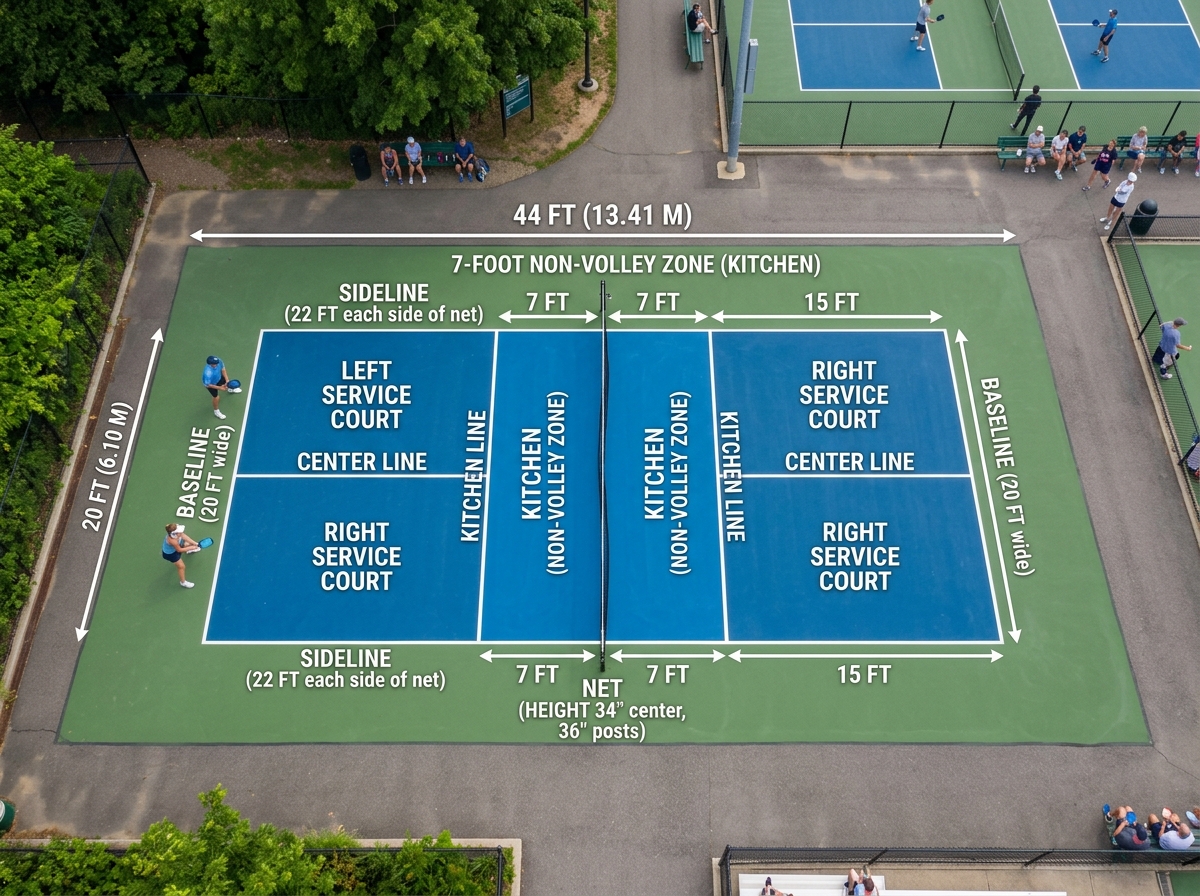
The Net Height
One common mistake beginners make is assuming the net is the same height all the way across. According to the official specs, the net should be 36 inches high at the sidelines but must drape slightly to 34 inches at the center. This slight dip is why many pros aim for the middle of the court!
Equipment Standards
To keep the game fair, USA Pickleball maintains a strict Approved Equipment List. If you are entering a sanctioned tournament, your gear must meet these requirements:
- Paddles: The combined length and width of the paddle cannot exceed 24 inches. Additionally, the length alone cannot be more than 17 inches.
- Balls: A legal ball must have between 26 and 40 circular holes. There are different designs for indoor and outdoor play to account for wind and surface texture.
Understanding where to stand is just as important as the dimensions themselves. For a deeper dive into where you should be during a match, check out our guide on understanding court positions in pickleball for seniors.
Mastering the Serve and the Pickleball Rules PDF
The serve is the only shot in pickleball that you have total control over. However, it is also the shot with the most technical restrictions in the pickleball rules pdf. Unlike tennis, where you smash the ball from over your head, pickleball requires an underhand motion.
The Two Types of Legal Serves
The rulebook currently recognizes two distinct ways to start a point:
- The Volley Serve: This is the traditional method. You hit the ball out of the air without letting it hit the ground. For this to be legal, your arm must move in an upward arc, and the highest point of the paddle head must be below your wrist when it hits the ball. Crucially, contact must be made below your waist.
- The Drop Serve: Introduced as a provisional rule and now permanent, the drop serve allows you to drop the ball and hit it after it bounces. The “upward arc” and “below the waist” restrictions do not apply here. However, you cannot toss or propel the ball downward; you must simply let gravity do the work.
Foot Positioning and the Baseline
When serving, at least one foot must be on the playing surface behind the baseline. Neither of your feet can touch the court or the baseline until after you have struck the ball. Furthermore, you must serve diagonally crosscourt into the opponent’s service area.
| Feature | Volley Serve | Drop Serve |
|---|---|---|
| Contact Point | Must be below the waist | No height restriction |
| Paddle Motion | Must be an upward arc | No motion restriction |
| Ball Release | Hit out of the air | Must bounce first |
| Propulsion | Cannot be tossed high | Must be dropped (not thrown) |
If you’re just starting out, we’ve put together a specialized resource on pickleball-serving-basics-for-senior-beginners to help you find your rhythm.
Scoring Systems and the Double-Bounce Rule
If you’ve ever sat on the sidelines of a pickleball match, the scoring might sound like a secret code. “4-2-1? What does that even mean?” we often hear people ask. Let’s break down how points are actually tallied.
Side-Out vs. Rally Scoring
In traditional “Side-Out” scoring, you can only score a point when your team is serving. If the receiving team wins the rally, they don’t get a point; they simply earn the right to serve (after the second server finishes their turn). Most games are played to 11 points, and you must win by at least two.
Some tournaments now use Rally Scoring, where a point is awarded at the end of every single rally, regardless of who served. This speeds up the game significantly.
The Double-Bounce Rule (The Two-Bounce Rule)
This is the most unique rule in pickleball. After the ball is served, the receiving team must let it bounce before hitting it back. Then, the serving team must let the return bounce before hitting it.
After these two initial bounces (one on each side), both teams are free to either volley the ball (hit it in the air) or play it off the bounce. This rule was designed to prevent the serving team from rushing the net and ending the point instantly with a smash.
For a more detailed breakdown of these mechanics, you might find our articles on cracking-the-code-pickleball-scoring-rules-for-seniors and how to navigate-the-pickleball-rules-for-beginners-over-60 very helpful.
How to Call the Score in a Pickleball Rules PDF
In doubles, the score consists of three numbers:
- The serving team’s score.
- The receiving team’s score.
- The server number (either 1 or 2).
At the start of a new game, the very first team to serve only gets one server. They call the score as “0-0-2” (or “0-0-Start”). After they lose that rally, the serve goes to the other team, and from then on, both players on each team get a turn to serve.
In singles, the score is just two numbers (your score and their score). Your position on the court is determined by your score: if your score is even (0, 2, 4…), you serve from the right side. If it’s odd (1, 3, 5…), you serve from the left. You can learn more about team dynamics in the-basics-of-playing-doubles-in-pickleball-for-beginners.
Navigating the Kitchen and Common Faults
The “Kitchen”—officially known as the Non-Volley Zone (NVZ)—is the most misunderstood area of the court. The pickleball rules pdf is very strict about what you can and cannot do in this 7-foot space.
The Golden Rule of the Kitchen
You cannot volley the ball (hit it in the air) while standing in the kitchen or touching the kitchen line. This includes your momentum! If you hit a volley from outside the kitchen but your forward motion carries you onto the line or into the zone afterward, it is a fault—even if the ball is already dead.
However, you can stand in the kitchen anytime you want; you just can’t hit the ball out of the air while you’re there. If the ball bounces in the kitchen, you can step in, hit it, and then step back out.
Common Faults to Avoid
A fault ends the rally. Common faults include:
- Service Faults: The ball hitting the net on the serve (though “lets” are no longer replayed in most competitive formats) or landing outside the diagonal service box.
- Double Hits: Hitting the ball twice before it goes over the net (unless it’s one continuous motion).
- Touching the Net: Your body, clothing, or paddle touching the net while the ball is in play.
- Out of Bounds: The ball landing outside the lines. Note: On a serve, the kitchen line is considered “out,” but all other lines are “in.”
To avoid these mistakes, we recommend reviewing understanding-the-basic-gameplay-of-pickleball-for-senior-beginners.
Downloading the Official 2025 Pickleball Rules PDF
If you are serious about the game, you should keep a copy of the full rulebook on your phone. You can Download the USA Pickleball rulebook here.
The 2025 and 2026 updates have brought some interesting changes, such as refinements to how referees handle incorrect server positions. In the past, an incorrect server was an immediate fault; now, in many cases, the referee will simply correct the players before the score is called to keep the game moving.
Advanced Gameplay: Line Calls, Time-outs, and Adaptive Play
As you move from recreational play to competitive matches, the “Code of Ethics” becomes just as important as the physical rules.
Line Calls and Ethics
In non-officiated play, you are responsible for calling the lines on your side of the net. The rule is simple: if you didn’t clearly see it out, it’s in. You should always give the benefit of the doubt to your opponent. If partners disagree on a call (one says “in,” one says “out”), the ball is ruled “in.”
Time-outs
The pickleball rules pdf allows for three types of time-outs:
- Standard: Each team gets two 1-minute time-outs per game.
- Medical: If a player is injured, they can request a one-time 15-minute medical time-out.
- Equipment: If your paddle breaks or your shoes come untied, you can get a short break to fix the issue without using a standard time-out.
Wheelchair and Adaptive Pickleball
Pickleball is an inclusive sport. The rulebook contains specific modifications for wheelchair players. The biggest difference is the Double Bounce Allowance. A wheelchair player is allowed to let the ball bounce twice on their side. The second bounce can land anywhere—even outside the court boundaries—and still be considered “in play” as long as the first bounce was in.
Frequently Asked Questions about Pickleball Rules
What are the most recent rule changes for 2025?
One of the biggest shifts involves “Catch and Carry” faults. It is now a fault if a player deliberately catches or carries the ball on their paddle. Additionally, there have been updates to paddle specifications to address new “power” technologies being used by manufacturers.
Can you hit the ball in the kitchen if it bounces?
Yes! You can enter the kitchen at any time. The only restriction is that you cannot hit the ball before it bounces while you (or your momentum) are touching the zone. If the ball bounces in the kitchen, step in and hit it.
How do singles rules differ from doubles?
The court size is exactly the same, which makes singles a very athletic game! The main difference is the scoring and positioning. In singles, there is no “second server.” If you lose the rally, the serve immediately goes to your opponent. Your score (even or odd) dictates which side of the court you serve from.
Conclusion
At Voce Economia, we believe that the best way to enjoy this sport is to play it the right way. Whether you are picking out your first set of beginner balls or preparing for your first local tournament, mastering the pickleball rules pdf is the first step toward becoming a “serious” player.
Fair play and a solid understanding of the rules make the game better for everyone. So, download that PDF, keep it handy on your phone, and we’ll see you in the kitchen!
For more tips on getting started, check out our More info about pickleball basics page. Happy dinking!
