
Why Pickleball Scoring Rules Trip Up So Many New Players
Pickleball scoring rules can feel confusing at first — but once you see the pattern, they click fast.
Here’s the quick version:
- Only the serving team can score points (called side-out scoring)
- Games are played to 11 points, and you must win by 2
- In doubles, you call three numbers before each serve: your score – their score – server number (e.g., “4-2-1”)
- In singles, you only call two numbers: your score – their score (e.g., “4-2”)
- The first serve of every doubles game starts at 0-0-2 (more on why below)
- Tournaments may play to 15 or 21 points, still win by 2
That’s the core of it. Everything else is just detail.
Many beginners feel a little lost the first time someone rattles off “zero-zero-two, serve!” — and that’s completely normal. As one common observation in the pickleball community puts it: the rules seem complicated at first, but become second nature the more you play.
The good news? Pickleball scoring is actually simpler than tennis. There are no sets, no love-fifteen-thirty, and no deuce confusion. Once you understand the serving sequence and why only one team can score at a time, the whole system makes sense.
This guide will walk you through everything — doubles, singles, faults, and tournament formats — so you can step onto the court with confidence.
The Fundamentals of Pickleball Scoring Rules
At its heart, pickleball uses what is known as “side-out scoring.” If you have ever played volleyball or watched old-school baseball, the logic is very similar. In pickleball, you can only score a point when your team is the one hitting the serve. If you are on the receiving team and you win a rally, you don’t get a point—you simply move one step closer to earning the right to serve (and thus, the right to score).
According to the Official USA Pickleball Rulebook, a standard game is played to 11 points. However, reaching 11 isn’t always enough to end the match. We also follow the “win by 2” rule. This means if the score is tied at 10-10, the game continues until one team has a two-point lead (for example, 12-10 or 15-13).
To help you visualize how this differs from other sports you might know, we’ve put together a quick comparison:
| Feature | Side-Out Scoring (Standard) | Rally Scoring (Variation) |
|---|---|---|
| Who can score? | Only the serving team | Either team can score on any rally |
| Game Point Total | Usually 11 (win by 2) | Usually 15 or 21 (win by 2) |
| Strategy Focus | Defensive consistency on return | High-intensity every point |
| Commonly Found | Recreational and standard play | Professional leagues (MLP) |
Understanding these basics is the first step toward feeling comfortable on the court. If you are just starting out, you might find our guide on Understanding the Basic Gameplay of Pickleball for Senior Beginners helpful for getting a handle on the flow of the game beyond just the numbers.
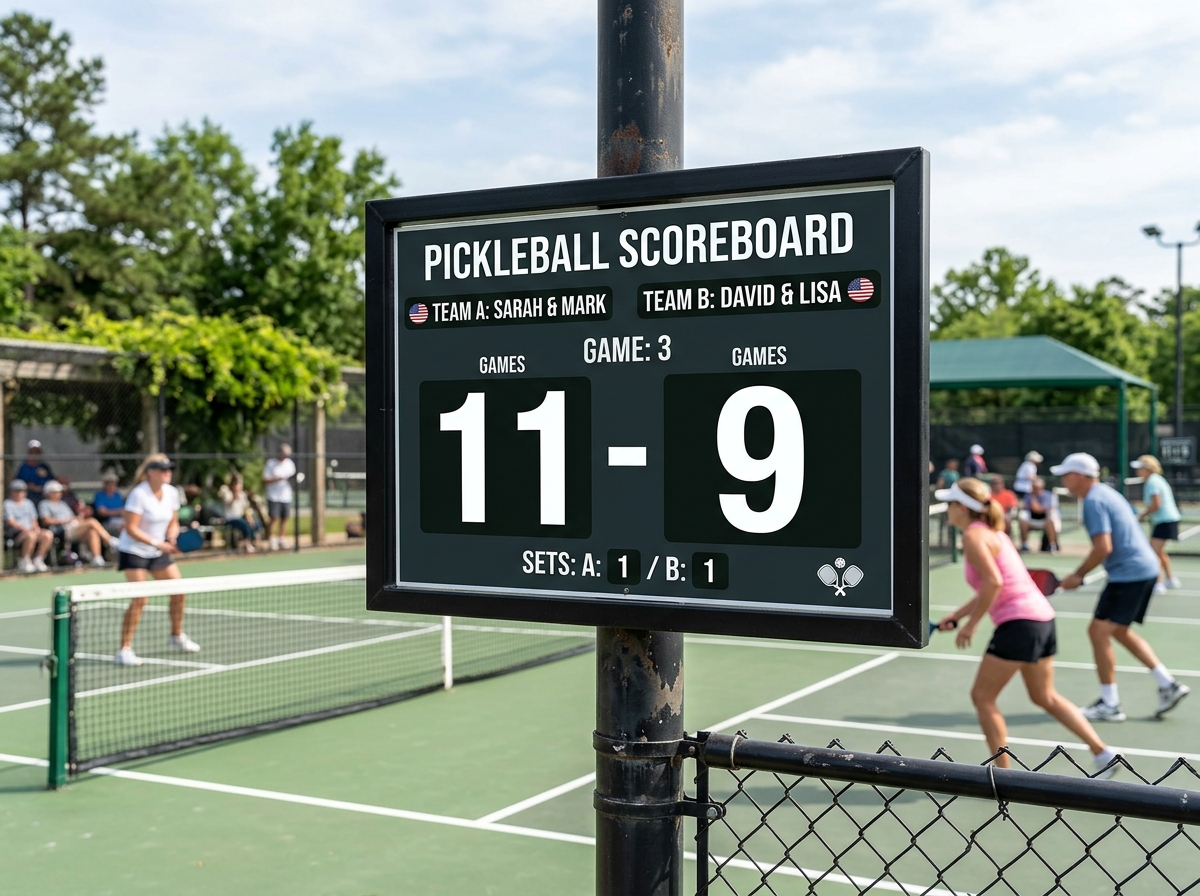
How to Call the Score in Doubles Play
Doubles is the most popular way to play pickleball, and it’s where the scoring gets its “three-number” reputation. Before every single serve, the server must call out the score loudly so everyone on the court can hear it.
The format is: Serving Team Score – Receiving Team Score – Server Number.
The “Me-You-Who” Mnemonic
A great way to remember this is the “Me-You-Who” method:
- Me: Our team’s score.
- You: Your team’s score.
- Who: Which server am I (1 or 2)?
In doubles, each team is allowed two “outs” (faults) before the serve turns over to the opponents (the “side-out”). When a team gains the serve, the player standing on the right side of the court becomes “Server 1.” If they lose a rally, the ball doesn’t go to the opponents yet; instead, it goes to their partner, who becomes “Server 2.” Only after Server 2 loses a rally does the side-out occur.
It is important to note that the server number (1 or 2) is not tied to the specific person for the whole game. It resets every time your team wins the serve back. Whoever happens to be on the right side when your team starts serving is Server 1 for that turn.
For a deeper dive into how players move around the court during these transitions, check out The Basics of Playing Doubles in Pickleball for Beginners. You can also find more technical details in the Detailed Pickleball Scoring Rules Guide.
The 0-0-2 Start: A Unique Element of Pickleball Scoring Rules
When you start a brand-new game of doubles, there is one very important exception to the two-server rule. To prevent the first serving team from having an unfair advantage right out of the gate, only one player is allowed to serve on the very first service turn of the game.
Because this first server is essentially acting as the “second” server of a normal rotation, the score is called as 0-0-2.
- If the serving team loses the very first rally of the game, it is an immediate side-out.
- The serve goes to the opponents, and from that point forward, both players on every team will get a chance to serve before a side-out occurs.
This rule can be a bit of a head-scratcher for newcomers, but it’s designed to keep the game balanced. We discuss this and other nuances in our guide to Navigate the Pickleball Rules for Beginners Over 60.
Singles vs. Doubles: Key Differences in Scoring
Singles pickleball is a completely different beast. It is faster, more physical, and requires much more court coverage. Because there are no partners involved, the pickleball scoring rules for singles are much more straightforward.
In singles:
- You only call two numbers: Server Score – Receiver Score.
- There is no “Server 1” or “Server 2” because, well, you’re the only one there!
- You only get one “out.” If you lose a rally while serving, it is an immediate side-out.
The Apple Heart and Movement Study: Racket Sports Insights has shown that the intensity of singles play offers significant health benefits, but it also means you need to be very clear on where you should be standing. Unlike doubles, where the serving team switches sides only after winning a point, your position in singles is dictated entirely by your own score.
Even and Odd Positioning in Pickleball Scoring Rules
Whether you are playing singles or doubles, your score determines which side of the court you should be serving from. This is one of the most reliable ways to “fact-check” the score if you lose track during a long rally.
- Even Scores (0, 2, 4, 6, 8, 10): The server serves from the right-hand service court.
- Odd Scores (1, 3, 5, 7, 9): The server serves from the left-hand service court.
In doubles, this rule applies to the position of the player who was the first server of the game for that team. If your team has an even score, the player who started the game on the right should be on the right side. If the score is odd, that same player should be on the left.
If you find yourself confused about where to stand, our article on Understanding Court Positions in Pickleball for Seniors provides excellent visual cues and tips to help you stay in the right spot.
Common Faults and Scoring Variations
While the goal is to score points, it’s just as important to know what stops you from scoring. A “fault” is any action that ends a rally. If the serving team commits a fault, they either move to their second server or lose the serve (side-out). If the receiving team commits a fault, the serving team earns a point.
Some of the most common faults include:
- The Kitchen (Non-Volley Zone) Fault: You cannot hit a volley (a ball hit out of the air before it bounces) while standing in the 7-foot zone near the net. You also cannot let your momentum carry you into the Kitchen after hitting a volley.
- The Two-Bounce Rule: After the serve, the receiving team must let the ball bounce once. Then, the serving team must also let the return-of-serve bounce once. After those first two bounces, you can either volley the ball or play it off the bounce.
- Service Faults: The serve must be hit underhand, the paddle must move in an upward arc, and the contact point must be below the waist. Additionally, the serve must land cross-court and clear the Kitchen line.
For those looking to perfect their opening shot, we recommend reading Pickleball Serving Basics for Senior Beginners.
Tournament Variations
While recreational games are almost always played to 11, you will see variations in competitive play. Many tournaments use a “Best 2 out of 3” format to 11 points. However, some brackets may play a single game to 15 or 21 points to speed up the schedule. Regardless of the point total, the “win by 2” rule almost always remains in effect.
Frequently Asked Questions about Pickleball Scoring
Can you score a point if you are the receiving team?
In traditional side-out scoring, no. You can only score points when your team is serving. If you win a rally as the receiver, you simply earn the opportunity to serve (or move the opponents closer to a side-out). However, in “Rally Scoring” (often used in professional leagues), a point is awarded to whoever wins the rally, regardless of who served.
What happens if the score is tied at 10-10?
The game enters a “win by 2” scenario. The game does not end at 11. Play continues until one team leads by two points (e.g., 12-10, 13-11, etc.). There is no upper limit or “cap” in standard rules; we’ve seen games go well into the 20s!
How do you know which server you are in doubles?
At the start of your team’s service turn (after a side-out), the person currently standing on the right side of the court is always Server 1. They will call the score ending in “-1.” If your team loses a rally, the serve moves to the partner, who then calls the score ending in “-2.” Once that turn is over and you eventually win the serve back, the roles might swap based on where you are standing.
Conclusion
Mastering pickleball scoring rules is less about memorizing a textbook and more about getting into the rhythm of the game. We always tell our readers: don’t be afraid to ask your opponents for a “score check” if you get confused. Most players are happy to help, and even the pros occasionally lose track of whether they are Server 1 or Server 2!
The best way to learn is to get out on the court and start calling those numbers. Whether it’s a casual 0-0-2 start or a high-stakes 10-10 tiebreaker, the cadence of the score is the heartbeat of the match.
At Voce Economia, we are dedicated to helping you navigate every aspect of this wonderful sport. For more tips on mastering the nuances of the game, check out our guide on Cracking the Code: Pickleball Scoring Rules for Seniors or Visit Voce Economia for more guides on gear and strategy.
See you on the court!
