
Why Pickleball Paddle Lead Tape Placement Changes Everything
Pickleball paddle lead tape placement is one of the easiest and cheapest ways to improve your game without buying a new paddle.
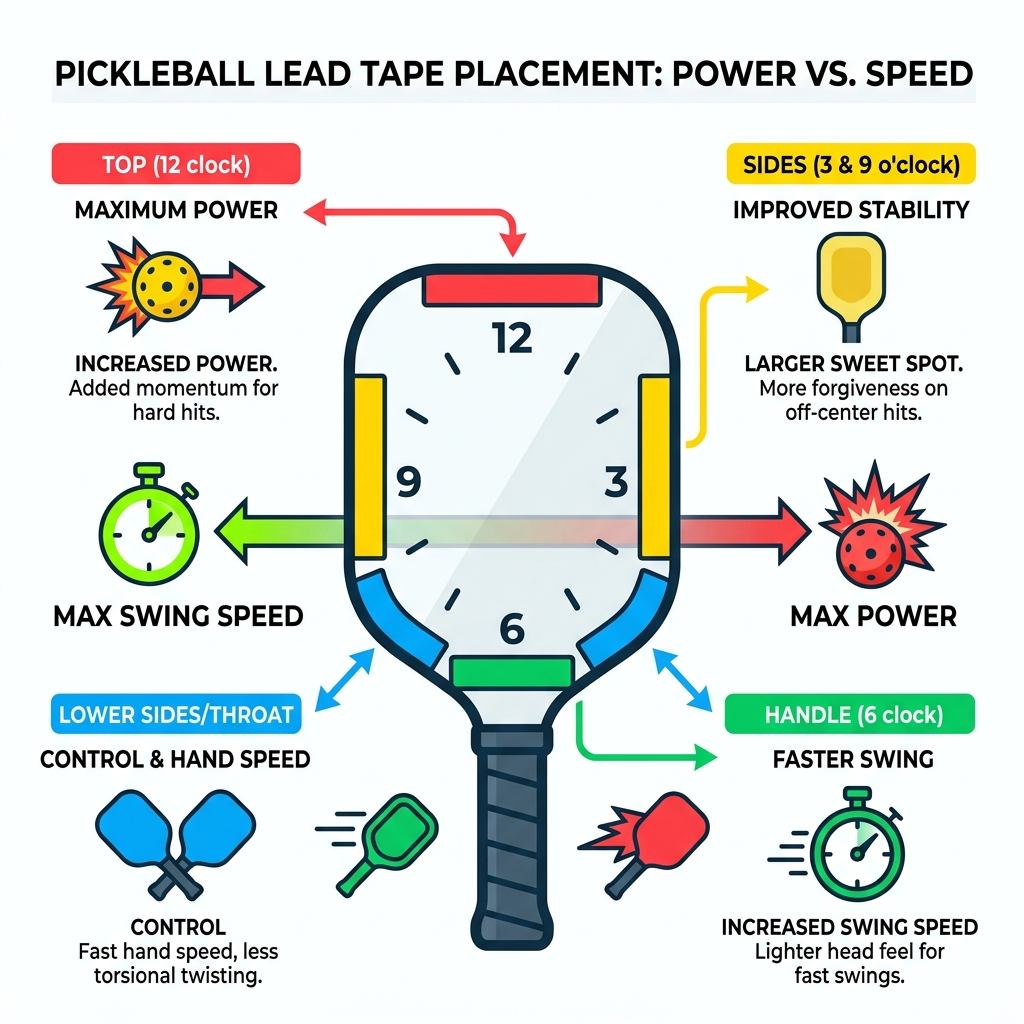
Here’s a quick-reference guide to the most common placement zones:
| Placement Zone | Clock Position | Main Benefit |
|---|---|---|
| Top of paddle | 12 o’clock | More power and swing weight |
| Sides of paddle | 3 and 9 o’clock | Better stability and larger sweet spot |
| Lower sides / throat | 4 and 8 o’clock | Control, hand speed, and torsional stability |
| Handle / grip base | 6 o’clock | Faster swing, lighter feel at the head |
Most paddles come off the shelf weighing between 7 and 8.2 oz. Many players — including pros — add a few grams of lead or tungsten tape to hit a final weight closer to 8.5–9 oz, fine-tuning how the paddle feels and performs.
The concept is simple: where you place the weight matters just as much as how much you add. A small strip of tape at the top of your paddle creates a very different feel than the same strip placed near the throat.
Even 3–5 grams of tape in the right spot can noticeably change your power, stability, or hand speed. That’s less than the weight of a paperclip — but on a paddle, you’ll feel it immediately.
This guide walks you through exactly where to put the weight, how much to use, and what to expect from each placement.
Understanding Pickleball Paddle Lead Tape Placement Zones
To master pickleball paddle lead tape placement, we first need to visualize the paddle face as a clock. This “clock-face” method is the industry standard for discussing weight distribution. Imagine 12 o’clock is the very top of the paddle, 6 o’clock is the bottom of the handle, and 3 and 9 o’clock are the widest points on the sides.
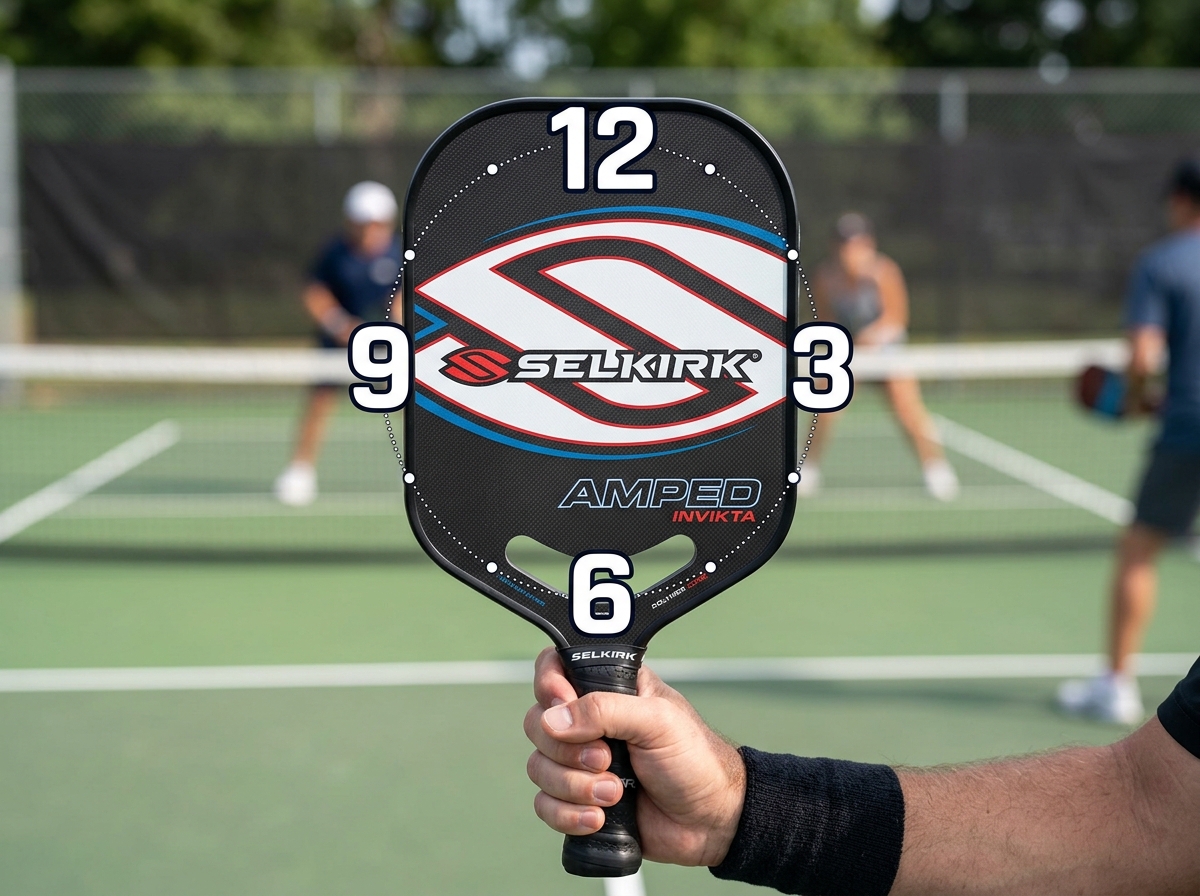
When we talk about adding weight, we generally divide the paddle into three primary zones:
- Zone 1 (The Top): The 10 to 2 o’clock area. This is where you go for raw power.
- Zone 2 (The Sides): The 3 and 9 o’clock positions. This is the “stability” zone.
- Zone 3 (The Throat/Handle): The 4, 5, 7, and 8 o’clock positions near the neck, or even down on the handle itself. This is for control and “hand speed.”
Static Weight vs. Swing Weight
It is vital to understand the difference between static weight and swing weight. Static weight is simply how much the paddle weighs on a scale. Most high-end paddles aim for a “golden balance” of 7.8 to 8.2 ounces. However, swing weight tells you how heavy the paddle feels when you actually move it through the air.
Adding weight to the top (12 o’clock) increases swing weight significantly because of the leverage principle—like holding a hammer by the very end of the handle versus holding it near the head. If you are just starting out, decoding paddle materials for beginners can help you understand how your paddle’s core and face material interact with these weight changes.
Maximizing Power with 12 O’Clock Pickleball Paddle Lead Tape Placement
If you want to turn your paddle into a “powerhouse,” the 12 o’clock position is your destination. By placing lead tape at the very top, you increase the head-heaviness of the paddle. This creates more momentum during your swing, which translates into deeper serves and more punishing overhead smashes.
This setup is particularly popular for singles players who need to hit passing shots from the baseline. However, there is a trade-off: maneuverability. A head-heavy paddle is harder to move quickly at the kitchen. If your “hands” feel sluggish during fast volley exchanges, you might have too much weight at the top.
Expanding the Sweet Spot at 3 and 9 O’Clock
Adding weight to the sides of the paddle (3 and 9 o’clock) is perhaps the most common modification for intermediate players. This increases torsional stability. In simpler terms, it prevents the paddle from twisting in your hand when you hit the ball off-center.
By weighting the perimeter, you effectively expand the “usable” sweet spot. This leads to more consistent defensive resets and reduces the “dead” feeling of shots that don’t hit the exact center of the face. It also helps dampen vibrations, which can make the paddle feel much more “plush” and solid.
Improving Control with 4/8 O’Clock Pickleball Paddle Lead Tape Placement
For players who prioritize the “soft game,” placing weight at the 4 and 8 o’clock positions (the lower corners of the head) is a fantastic middle ground. This adds stability to the paddle without drastically increasing the swing weight.
This low-profile weighting keeps your hand speed high, which is essential for those lightning-fast kitchen volleys. It’s a great choice for senior players navigating paddle weights who want a more stable feel without the arm fatigue associated with a head-heavy paddle.
Lead Tape vs. Tungsten: Choosing Your Customization Material
When you’re ready to start sticking things to your expensive paddle, you have two main choices: traditional lead tape or the modern tungsten alternative.
| Feature | Lead Tape | Tungsten Tape |
|---|---|---|
| Safety | Contains lead (toxic if ingested/handled) | Non-toxic and skin-safe |
| Density | Very thin and high density | Slightly thicker but very dense |
| Cost | Very affordable (~$7.50 for a roll) | More expensive (~$11-$15) |
| Ease of Use | Very easy to cut and layer | Often comes in pre-weighted strips |
For many of us, a lead tape roll is the classic choice because it’s inexpensive and highly customizable. However, if you are worried about lead exposure—especially if you have kids around or tend to touch your face during matches—a tungsten version alternative is the way to go.
Tape usually comes in two common widths: 1/4″ (ideal for thin, edgeless paddles) and 1/2″ (perfect for paddles with edge guards). You’ll also see different weights, such as 0.25g per inch or 0.5g per inch. We generally recommend the 0.5g/in variety so you don’t have to wrap multiple layers around your paddle.
Safety and Legal Considerations
Is this legal? Yes! Under USA Pickleball rules, adding lead tape is perfectly legal as long as it doesn’t change the basic shape or surface of the paddle. There are no specific weight limits for customized paddles.
However, safety is key. If you use lead tape, we strongly recommend covering it with electrical tape. This prevents your skin from coming into direct contact with the lead and ensures the tape doesn’t peel off mid-game. Plus, it makes your paddle look much cleaner!
Step-by-Step Guide to Applying Weight
Ready to customize? Don’t just slap tape on haphazardly. Follow this process to ensure a professional, balanced result.
- Clean the Surface: Use a little rubbing alcohol and a cloth to wipe down the edge guard. Any oils from your hands or dirt from the court will prevent the adhesive from sticking.
- Measure and Cut: Use a ruler or a scale. If you’re using precut strips, this part is already done for you. If using a roll, symmetry is vital. If you put 4 inches on the right side, you must put 4 inches on the left.
- Apply Symmetrically: Start from a reference point (like the center of the throat) and work your way up. Ensure the tape is centered on the edge guard so it doesn’t overlap onto the hitting surface.
- Press Firmly: Use your thumb or the edge of a credit card to press the tape down firmly, removing any air bubbles.
- Finish the Grip: If you find the paddle now feels a bit head-heavy, you might consider optimizing your pickleball grip with a thicker overgrip to counterbalance the weight.
How Much Weight Should Beginners Add?
If your paddle is in the standard 7-8.2oz range, don’t go crazy. We suggest a 3–5 gram start. This is usually enough for you to feel a difference without ruining your timing.
Most pre-cut strip options weigh about 1 to 3 grams each. Start with two strips at the 3 and 9 o’clock positions. Play a few games. If it feels good but you want more “oomph,” add 0.1oz (about 3 grams) increments until you find your “sweet spot.”
Measuring and Securing Your Setup
Precision matters. If you can, use a small kitchen scale to measure your paddle’s total weight before and after. Remember: 1 ounce = 28.35 grams.
Once you are happy with the placement, cover the lead tape with electrical tape or specialized edge guard tape. This provides long-term durability and protects the weighted tape from scrapes when you’re digging out those low dinks.
Pro Player Strategies and Common Customization Mistakes
We often look to the pros for inspiration. Ben Johns, arguably the greatest player in the game, is known to add weight to the bottom of his paddle to maintain extreme hand speed while gaining stability. Simone Jardim often uses a more head-heavy setup to help generate her signature power, while Lucy Kovalova often balances hers in the mid-paddle area for a blend of stability and touch.
Most pros play with paddles in the 8.5–8.7oz range. Many find that once they cross the 8.7oz threshold, they start to experience “heavy hands” or wrist fatigue.
Avoiding the “Frankenstein” Paddle
One of the biggest mistakes is creating a “Frankenstein” paddle—a paddle so heavily modified that it actually hurts your game.
- The 12 O’Clock Trap: Putting too much weight at the very top can lead to a high risk of tennis elbow. The extra leverage puts massive strain on your tendons during every swing.
- Asymmetry: If your tape isn’t perfectly balanced on both sides, the paddle will twist awkwardly, leading to inconsistent shots and potential wrist strain.
- The “Slow Hand” Syndrome: If you’re getting beat in hand battles at the net, your paddle might simply be too heavy for your current strength level. In that case, checking out lightweight paddle guides might be a better starting point.
When to Add Weight Based on Playing Style
Your “playing personality” should dictate your pickleball paddle lead tape placement.
- The Banger: If you love to drive the ball and play aggressively, focus on the 12 o’clock and 10/2 o’clock positions.
- The Dinker: If you win with resets and soft lobs, stick to the 4/8 o’clock positions or the handle.
- Weather Adjustments: Believe it or not, some players change their tape based on the weather! In the extreme Texas heat, the ball gets “mushy” and loses pop. Adding a little extra lead can help you drive through the heavy air. In cold weather, the ball is hard and fast, so you might want a lighter, more controlled setup.
Frequently Asked Questions about Paddle Weighting
Does lead tape increase the sweet spot?
Technically, it increases the effective sweet spot. By adding weight to the perimeter (3 and 9 o’clock), the paddle becomes more stable. This means shots hit near the edges won’t lose as much energy or “twist” the paddle, making the entire face feel more consistent.
Will adding weight cause arm injuries?
It can if you add too much weight too quickly, especially at the 12 o’clock position. The increased swing weight puts more torque on your elbow and wrist. Always start small and listen to your body. If you feel any “twinges” in your elbow, remove the tape immediately.
Is tungsten tape better than lead tape?
“Better” is subjective. Performance-wise, they do the exact same thing. Tungsten is safer and often comes in cleaner-looking strips, while lead is cheaper and easier to layer precisely. For most casual players, tungsten is the recommended choice for peace of mind.
Conclusion
At Voce Economia, we believe that your equipment should work for you, not against you. Customizing your paddle with lead or tungsten tape is a journey of trial and error. There is no “perfect” setup that works for everyone—there is only the setup that feels right in your hand.
Start with a small amount of weight, keep your placements symmetrical, and always prioritize your arm health. As your game evolves, your weight distribution likely will too. Now, go grab some tape, hit the courts, and find that perfect swing!
Explore more pickleball equipment guides to keep leveling up your gear knowledge.
