
Where Should You Add Weight to Your Pickleball Paddle?
Why Pickleball Paddle Weight Placement Changes Everything
Pickleball paddle weight placement is one of the simplest ways to customize your paddle for more power, better stability, or a larger sweet spot — without buying a new paddle.
Here’s a quick-reference guide to the most common placement positions:
| Position | Clock Location | Primary Benefit |
|---|---|---|
| Top of paddle | 12 o’clock | More power on drives |
| Upper sides | 10 & 2 o’clock | Power + some stability |
| Middle sides | 3 & 9 o’clock | Stability + sweet spot |
| Lower sides | 4 & 8 o’clock | Control + maneuverability |
| Throat/neck | 5 & 7 o’clock | Reset stability, softer feel |
| Handle | Under grip | Handle-heavy balance |
Most beginners do well starting with 2-3 grams on each side at the 3 and 9 o’clock positions. That’s it. You’ll feel a real difference in how stable the paddle feels on off-center hits — without slowing down your swing.
Adding weight to a pickleball paddle is legal under USA Pickleball rules, costs just a few dollars in tape, and is something even recreational players do regularly. In fact, pros like Ben Johns (8.0-8.2 oz) and Anna Leigh Waters (around 7.8 oz) play with carefully tuned paddle weights.
That said, placement matters more than the amount you add. The wrong spot can make your reaction time slower at the kitchen line — which is the last thing a beginner needs.
Below, we’ll walk you through exactly where to add weight, how much to use, and how to apply it safely — step by step.
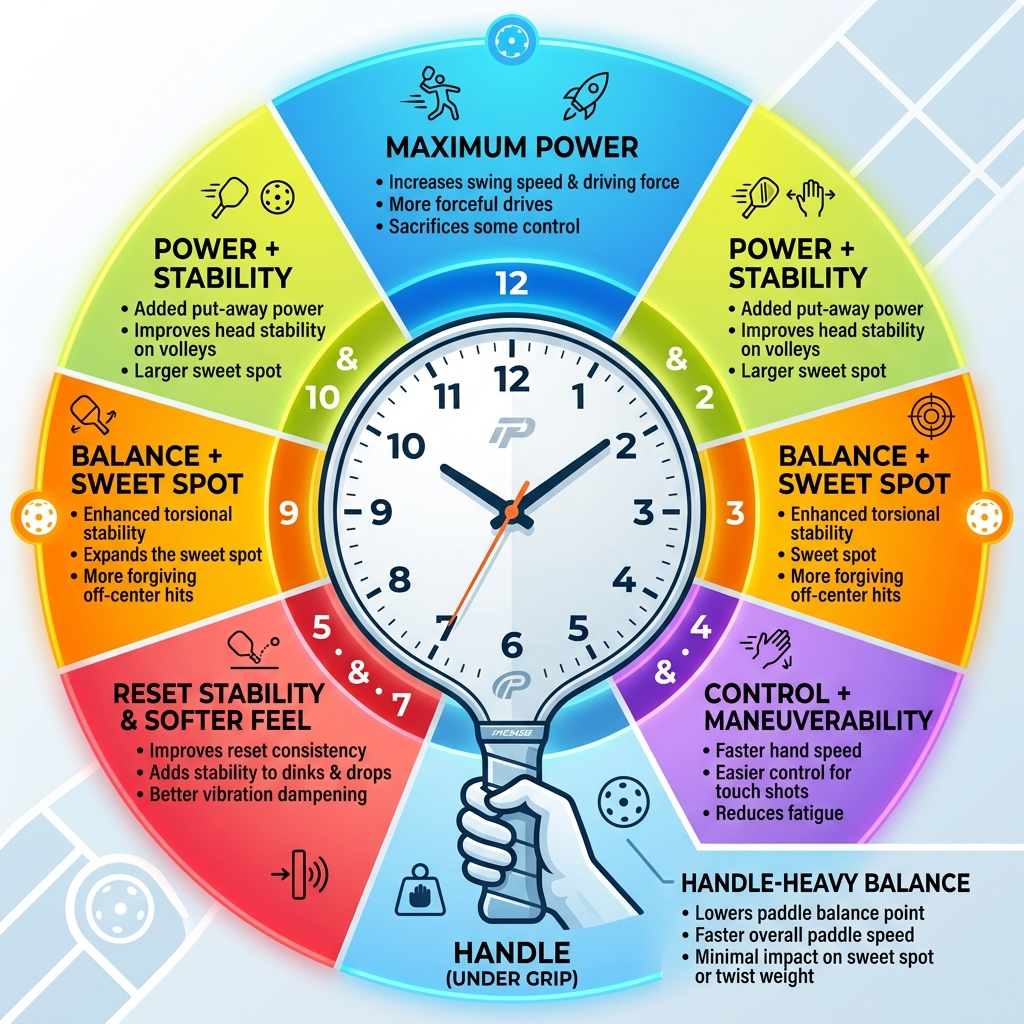
Quick look at pickleball paddle weight placement:
Understanding Pickleball Paddle Weight Placement
Before we start sticking tape all over your expensive gear, we need to understand the “why” behind the weight. Most paddles on the market today weigh approximately 8.0 ounces, which is a neutral starting point for most players. However, how that weight is distributed—the pickleball paddle weight placement—dictates whether the paddle feels like a magic wand or a heavy brick.
There are three main ways a paddle can be balanced:
- Head-Heavy: The weight is concentrated toward the top. This provides massive “plow-through” and power but can feel sluggish at the net.
- Handle-Heavy (Head-Light): The weight is tucked into the grip. This makes the paddle feel “zippy” and fast for reflex volleys.
- Even-Balanced: The weight is distributed uniformly, offering a blend of both worlds.
When we modify a paddle, we are adjusting the balance point. You can find yours by teetering the paddle on your finger at the throat. If it tips toward the head, it’s head-heavy. Understanding this balance is vital, especially for specific demographics like senior players navigating paddle weights to avoid injury while maintaining performance.
Optimal Pickleball Paddle Weight Placement for Power
If you feel like your drives are dying before they reach the baseline, you likely need more “swing weight.” By placing weight at the 12 o’clock position (the very tip of the paddle), you create a lever effect.
Adding just 3–5 grams here can significantly increase the force of your swing. This is the go-to setup for “power baseliners” who want to overwhelm opponents with heavy groundstrokes. Because lead can be messy, many of our experts suggest using tungsten tape on Amazon for a safer, non-toxic alternative that achieves the same result.
Improving Stability with Pickleball Paddle Weight Placement
Do you ever hit the ball slightly off-center and feel the paddle “twist” in your hand? That’s a lack of twist weight. To fix this, we focus on the 3 and 9 o’clock positions.
By adding weight to the perimeter of the paddle, you increase the Moment of Inertia (MOI). In plain English: the paddle becomes harder to turn or twist upon impact. This effectively expands the sweet spot, making those “oops” hits feel much more controlled.
| Feature | Head-Heavy (12 o’clock) | Handle-Heavy (Throat/Grip) |
|---|---|---|
| Power | High | Low |
| Hand Speed | Slower | Faster |
| Stability | Medium | High |
| Best For | Singles/Drives | Doubles/Dinks |
The Science of Weight Distribution and Performance
Why does a few grams of tape change the game so much? It comes down to physics. When we talk about pickleball paddle weight placement, we are really talking about vibration reduction and plow-through. A heavier paddle (8.5+ oz) typically reduces vibration by about 15%, which is great news for your elbow.
Expanding the Sweet Spot
Research suggests that proper weight placement can expand your usable sweet spot by up to 30%. While 3 and 9 o’clock are the standard for stability, many advanced players prefer the 4 and 8 o’clock positions. This lowers the center of gravity slightly compared to the middle-side placement, offering a “solid” feel without making the head feel too heavy. This is a crucial concept we cover when decoding paddle materials for beginners, as different cores react differently to added mass.
Impact of Paddle Thickness on Weighting
Your paddle’s thickness—usually 13mm, 14mm, or 16mm—interacts directly with your tape.
- 13mm Paddles: These are naturally “poppy” and powerful. Adding weight here usually focuses on stability (3 and 9 o’clock) to tame the raw power.
- 16mm Paddles: These are control-oriented. Adding weight to the head of a 16mm paddle can give you the “best of both worlds”—the soft feel of a thick core with the power of a heavy hitter.
If you are looking to experiment, check out these top-rated paddle tuning tapes to ensure you have the right adhesive for your specific paddle surface.
Step-by-Step Guide to Applying Weight Tape
Ready to get to work? Applying weight isn’t rocket science, but doing it neatly ensures the tape stays put during a heated fire-fight at the net.
- Clean the Surface: Use rubbing alcohol to wipe down the edge guard. Dust and oils from your hands will prevent the tape from sticking.
- Measure and Cut: Most 1/4″ lead tape adds about 0.5 grams per inch. If you want to add 2 grams to each side, cut two 4-inch strips.
- Symmetrical Placement: Use a ruler or the “clock” method to ensure the strips are in the exact same spot on both the left and right sides.
- Press Firmly: Use your thumb (or a credit card) to press the tape into the edge guard.
- Cover Up: If using lead, always cover it with electrical tape or edge guard tape to cover weights. This prevents you from touching the lead and keeps the strips from peeling off. You can find high-quality lead tape on Amazon that comes in rolls for easy customization.
The Recommended Sequence for Adding 3g Weights
We recommend a “test and learn” approach. Don’t dump 15 grams on your paddle at once!
- Step 1: Add 2–3 grams at 3 and 9 o’clock. Play 3+ sessions.
- Step 2: If you want more power, add 2 grams at the 12 o’clock position.
- Step 3: If the paddle feels too head-heavy, add an overgrip or a small amount of weight to the throat to balance it out.
understanding paddle grip size is also a form of weighting; an extra overgrip adds about 6–8 grams to the handle!
Materials and Tools Needed
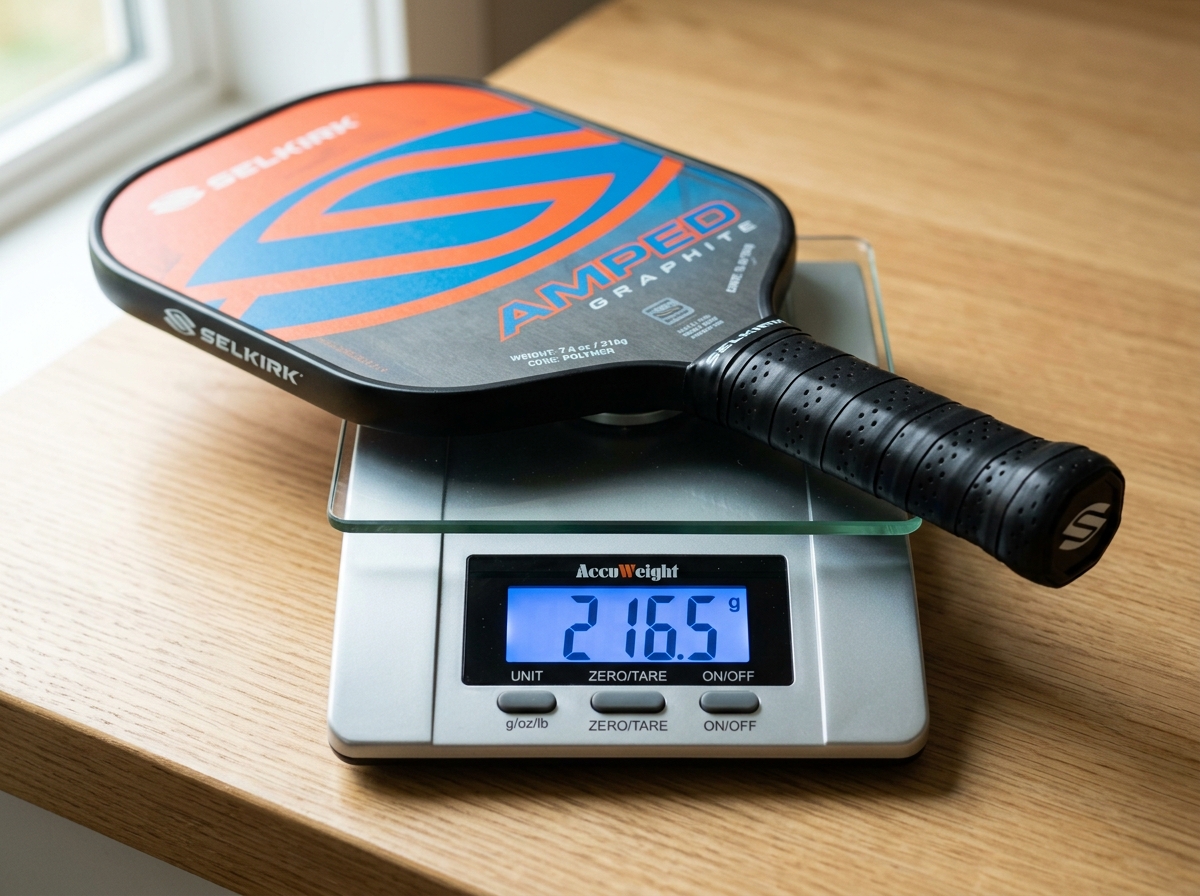
- Digital Kitchen Scale: Accurate to 0.1oz or 1g.
- Rubbing Alcohol: For cleaning.
- Scissors: For precise cuts.
- Weighted Tape: Lead or Tungsten.
- Electrical Tape: For finishing and safety.
Customizing for Your Skill Level and Playstyle
Your pickleball paddle weight placement should reflect the player you are today, not the pro you’re watching on YouTube.
Beginner vs. Advanced Weighting Strategies
For beginners, the goal is usually forgiveness. Most beginners benefit from 4–8 grams of total weight added to the sides (3 and 9 o’clock). This helps stabilize the paddle during the learning phase. We often recommend lightweight paddles for senior beginners because they are easier on the joints, but a few grams of tape can make these light paddles feel much more premium.
Advanced players often push the limits, adding 10–15 grams to achieve a specific “swing weight” (usually between 110-120). They might use adjustable paddles or complex tape configurations to fine-tune their “plow-through” on serves.
Placement for Net Play and Dinking
If you are a “kitchen specialist” who loves dinking and resetting the ball, avoid heavy weight at the 12 o’clock position. Instead, look at the 5 and 7 o’clock positions (near the throat). This adds stability to the lower half of the paddle—where many dinks are struck—without making the paddle feel heavy when you need to move your hands fast for a volley battle.
Safety, Legality, and Risk Management
Is this legal? Yes! USAP Rule 2.E allows for lead tape as long as it doesn’t change the hitting surface texture or exceed size restrictions. However, you must keep the tape on the edge guard.
Avoiding Injury and Fatigue
There is a “Goldilocks zone” for weight.
- Too Light: You have to swing harder to get depth, which can cause “pickleball elbow” (similar to tennis elbow).
- Too Heavy: You strain your shoulder and wrist trying to move the mass.
A mid-weight paddle (7.5–8.2 oz) is the sweet spot for 75% of players. Interestingly, a lighter paddle can offer up to 12% faster hand speed, but a heavier paddle reduces vibration by 15%. If you’re feeling a “tweak” in your arm, try optimizing your pickleball grip or moving your weight lower toward the handle to reduce the strain.
How to Test and Revert Modifications
Never make a change and immediately go play a tournament. Use a “Testing Checklist”:
- Wall Taps: Do 50 quick volleys against a wall. Do your hands feel late?
- Baseline Drives: Hit 20 drives. Are they landing deeper with less effort?
- Dink Drills: Does the paddle feel stable or “jumpy”?
If you hate the feel, don’t worry. Simply peel the tape off. If there is sticky residue left behind, a little rubbing alcohol on a cloth will take it right off. We always suggest keeping a log of your weights, especially when comparing against a review of top-rated paddles, so you know exactly what works for your arm.
Frequently Asked Questions about Paddle Weighting
Is adding lead tape to a pickleball paddle legal?
Yes, it is perfectly legal under USA Pickleball rules for both recreational and tournament play, provided the tape is applied to the edge guard and doesn’t interfere with the hitting surface.
How much weight should I add to my paddle first?
We recommend starting with 4 grams total—2 grams at 3 o’clock and 2 grams at 9 o’clock. This is the most “neutral” way to improve the paddle’s feel without a massive adjustment period.
Does adding weight increase spin?
Not directly. Spin is generated by the paddle’s surface friction and your swing path. However, a more stable paddle (thanks to weight) can help you execute your swing more consistently, which may result in better spin.
Conclusion
At Voce Economia, we believe your gear should work for you, not against you. Pickleball paddle weight placement is the ultimate “life hack” for the court. Whether you’re looking for the baseline power of a pro or the steady hands of a kitchen specialist, a few strips of tape can transform your game.
Start small, stay symmetrical, and always listen to your body. If you’re ready to dive deeper into how to pick the right gear from the start, explore more pickleball equipment guides on our site. Happy hitting!
