
The Ultimate Guide to Buying Your First Pickleball Paddle
Why Your First Pickleball Paddle Choice Matters More Than You Think
This beginner pickleball paddle guide will help you find the right paddle fast. Here’s what you need to know upfront:
Quick Answer: What to Look for in Your First Paddle
| Feature | What Beginners Need |
|---|---|
| Weight | 7.5 – 8.5 oz (mid-weight) |
| Core thickness | 13mm – 16mm (thicker = more control) |
| Core material | Polymer honeycomb |
| Surface material | Fiberglass or carbon fiber |
| Grip size | 4 1/8″ – 4 3/8″ circumference |
| Shape | Standard or widebody |
| Budget | $50 – $150 |
Pickleball is one of the fastest-growing sports in the country right now. Millions of new players are picking up a paddle for the first time every year. And that’s exactly where the problem starts.
Walk into any sporting goods store — or scroll through Amazon — and you’ll find hundreds of options. Different weights, shapes, materials, price points. It’s easy to feel lost before you’ve even hit a single ball.
Here’s the honest truth: the wrong paddle can make learning harder. A paddle that’s too heavy strains your arm. One with too much power sends the ball flying out of bounds. And a cheap, poorly made paddle won’t give you the feel you need to develop real control.
The good news? You don’t need to spend $200+ to get a great first paddle. You just need to know what actually matters for a new player — and what’s just marketing noise.
This guide cuts through all of it.
Know your beginner pickleball paddle guide terms:
Key Features of a Beginner Pickleball Paddle Guide
When you are just starting out, your paddle is more than just a piece of equipment; it is your primary tool for learning the “feel” of the game. For most new players (generally rated between 1.0 and 3.5), the goal isn’t to hit the ball at 100 mph—it’s to keep the ball in play. This is why we prioritize “forgiveness” and “control” over raw power.
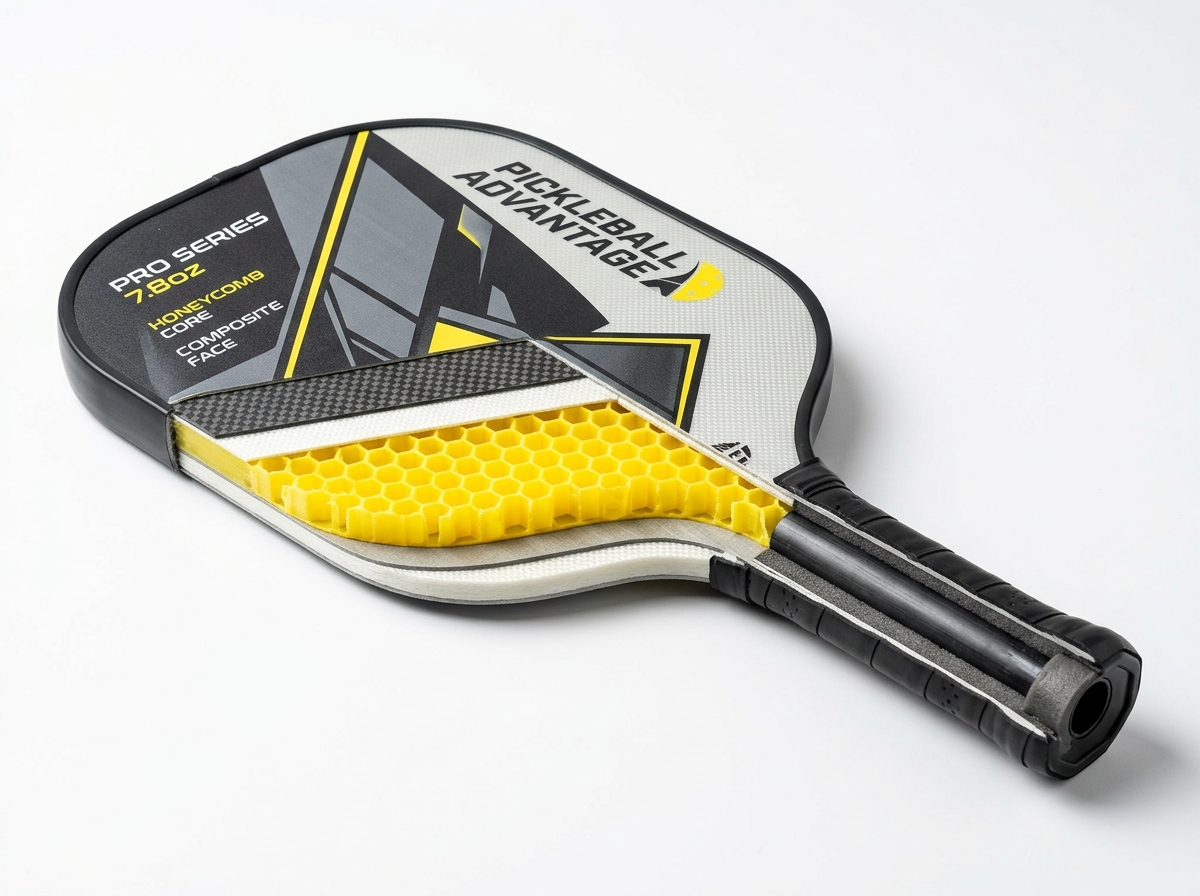
A forgiving paddle has a large “sweet spot.” This means that even if you don’t hit the ball perfectly in the center of the face, the ball still goes roughly where you intended. If you choose a professional-level power paddle too early, a slight miss-hit will send the ball into the net or soaring out of bounds.
In our experience, Decoding Pickleball Paddle Materials for Beginners is the first step to making a smart purchase. Most modern paddles use a polymer honeycomb core. This plastic blend is the industry standard because it is durable, relatively quiet, and provides a consistent bounce.
For the surface (the “face”), you will usually choose between fiberglass and carbon fiber. According to scientific research on fiberglass properties, this material is more flexible and provides more “pop,” which helps with power. Carbon fiber, on the other hand, is stiffer and offers better “feel” and control, which we often recommend for beginners who want to master their dinks and drop shots.
Finally, look for a paddle with a sturdy edge guard. As a beginner, you will scrape your paddle on the ground while reaching for low balls. A good edge guard protects the core from delaminating, while internal foam injections can provide essential vibration dampening to keep your joints happy.
Understanding Core Thickness
Core thickness is a spec that many beginners overlook, but it fundamentally changes how the paddle plays.
- 13mm (Thin Cores): These offer more “pop” and power. The ball spends less time on the face, making it fly off faster.
- 16mm (Thick Cores): These are the “control” kings. A thicker core absorbs more energy, increasing “dwell time” (how long the ball stays on the paddle). This makes it much easier to control the direction and depth of your shots.
We suggest beginners lean toward 14mm to 16mm. As you focus on Mastering the Soft Game with Lightweight Pickleball Gear, you’ll find that a thicker core helps you keep those delicate dinks low over the net.
Paddle Shapes and Forgiveness
The shape of your paddle dictates how much room for error you have.
- Standard Shape (approx. 16″ x 8″): The most balanced option. It offers a large sweet spot and a familiar feel.
- Widebody (8″ or wider): These are the most forgiving. They offer the largest hitting surface, making them perfect for those who are still working on their hand-eye coordination. Check out our tips on How to Choose Your First Pickleball Without Losing Your Mind for more on shape selection.
- Elongated (16.5″ x 7.5″): These are longer and narrower. While they offer more reach and power, the sweet spot is smaller and further from your hand, which can be frustrating for absolute novices.
Choosing the Right Weight and Grip Size
If there is one thing that can cause immediate physical pain in pickleball, it’s using the wrong weight or grip size.
The “Goldilocks” Weight Zone
Pickleball paddles are generally categorized into three weight classes:
- Lightweight (under 7.6 oz): Great for “fast hands” at the net, but requires you to swing harder to generate power.
- Mid-weight (7.6 – 8.2 oz): The “Goldilocks” zone for beginners. It provides enough mass to drive the ball deep without causing muscle fatigue or straining your elbow.
- Heavyweight (over 8.2 oz): Provides effortless power but can be sluggish at the net and may lead to “Pickleball Elbow” if your mechanics aren’t perfect.
For most new players, we recommend a static weight of 7.8 to 8.1 ounces. This range offers the best balance of stability and maneuverability. For more specific advice, see Navigating Pickleball Paddle Weights: A Guide for Senior Players or our Lightweight Pickleball Paddles: A Guide for Senior Beginners.
Measuring Your Grip for the Beginner Pickleball Paddle Guide
A grip that is too small will twist in your hand, while a grip that is too large prevents you from snapping your wrist properly. Most grips range from 4″ to 4.5″.
To find your size, use the Ring Finger Test: Measure the distance from the tip of your ring finger to the middle crease of your palm. That measurement in inches is your ideal grip circumference.
Another quick check is the Index Finger Rule: Hold the paddle with your normal grip. You should be able to fit the index finger of your other hand into the gap between your fingertips and the heel of your palm. If there’s no room, the grip is too small. If there’s a huge gap, it’s too large.
For seniors or those with arthritis, Understanding Pickleball Paddle Grip Size for Seniors and Optimizing Pickleball Grip for Senior Players offer deeper insights into comfort-focused adjustments like using overgrips.
Top Recommended Models for New Players in 2026
The market in 2026 has brought high-end technology down to very affordable prices. You no longer have to spend $250 to get a “Gen-2” thermoformed paddle. Before buying, always look for the “USA Pickleball Approved” seal to ensure your gear meets USA Pickleball official standards for tournament play.
Best Overall Beginner Pickleball Paddle Guide Pick
Our top recommendation for 2026 is the Honolulu Sword & Shield J2NF. This paddle uses premium T700 Raw Carbon Fiber, which provides incredible spin and a soft, controlled feel. It is a paddle you can start with on day one and continue using as you reach an intermediate level.
If you are looking for high performance under $100, the 11SIX24 Pegasus Jelly Bean is a fantastic alternative. It offers about 80% of the performance of elite paddles at a fraction of the cost, making it a “best-value” champion in our Review of Top Rated Paddles Designed for Senior Players.
Best Value and Starter Sets
If you are playing with a partner, the Friday Original offers a famous “2 for $99” deal. These paddles are stylish, durable, and feature a 16mm core that is perfect for learning control.
For those who want a complete “out of the box” experience, the SLK Neo 2.0 Set includes two paddles, balls, and a bag. It’s the gold standard for Pickleball Starter Packs That Won’t Break the Bank.
And don’t forget the little ones! The Oneshot Juniorshot Series is specifically designed for kids, with smaller grips and lighter weights to prevent injury. For more budget options, visit our guide on Budget-Friendly Pickleball Gear for Beginners.
How Your Background Influences Paddle Choice
Your previous sports experience is a huge factor in which paddle will feel “right.” Muscle memory is a powerful thing, and you should use it to your advantage.
Transitioning from Tennis or Ping Pong
- Tennis Players: You are used to a longer handle and a “head-heavy” feel. You will likely prefer elongated paddles with a handle length of 5.25″ to 5.5″. This allows you to use a two-handed backhand comfortably. Check our Comprehensive Pickleball Equipment Checklist for Seniors for more transition tips.
- Ping Pong Players: You are used to using your wrists to generate spin and speed. You will likely prefer a lightweight, standard-shaped paddle that is easy to flick.
- No Racket Background: Stick to a Widebody or Standard shape. These provide the most stability and the largest sweet spot, helping you build confidence from your very first rally.
For those dealing with mobility issues, The Advantages of Adjustable Paddles for Older Pickleball Players can be a game-changer. You can find more specific gear advice in our Equipment Category.
Frequently Asked Questions about Beginner Paddles
How much should a beginner spend on their first paddle?
The “sweet spot” for a first paddle is $50 to $130.
- Under $40: You often run into the “Amazon Trap”—paddles made of cheap wood or thin plastic that vibrate excessively and break quickly.
- Over $150: You are paying for advanced “pro” features like extreme power or specialized spin textures that you likely won’t be able to control yet.
Should I start with a wood pickleball paddle?
In a word: No. Wood paddles are heavy (often over 9 oz), which leads to arm fatigue. They also lack a honeycomb core, meaning they have almost no “soft touch.” Unless you are playing a one-time game at a backyard BBQ, invest in a composite or carbon fiber paddle.
When is it time to upgrade from a beginner paddle?
Most quality beginner paddles will last 12 to 18 months. You’ll know it’s time to upgrade when:
- You start playing in competitive tournaments.
- You consistently hit the sweet spot and want more specialized power or spin.
- The paddle develops “dead spots” (where the ball doesn’t bounce correctly).
Conclusion
At Voce Economia, we want your first experience on the court to be filled with long rallies and plenty of laughs, not frustration over gear. By choosing a mid-weight, 16mm core paddle with a grip that actually fits your hand, you are setting yourself up for success.
Use this beginner pickleball paddle guide as your checklist, grab a friend, and get out there! If you’re still undecided, consider Choosing the Best Beginner Pickleball Sets for Home Use to get everything you need in one go.
Ready to start your journey? Visit https://voceeconomia.com/ for more expert tips on mastering the court!
