
The Novice Guide to Finding Budget Durable Outdoor Balls
Why Beginner Pickleball Ball Reviews Matter More Than You Think
If you’re reading beginner pickleball ball reviews, here’s a quick answer to help you choose right now:
Best beginner pickleball balls at a glance:
| Ball | Best For | Approx. Cost Per Ball | Durability |
|---|---|---|---|
| Franklin X-40 | Overall best for beginners | $2.50-$3.40 | 20-30 games |
| GoSports GS40 | Best budget pick | $2.07 | Good for rec play |
| Crown Pickleballs | Best bulk value | ~$1.00 | Comparable to premium |
| OSO Pickleballs | Premium feel, lower cost | Mid-range | Long-lasting |
| Onix Dura Fast 40 | Consistent outdoor play | ~$1.00 bulk | 12-15 games |
Starting out in pickleball is exciting. But the wrong ball can make learning much harder than it needs to be.
Balls that bounce inconsistently, crack after a few sessions, or move too fast make it difficult to develop real control and feel. Many beginners don’t realize the ball itself is the problem — they just think they’re struggling.
The good news? A few well-chosen, affordable balls solve this completely.
The Franklin X-40 is the most widely recommended ball for new players. It plays slower and more consistently than most alternatives, which gives beginners time to build technique. It’s also the ball you’re most likely to see at recreational play, leagues, and tournaments across the U.S. — so buying it means you’re already practicing with what everyone else uses.
For budget-conscious beginners, options like the GoSports GS40 (around $2.07 per ball) and Crown Pickleballs (as low as ~$1 per ball in bulk) offer solid performance without overspending while you’re still learning.
One important thing most beginners overlook: the surface you play on matters as much as the ball you choose. Outdoor hard courts and gymnasium floors need different balls to perform well. Using the wrong type leads to skipping, skidding, and unpredictable bounces.
This guide breaks down the best affordable, durable outdoor balls for beginners — so you can stop guessing and start playing better.
Essential Factors for Choosing Beginner Pickleball Balls
When we first step onto the court, a ball is just a ball, right? Not exactly. In pickleball, the ball you choose dictates the rhythm of your game. For a novice, the goal is to find a ball that stays in the air long enough for you to react but is tough enough to handle the friction of an outdoor court.
To help you navigate the sea of options, we’ve put together a quick comparison of what you should look for in your first set of gear.
| Feature | Beginner Priority | Why it Matters |
|---|---|---|
| Speed | Low to Medium | Slower balls give you more time to set your feet and swing. |
| Durability | High | Beginners tend to hit “flat,” which puts stress on the plastic. |
| Bounce Height | Consistent | You want a predictable rebound to build muscle memory. |
| Hole Count | 40 (Outdoor) | More, smaller holes help the ball resist wind and fly straight. |
Official USA Pickleball Equipment Standards
If you plan on playing in any local leagues or “sanctioned” events, you need to ensure your balls are USA Pickleball approved. According to official standards, a regulation ball must weigh between 0.78 and 0.935 ounces and have a diameter of roughly 2.87 inches. While most major brands meet these specs, some ultra-cheap “no-name” balls found in online marketplaces might be too light or too small, which will ruin your timing when you eventually play with standard gear.
Understanding Surface Compatibility
One of the biggest “aha!” moments for new players is realizing that “indoor” and “outdoor” aren’t just marketing terms—they refer to the court surface.
- Outdoor Balls: These are made of harder, heavier plastic with 40 small, precision-drilled holes. They are designed to withstand the rough texture of asphalt and concrete.
- Indoor Balls: These are softer, lighter, and usually have 26 larger holes. They are designed for “soft” surfaces like gymnasium wood or tiled floors.
A common mistake we see is beginners trying to use outdoor balls on a wooden basketball court. Because the ball is so hard and the floor is so slick, the ball will often skid or “slide” rather than bounce. Conversely, using an indoor ball outside is a recipe for disaster; the wind will take it like a kite, and the rough ground will chew up the soft plastic in minutes. For more on this, check out our guide on finding the best pickleball balls for beginners.
Best Budget Pickleball Ball Reviews for Beginners
We know that starting a new hobby can get expensive quickly. Between paddles, shoes, and court fees, the last thing you want is to spend $50 a month just on plastic balls. Luckily, there are some fantastic budget-friendly options that don’t sacrifice quality.
GoSports GS40
If you are looking for the best “bang for your buck,” the GoSports GS40 is hard to beat. At approximately $2.07 per ball when bought in a 4-pack (and even cheaper in bulk), it’s a steal. These balls are slightly faster than the Franklin X-40 but offer excellent durability for recreational play. They are perfect for beginners who are still losing balls over fences or into the bushes.
Crown Pickleballs
For those who want to buy in bulk and forget about it for a season, Crown Pickleballs are a hidden gem. In large quantities, these can drop to about $1.00 per ball. What’s impressive is that they don’t feel “cheap.” They have a quality weight and bounce that mimics premium balls like the Dura Fast 40, making them a top contender in any budget-friendly pickleball gear for beginners list.
Top Picks for Beginner Pickleball Ball Reviews
When we look at the broader market, two names consistently rise to the top for players who want reliability over raw speed.
1. Franklin X-40
This is the “Gold Standard.” If you walk onto any public court in the U.S., you will likely see a sea of neon green Franklin X-40s. Why? Because they are incredibly consistent. They don’t “egg” (become oval-shaped) easily, and they play at a medium pace that is perfect for the “soft game” (dinking and resetting). They typically last 20-30 games before they either crack or become too soft to play with.
2. OSO Pickleballs
OSO is a brand that has gained a lot of traction recently. They offer a performance that many players compare to the high-end Onix Dura Fast 40 but at a more accessible price point. They are known for their flight stability, meaning they won’t wobble in the air, which is a huge plus for beginners trying to track the ball’s path.
Avoiding Common Mistakes in Beginner Pickleball Ball Reviews
It’s easy to get swayed by “Pro” labels. Many beginners see the Onix Dura Fast 40 or the Vulcan VPRO FLIGHT and think, “If the pros use it, I should too!”
Wait right there. These are “fast” balls. They are designed for players with lightning-fast reflexes. For a beginner, a Dura Fast 40 can feel like a rock coming at your face. Furthermore, these harder balls crack much faster—sometimes in as few as 10 games—especially in cold weather.
Another mistake is ignoring the temperature. If it’s below 50 degrees Fahrenheit, almost all pickleball balls become brittle. If you’re playing in the winter, look for balls that are slightly softer (like the Franklin X-40) rather than the hard-shell tournament balls. To avoid frustration, you should stop playing with bad balls and get the best instead.
Performance Breakdown of Popular Outdoor Balls
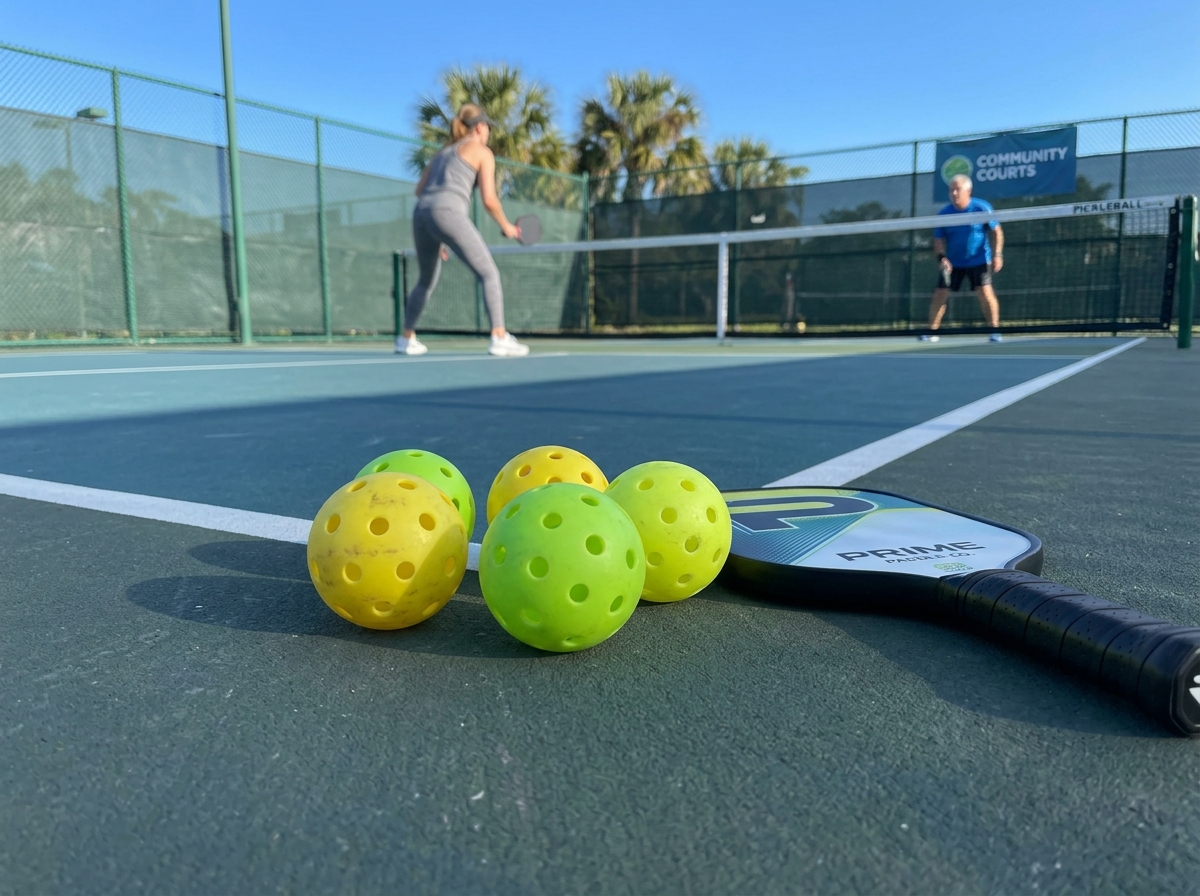
When you’re out on the court, you want to focus on your footwork and your swing, not whether the ball is going to take a weird hop. Here is how the big players stack up in terms of performance.
Franklin X-40: The All-Rounder
The X-40 is the most popular ball for a reason. It features 40 precisely drilled holes that provide a balanced flight. It isn’t the fastest ball on the market, which is actually a benefit for beginners. It allows for longer rallies and gives you the opportunity to practice your “drops” and “dinks” without the ball flying off your paddle like a rocket.
Onix Dura Fast 40: The Speedster
The “Dura” is legendary. It is a seamless, one-piece ball that is very hard and very fast. While it is the preferred ball for high-level tournament play because it doesn’t “soften” over time, it is notoriously fragile. If you mis-hit it on a cold morning, it will likely crack. For beginners, the cost-to-durability ratio usually doesn’t make sense.
Selkirk Pro S1: The Durability King
Selkirk made waves by offering a one-year no-crack warranty on the Pro S1. This ball is designed with 38 holes instead of 40, which Selkirk claims helps it maintain its shape and resist cracking. While it is more expensive upfront (around $3.75 per ball), the fact that it won’t crack after a few games makes it a great long-term value for a beginner who plays frequently.
Why Visibility and Color Matter for Beginners
Have you ever wondered why almost every pickleball is neon green or “optic yellow”? It’s not just fashion. Scientific research on sports visibility shows that these colors are the easiest for the human eye to track against the blue or green backgrounds of most courts.
For beginners, visibility is crucial. You are still training your eyes to judge distance and speed. A high-contrast ball helps you react faster. While you can find orange, pink, or even white balls, we recommend sticking to neon green or yellow for outdoor play to ensure you (and your partner) can see the ball clearly under the bright sun.
Maintenance and Longevity: When to Replace Your Gear
Unlike a tennis ball that eventually loses its “fuzz,” a pickleball dies in two ways: it either cracks or it goes “soft.”
Signs of a Dead Ball
- The Crack: This is obvious. You’ll hear a “thud” instead of a “pop” when you hit it. Always inspect your ball after a hard rally if the sound changes.
- Out-of-Round (Egging): Over time, the plastic can warp. If you spin the ball on the ground and it wobbles like an egg, it’s time to toss it. An “egged” ball will have an unpredictable bounce.
- Soft Spots: If you can easily squeeze the ball with your thumb and it feels “mushy,” it has lost its structural integrity. This usually happens to Franklin X-40s after about 25 games.
Storage and Weather Impact
Temperature is the number one enemy of your gear. We’ve seen players leave their balls in a hot car trunk in the summer or a freezing garage in the winter. Extreme heat makes the plastic too soft, while cold makes it brittle. To get the most life out of your purchase, store your balls inside your house at room temperature.
Frequently Asked Questions about Beginner Balls
Can beginners use outdoor balls on indoor courts?
Yes, and increasingly, they do. Many dedicated indoor facilities now use “outdoor” style surfaces (like Acrytech or Pickleroll). In these cases, you should use an outdoor ball. However, if you are playing on a traditional hardwood basketball court, an outdoor ball will be too bouncy and slippery. Stick to an indoor-specific ball like the Franklin X-26 for wood floors.
How long do pickleball balls typically last?
For a beginner playing at a moderate pace, a good ball like the Franklin X-40 or Selkirk Pro S1 should last between 20 and 30 games. If you are a “banger” (someone who hits the ball as hard as possible every time), expect that lifespan to drop significantly.
Which balls are best for cold weather play?
In chilly conditions, you want a ball that isn’t too hard. The Onix Dura Fast 40 is notorious for cracking in the cold. We recommend the Franklin X-40 or the Selkirk Pro S1 for winter play, as their plastic composition tends to handle lower temperatures slightly better without shattering.
Conclusion
Finding the right ball doesn’t have to be a chore. For most of us starting out, the Franklin X-40 is the perfect balance of price, performance, and “standard” feel. If you’re looking to save every penny, the GoSports GS40 or Crown Pickleballs will serve you just as well while you hone your skills.
At Voce Economia, we are dedicated to providing beginner-focused guides that help you get onto the court without breaking the bank. Choosing the right ball is the first step toward a more consistent, enjoyable game. Now that you know what to look for, grab a pack, find a court, and start playing!
Check out our full equipment category for more reviews on paddles, shoes, and starter sets.
