
The Beginner Guide to Serving Rotation and Service Rules
Why the Pickleball Doubles Serving Order Confuses So Many New Players
Pickleball doubles serving order is one of the first things that trips up new players — and it makes sense why. The rotation between partners, the score-based positioning, and the unusual “0-0-2” start feel nothing like any other sport.
Here’s the quick version of how it works:
Pickleball Doubles Serving Order at a Glance
- The game starts at 0-0-2 — only one player on the first team gets to serve before the serve switches sides.
- The server always starts on the right side when their team’s score is even, and the left side when it’s odd.
- If the serving team wins a point, the same server switches sides with their partner and serves again.
- If the serving team faults, the partner becomes the next server (no side switch).
- If the partner also faults, it’s a side-out — the other team takes over serving, starting from their right side.
- Before every serve, the server calls three numbers: their team’s score, the other team’s score, and the server number (1 or 2).
This system sounds complicated at first, but after a game or two it becomes second nature.
Doubles is the most popular way to play pickleball — it’s faster, more social, and surprisingly strategic. But none of that fun happens smoothly if players are unsure who should be serving, or from which side. Misunderstandings about the serving rotation are one of the most common sources of confusion and disputes in casual games.
The good news? The whole system follows one simple rule: your team’s score tells you where to stand. Once that clicks, everything else falls into place.
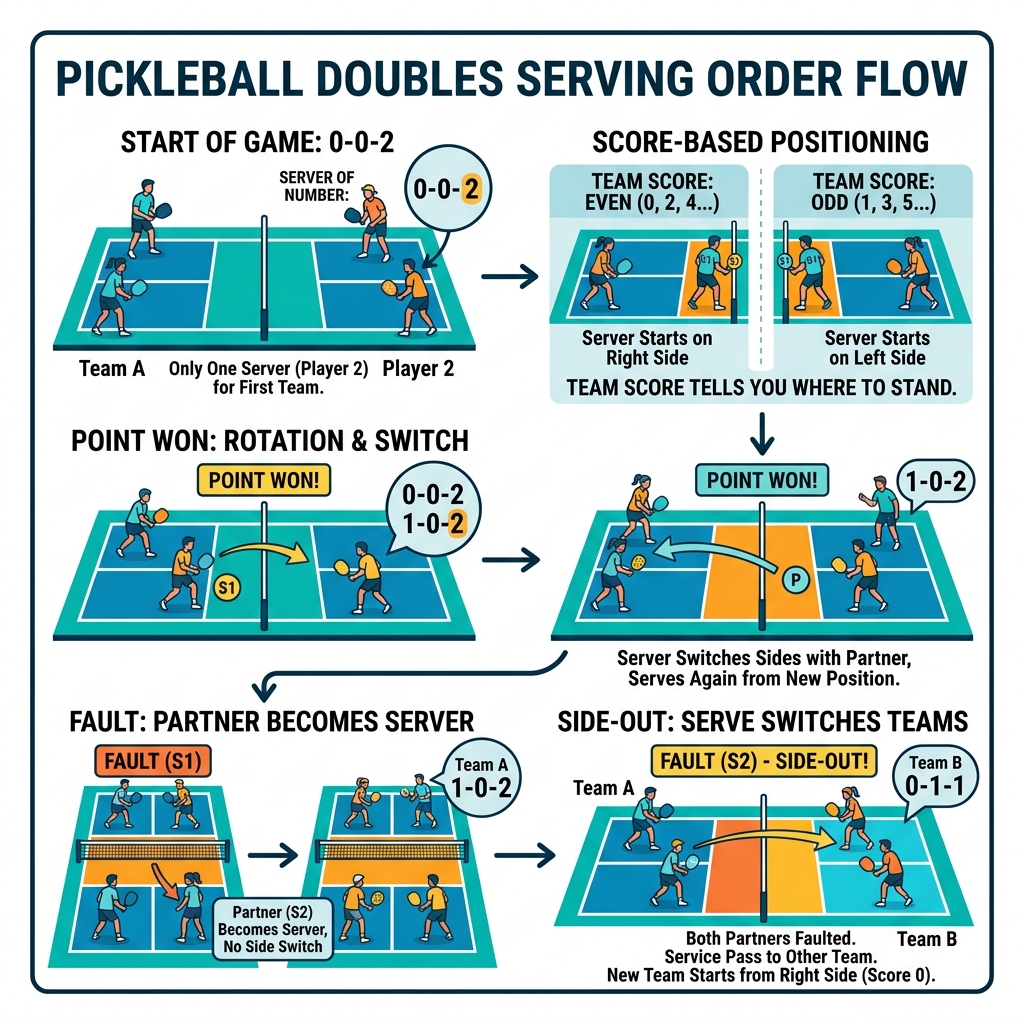
Discover more about pickleball doubles serving order:
Fundamental Rules for a Legal Pickleball Serve
Before we dive into the complex rotation of partners, we have to master the act of the serve itself. In pickleball, the serve isn’t meant to be an overwhelming offensive weapon like in tennis; instead, it’s designed to start the rally fairly.
The Mechanics of the Motion
To keep things consistent, the USA Pickleball Official Rulebook mandates a specific underhand motion. When you strike the ball, your arm must move in an upward arc. Crucially, the contact point between the paddle and the ball must be below your waist (specifically, below your navel). Additionally, the highest point of your paddle head must be below the highest part of your wrist at the moment of impact.
Foot Placement and Positioning

When you are ready to serve, your feet must be in the correct zip code. At the moment you strike the ball:
- At least one foot must be on the playing surface behind the baseline.
- Neither foot may touch the court surface inside the baseline.
- Neither foot may touch the area outside the imaginary extensions of the sideline or the centerline.
The serve must travel diagonally crosscourt and land within the confines of the opposite service court. Be careful: if your serve lands in the “Kitchen” (the non-volley zone) or even touches the Kitchen line, it is a fault and you lose that serve. However, hitting the baseline, sideline, or center service line of the correct box is considered “in.”
Volley Serve vs. Drop Serve
Most players use the traditional “volley serve,” where you hit the ball out of the air without letting it bounce. However, a popular variation is the drop serve in pickleball. For this, you simply drop the ball from any height and hit it after it bounces. There are no restrictions on paddle height or upward arc for a drop serve, making it a great option for those who struggle with the traditional mechanics. You can learn more about these nuances in our guide on pickleball serving basics for senior beginners.
Finally, remember the 10-second rule. Once the score has been called, the server has exactly 10 seconds to execute the serve. If you take too long to find your rhythm, you’ll be called for a fault!
Mastering the Pickleball Doubles Serving Order
Understanding the pickleball doubles serving order is about tracking two things simultaneously: which partner is serving and which side of the court they are standing on. Unlike singles, where you simply switch sides based on your score, doubles involves a “tag-team” approach.
The Starting Point
At the very beginning of a match, the teams usually use a fair method like a coin toss or “rock, paper, scissors” to decide who serves first. The team that wins the toss chooses to serve, receive, or pick a side. The player on the right-hand side of the court always starts the serving sequence for their team.
The Partner Rotation
In a standard rotation, both players on a team get a chance to serve before a “side-out” occurs (where the ball goes to the other team).
- Server 1 serves until their team commits a fault.
- The serve then moves to Server 2 (the partner), who serves from whichever side they are currently standing on.
- Once Server 2 commits a fault, the serve moves to the opposing team.
This “two-server” rule applies throughout the game, with one major exception at the very start, which we will cover shortly. For those just getting their feet wet, checking out the basics of playing doubles in pickleball for beginners can provide additional visual context.
How Score Dictates the Pickleball Doubles Serving Order
If you ever feel lost on the court, just look at your score. The score is the ultimate compass for understanding court positions in pickleball for seniors and players of all ages.
The Even/Odd Rule:
- Even Scores (0, 2, 4, 6, 8, 10): When the serving team’s score is even, the player who was the initial server at the start of the game must be on the right side of the court.
- Odd Scores (1, 3, 5, 7, 9): When the serving team’s score is odd, that same starting player must be on the left side of the court.
We only switch sides with our partners when we win a point while serving. If you are the server and you win a rally, you move to the other side of your own court to deliver the next serve. The receiving team never switches sides; they stay put until they win the serve back.
Managing the Sequence in Your Pickleball Doubles Serving Order
To keep the game fair, the pickleball doubles serving order uses a “First Server Exception.” If the team that started the game with the serve had two chances to serve, they would have a massive advantage.
To balance this, the very first serving turn of the game only allows one player to serve. This is why the starting score is called “0-0-2.” The “2” indicates that the team is already on its second server’s turn. If they lose that first rally, it’s an immediate side-out. After that initial turn, every team gets two servers for the rest of the game.
Scoring and Communication in Doubles Play
Communication is the glue that holds a doubles team together. In pickleball, this starts with calling the score. If you don’t call the score, the serve doesn’t count, and you might even be called for a fault.
The Three-Number System
In doubles, we use a three-number score format:
- First Number: The serving team’s score.
- Second Number: The receiving team’s score.
- Third Number: The server number (either 1 or 2).
For example, if the score is “5-3-1,” it means the serving team has 5 points, the receiving team has 3 points, and the first server of the rotation is currently serving. You can find a deeper dive in our mastering pickleball scoring guide.
Singles vs. Doubles Scoring Comparison
| Feature | Singles Scoring | Doubles Scoring |
|---|---|---|
| Number of Score Digits | 2 (Server-Receiver) | 3 (Server-Receiver-Server #) |
| Starting Score | 0-0 | 0-0-2 |
| Side-Out | After 1 fault | After 2 faults (except start) |
| Position Logic | Based on server’s score | Based on team’s score |
Calling the score correctly is a vital part of the USA Pickleball’s Rules Summary. It ensures everyone is in the right position and prevents “score amnesia” during long, heated rallies.
The Double Bounce Rule and Court Positioning
Once the serve is in the air, the pickleball doubles serving order transitions into tactical positioning. This is where the “Double Bounce Rule” (also known as the Two-Bounce Rule) comes into play.
The Rule Defined
The ball must bounce once on each side before anyone is allowed to hit a volley (a shot out of the air).
- The receiver must let the serve bounce.
- The serving team must let the return of serve bounce.
This rule is brilliant because it prevents the serving team from rushing the net immediately and smashing the ball, which would make rallies very short. It forces a more strategic, “chess-match” style of play.
Positioning Strategy
Because of the double bounce rule, the two teams start in different positions:
- The Serving Team: Both players usually stay near the baseline. If the server’s partner rushes the net too early, they are a sitting duck for a return that they aren’t allowed to volley.
- The Receiving Team: The person receiving the serve stays back, but their partner usually stands right at the Kitchen line. This is because the partner isn’t hitting the ball yet, so they can take an aggressive position early.
After those first two bounces, the goal for both teams is to navigate the rules and move together toward the Kitchen line. This “two-up” positioning is the strongest defensive and offensive stance in the game.
Common Faults and Strategic Serving Tips
Even pros make mistakes with the pickleball doubles serving order. Knowing what to watch for can save you from giving away easy points.
Common Serving Faults
- Foot Faults: Stepping on the line during the serve. According to the USA Pickleball rulebook (13.D.1.c), if players disagree on a foot fault in a non-officiated game, they should simply replay the point.
- Wrong Side/Server: Serving from the left when the score is even, or having Server 2 serve when it should be Server 1’s turn.
- Kitchen Violation: The serve hitting the non-volley zone line.
Strategic Tips for Success
While the serve is meant to start the point, you can still use it to your advantage:
- Target the Backhand: Most players have a weaker backhand. Aiming your serve deep into that corner can result in a weak return.
- Placement Over Power: A deep serve that keeps your opponents pinned to the baseline is much better than a fast serve that lands mid-court.
- Vary Your Depth: Occasionally mix in a shorter serve to keep the receivers guessing.
- Communicate: Always confirm the score with your partner before calling it out. A quick “You’re 1, right?” can prevent a costly out-of-turn fault.
For more advanced tips, check out our article on cracking the code of scoring rules.
Frequently Asked Questions about Serving Rotation
What happens if the wrong person serves?
If the wrong player serves or serves from the wrong side of the court, it is a fault. If the mistake is caught before the rally ends, the serving team loses the serve and no point is awarded. If the rally is completed, the result stands in some casual circles, but official rules generally require a correction as soon as the error is identified.
Why does the game start at 0-0-2?
This is the “First Server Exception.” It ensures that the team serving first doesn’t get an unfair advantage by having two chances to score before the other team even touches the ball. By starting at “Server 2,” the first team only gets one fault before the ball is turned over.
Can I switch sides with my partner during a rally?
Yes! According to the USA Pickleball rulebook (rule 4.B.7), there are no restrictions on where players stand on their side of the net after the serve is hit. You can “stack” (stay on one side) or switch sides mid-rally to cover a gap. Just remember that you must return to your “correct” side based on the score before the next serve begins.
Conclusion
Mastering the pickleball doubles serving order is a rite of passage for every player. It may feel like a lot of numbers and rules at first, but these systems are what make pickleball the balanced, strategic, and addictive game we love.
At Voce Economia, we believe that understanding the “why” behind the rules is the fastest way to build confidence on the court. Whether you are practicing your drop serve or perfecting your partner communication, every pro was once a beginner confused by the “0-0-2” call.
So grab your paddle, head to the courts, and don’t be afraid to ask your opponents for a score check. With a little practice, you’ll be calling the score and managing the rotation like a seasoned veteran. For more guides on gear and gameplay, visit us at voceeconomia.com. See you on the courts!
