
Stop the Sting with the Right Pickleball Paddle Weight
Why the Best Pickleball Paddle Weight for Tennis Elbow Can Keep You in the Game
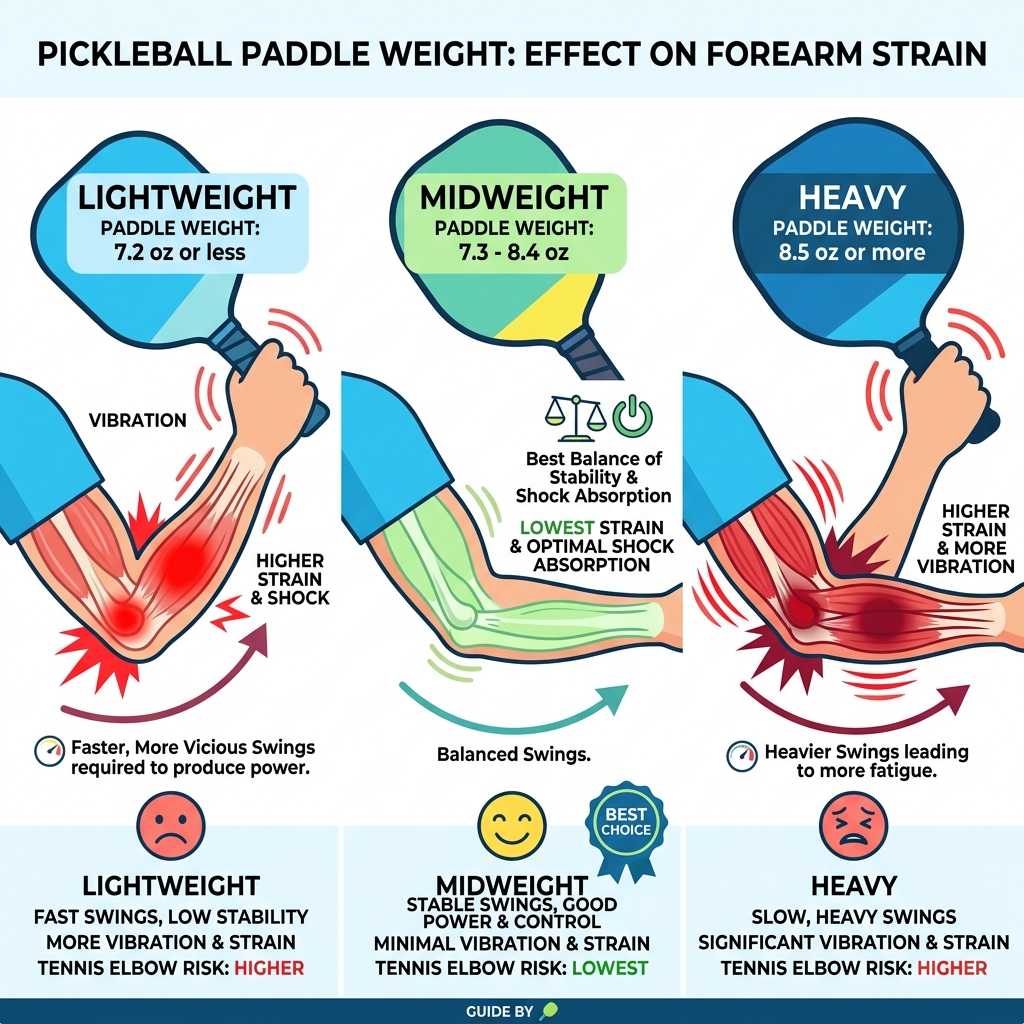
The best pickleball paddle weight for tennis elbow is a midweight paddle in the 7.3 to 8.4 oz range. This weight class balances power and control while reducing the vibration that strains your forearm tendons.
Quick answer:
| Paddle Weight | Category | Tennis Elbow Risk |
|---|---|---|
| 7.2 oz or less | Lightweight | Higher – encourages harder swings |
| 7.3 – 8.4 oz | Midweight | Lowest – best balance of stability and shock absorption |
| 8.5 oz or more | Heavy | Higher – more vibration, more arm fatigue |
That burning ache on the outside of your elbow after a long pickleball session? That is tennis elbow – and it is more common on the pickleball court than most beginners expect.
Tennis elbow (also called lateral epicondylitis) happens when the tendons connecting your forearm muscles to your elbow get overloaded from repetitive motion. Every swing, every dink, every backhand flick puts stress on those tendons. Over time, that stress adds up.
Here is the important part: your paddle weight plays a real role in how much stress reaches your elbow. The wrong weight – whether too light or too heavy – can make things significantly worse.
The good news? Choosing the right paddle weight is one of the simplest changes you can make to protect your arm and stay on the court longer.
Know your best pickleball paddle weight for tennis elbow terms:
Understanding Tennis Elbow in Pickleball
If you have ever felt a sharp pain or a dull ache on the bony bump on the outside of your elbow, you have encountered lateral epicondylitis. In racket sports, we call it tennis elbow, but it is just as prevalent on the pickleball court. We often see it in players who rely too heavily on “wristy” shots or those who haven’t quite mastered their Pickleball Injury Prevention for Beginners routines.
The injury occurs when the tendons in your forearm—specifically those that help you extend your wrist—develop tiny tears from repetitive strain. In pickleball, this often stems from the high-frequency vibrations that travel from the paddle face, through the handle, and directly into your arm.
Expert insights from orthopedic specialists, such as those at Mass General Brigham, suggest that while technique is the root cause, equipment choice acts as a major catalyst. Repetitive wrist flicks, especially on the backhand side, create a “whiplash” effect on the tendon. If your paddle isn’t designed to absorb that shock, your elbow has to do the work instead.
Finding the Best Pickleball Paddle Weight for Tennis Elbow
When we talk about the best pickleball paddle weight for tennis elbow, we are looking for the “Goldilocks” zone. You want a paddle that is heavy enough to provide stability so it doesn’t twist in your hand upon impact, but light enough that you aren’t straining your muscles just to hold it up.
Paddle weight is generally divided into three main categories:
- Lightweight: 7.2 oz or less.
- Midweight: 7.3 to 8.4 oz.
- Heavy: 8.5 oz or more.
While it might seem intuitive to grab the lightest paddle possible to “save” your arm, the science of vibration absorption tells a different story. Heavier objects generally vibrate less than lighter ones when struck by a ball. This is why Navigating Pickleball Paddle Weights: A Guide for Senior Players often emphasizes finding a balance rather than just going as light as possible.
Why Midweight is the Best Pickleball Paddle Weight for Tennis Elbow
The 7.3 to 8.4 oz range is widely considered the sweet spot for players dealing with arm issues. A midweight paddle provides enough mass to plow through the ball without the paddle twisting. When a paddle twists (torque), your forearm muscles have to fire rapidly to stabilize it, which is a leading cause of tendon inflammation.
Furthermore, midweight paddles often feature thicker honeycomb cores (usually 16mm or more) which are excellent at dampening vibrations. This balance of power and shock reduction makes it easier for players Managing Arthritis While Playing Pickleball to stay active without the “sting” of impact.
The Risks of Lightweight and Heavy Paddles
It is a common myth that Lightweight Pickleball Paddles: A Guide for Seniors are always the safest choice. Here is the catch: because a lightweight paddle (under 7.2 oz) lacks mass, you often have to swing much harder to generate power. These faster, more aggressive swings—combined with the fact that light paddles vibrate more on off-center hits—can actually accelerate tennis elbow.
On the flip side, heavy paddles (8.5 oz+) present a different risk. While they absorb vibration well, the sheer weight can lead to muscle fatigue. A tired muscle cannot protect the tendon. If you are struggling to get your paddle into position quickly at the kitchen line, the weight might be causing you to use improper mechanics, leading to a different kind of strain.
Beyond Weight: Features that Reduce Elbow Strain
While static weight is the headline, several other technical features determine if a paddle is truly “arm-friendly.” If you are shopping for the best pickleball paddle weight for tennis elbow, keep an eye on these specifics:
- Core Thickness: A 16mm core is generally better for the elbow than a 13mm or 14mm core. Thicker cores absorb more energy, resulting in a “plush” feel.
- Vibration Dampening Tech: Brands like ProKennex use Kinetic Technology (tiny tungsten beads) to absorb shock. Others, like JOOLA or Engage, use foam-injected walls or specialized polymer cores to kill vibration before it reaches the handle.
- Carbon Fiber Faces: Raw carbon fiber often provides a softer feel compared to stiff fiberglass, which can feel “clattery” and harsh on the joints.
Understanding these materials is key, as we discuss in our guide on Decoding Pickleball Paddle Materials for Beginners.
Swing Weight and the Best Pickleball Paddle Weight for Tennis Elbow
Static weight is what the paddle weighs on a scale. Swing weight is how heavy the paddle feels when you actually move it. This is measured on a scale of 100 to 145.
A paddle with a low swing weight (around 100-110) is much easier on the elbow because it requires less force to start and stop the motion. For example, the Engage Pursuit Pro1 Hybrid is famous for having a swing weight of just 101, despite being a midweight paddle. This “head-light” balance reduces torque on the wrist. You can learn more about balancing your gear in our article on Where to Put the Weight for the Perfect Pickleball Swing.
The Role of Grip Size and Handle Length
We cannot talk about the best pickleball paddle weight for tennis elbow without mentioning the grip. If your grip is too small, you will naturally squeeze the handle tighter to keep it from rotating. This “death grip” keeps your forearm muscles in a state of constant tension, which is a recipe for injury.
Use the index finger test: when you hold the paddle, there should be enough space between your fingertips and the palm of your hand to fit the index finger of your other hand.
- Standard Grip: 4.25 inches.
- Small Grip: Under 4.125 inches.
- Large Grip: 4.5 inches.
For more details, check out our resources on Understanding Pickleball Paddle Grip Size for Seniors and Optimizing Pickleball Grip for Senior Players.
Proactive Strategies to Prevent Pickleball Elbow
Choosing the right equipment is half the battle. The other half is how you use it.
- The Two-Handed Backhand: This is one of the most effective ways to save your elbow. By using your non-dominant hand, you distribute the load across two arms rather than putting all the stress on the outside of one elbow.
- Customization with Lead Tape: If you have a paddle you love but it feels too light or unstable, you can add lead tape. Adding weight to the throat of the paddle can increase stability without making the head feel too heavy.
- Technique Lessons: Often, we “flick” the wrist because we are out of position. Working with a coach to improve footwork can ensure you hit the ball in front of your body using your large muscle groups (legs and core) rather than just your arm.
For specific exercises to build resilience, refer to our Exercise Routines to Strengthen Arms for Pickleball and our tips on Safe Pickleball Techniques for Seniors.
Frequently Asked Questions about Paddle Weight
Is a lighter paddle always better for tennis elbow?
No. While it is easier to move, a very light paddle (under 7.2 oz) provides less stability and absorbs less shock. This often causes players to swing harder and experience more vibration, which can worsen tennis elbow. A midweight paddle is usually the safer bet.
How does core thickness affect elbow pain?
Thicker cores (16mm to 20mm) generally offer more vibration dampening. They have a “denser” feel that absorbs the energy of the ball impact, whereas thinner cores (11mm to 13mm) tend to be stiffer and transfer more shock directly to the player’s arm.
Can I use lead tape to fix a head-heavy paddle?
Yes. If your paddle feels “top-heavy,” it can put extra leverage and strain on your wrist and elbow. By adding small amounts of lead tape to the throat or handle area, you can pull the balance point closer to your hand, making the paddle feel more maneuverable and less taxing on your joints.
Conclusion
At Voce Economia, we believe that the right gear should empower you, not sideline you. Finding the best pickleball paddle weight for tennis elbow is a personal journey, but starting in the midweight range of 7.3 to 8.4 oz is the most evidence-backed strategy to reduce strain.
By combining a stable, vibration-dampening paddle with proper grip size and a commitment to injury prevention, you can stop the sting and focus on what really matters: enjoying the game. For more beginner-friendly advice on choosing the right gear, explore our full Pickleball Equipment Category.
