
Why the Best Pickleball Balls Make or Break Your Game
The best pickleball balls for most players are listed here at a glance:
| Rank | Ball | Best For | Surface |
|---|---|---|---|
| 1 | Franklin X-40 | Most players, beginners | Outdoor |
| 2 | Selkirk Pro S1 | Durability seekers | Outdoor |
| 3 | Vulcan VPRO Flight | Speed and spin | Outdoor |
| 4 | Life Time Pro 48 | Advanced/tournament | Outdoor |
| 5 | Franklin X-26 | Indoor/gym courts | Indoor |
Not all pickleballs are created equal. The ball you play with directly affects how fast the game feels, how high it bounces, and how long it lasts before cracking or going soft.
For beginners especially, a bad ball makes learning much harder. Inconsistent bounce? That’s often the ball, not you.
Here’s what’s at stake: outdoor balls use harder plastic with 40 holes for wind resistance, while indoor balls are softer with 26 holes for smooth gym floors. Use the wrong one on the wrong surface and you’ll deal with unpredictable skids or dead bounces every single rally.
The good news is that the right ball doesn’t have to be expensive. Whether you’re just starting out or playing three times a week, there’s a solid option for your budget and skill level.
Choosing the Best Pickleball Balls: What Really Matters
When we head out to the courts, we often spend hundreds on the latest carbon fiber paddles but then grab whatever dusty ball is at the bottom of our bag. This is a mistake! The ball is the only piece of equipment that touches every single shot. After years of testing different brands, we’ve found that four main factors dictate whether a ball is worth your money: durability, speed, bounce consistency, and weather performance.
Durability is the biggest pain point for most players. There is nothing more frustrating than a ball cracking mid-rally during a heated game. Some balls, like the ONIX Dura Fast 40, are famous for their speed but are notorious for cracking quickly, especially in cold weather. On the other hand, balls like the Franklin X-40 are much more resilient but can become “squishy” over time, losing their pop.
Speed and spin accessibility also vary wildly. A “fast” ball is usually harder and smoother, cutting through the air quickly. A “slow” ball is often softer or has a slightly textured surface, allowing for better “bite” on the paddle for spin. If you are playing against hard hitters, a faster ball makes the game lightning-quick, which can be a thrill or a nightmare depending on your reaction time.
Finally, we have to consider Scientific research on ball aerodynamics and durability. The way a ball is manufactured—whether it’s roto-molded as one piece or injection-molded and then fused—changes how it flies. A seamless one-piece construction generally offers a truer flight, meaning the ball won’t “wobble” mid-air.
Finding the Best Pickleball Balls for Beginners
If you are just starting your pickleball journey, we highly recommend staying away from the “pro-level” fast balls. Beginners need a ball that is slightly softer and slower. Why? Because a slower ball gives you more time to react, find your positioning, and execute a proper swing.
The best pickleball balls for beginners are usually those that offer high visibility and a consistent, predictable bounce. We love neon green or optic yellow for this reason—they pop against almost any court surface. A softer ball also tends to be more “forgiving” on the arm and shoulder, which is great if you aren’t used to the repetitive motion of the game yet. For a deeper dive into the specific nuances of starting out, check out our More info about beginner balls.
The Best Pickleball Balls for Professional Tournament Play
In professional pickleball, the “official ball” is a big deal. Until recently, the ONIX Dura Fast 40 and Franklin X-40 dominated the scene. However, 2024 and 2025 brought major shifts.
The PPA Tour (Professional Pickleball Association) signed a landmark deal with Vulcan to use the Vulcan VPRO Flight as their official ball. Meanwhile, the Life Time Pro 48 has emerged as a serious contender for high-level play, often preferred by pros like Zane Navratil for its incredible speed and “true” bounce. These balls are much more rigid than recreational balls. This rigidity allows for maximum power transfer, but it also means they are more prone to breaking if you play in temperatures below 50°F.
Top-Rated Outdoor Balls for 2025 and 2026
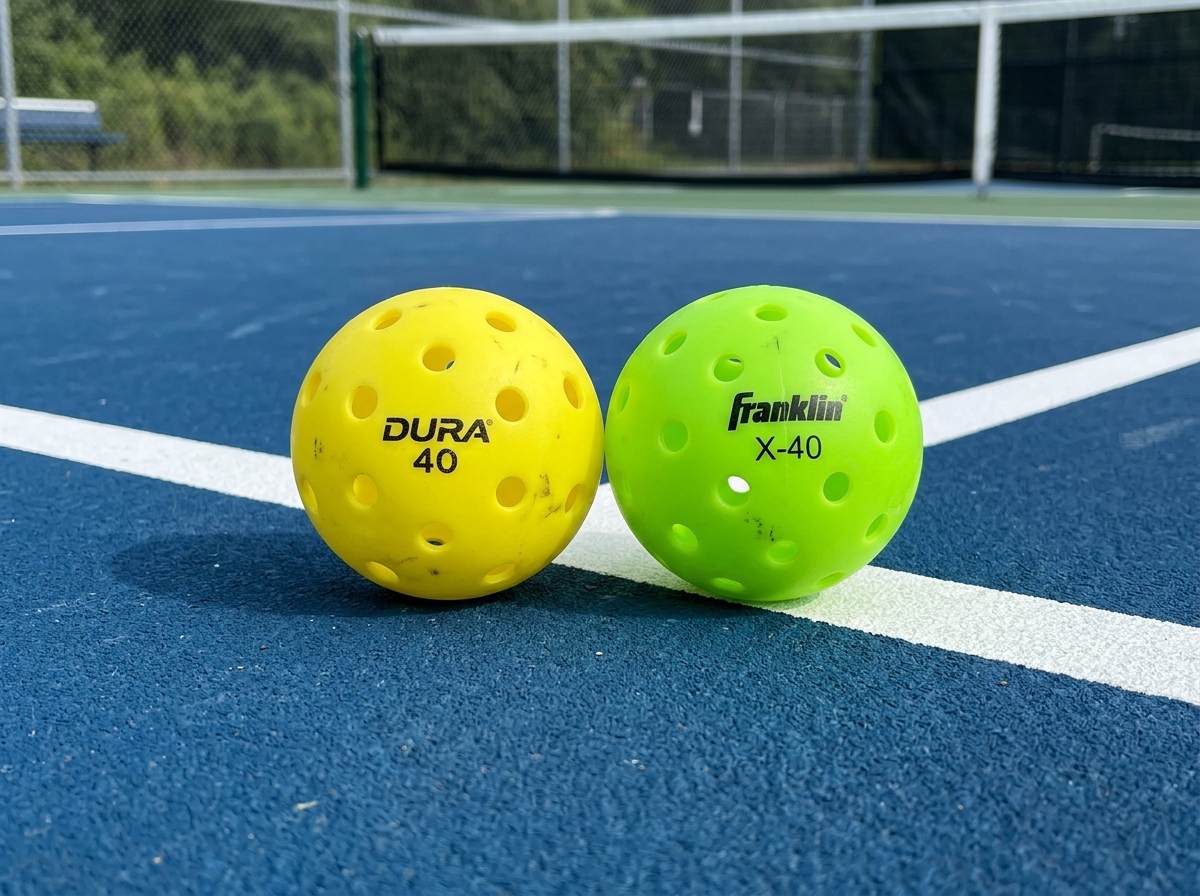
Outdoor pickleball is a different beast. You’re dealing with wind, rough asphalt or concrete surfaces, and varying temperatures. The best pickleball balls for outdoor use are built with 40 precision-drilled holes to help the ball fly straight even when there’s a breeze.
- Franklin X-40: This remains our “Best Overall” pick. It strikes a perfect balance between price, durability, and performance. It has a 4.7/5 rating from hundreds of players and is the official ball of the US Open Pickleball Championships. It lasts about 20-30 games before it starts to lose its shape.
- Selkirk Pro S1: If you hate buying new balls every week, this is your winner. It features a unique 38-hole pattern and an industry-first one-year no-crack warranty.
- Vulcan VPRO Flight: The current choice for the PPA Tour. It’s engineered for mathematically perfect roundness, which prevents those annoying “flat spots” that cause bad bounces.
- Life Time Pro 48: A newcomer that has quickly replaced the Dura Fast 40 as the “speed king.” It’s incredibly fast and consistent, making it a favorite for advanced players.
- ONIX Dura Fast 40: The old-school choice. It’s the fastest ball on the market but has the shortest lifespan. Many “Dura lovers” won’t play with anything else because of how crisp it feels.
The Most Durable Pickleball Ball Options
When we talk about durability, we aren’t just talking about the ball not breaking. We are talking about the ball maintaining its “roundness.” Many cheap balls will “egg”—meaning they warp into an oval shape—after just one session.
The Selkirk Pro S1 is currently the gold standard for longevity. We’ve tested these in chilly conditions where other balls shattered like glass, and the Pro S1 held up beautifully. The fact that you can literally send them back if they crack is a game-changer for frequent players. For more details on how to take advantage of this, see the Selkirk Pro S1 Warranty Info.
Best Speed and Performance Balls
For the speed demons out there, the Vulcan VPRO Flight and Life Time Pro 48 are the top dogs. These balls use an “ultra-purified resin” formula. This high-end plastic is denser and more uniform, which results in a higher bounce (around 33.5 inches) and faster flight.
The Vulcan VPRO Flight, in particular, is designed for “aggressive play.” If you are a power player who loves to drive the ball from the baseline, you will feel the difference in how this ball leaves your paddle. It feels “crisp” rather than “mushy.”
Indoor vs. Outdoor: Surface-Specific Selection
One of the most common questions we get at Voce Economia is: “Can I just use the same ball everywhere?” Technically, yes, but you won’t have a good time.
Indoor balls (like the Franklin X-26) are lighter and have 26 larger holes. They are designed to be used on smooth surfaces like wooden basketball courts or tiled gym floors. Because these surfaces are slippery, an indoor ball is made of a “grippier” plastic to prevent it from skidding across the floor.
Outdoor balls have 40 smaller holes and are heavier (roughly 0.9 oz). This weight is crucial for wind resistance. If you take an indoor ball outside, the slightest breeze will carry it away like a kite. Conversely, if you use an outdoor ball on a gym floor, it will feel like you’re hitting a rock, and it will skid dangerously fast. For more on making the right choice, read our guide on More info about ball selection for beginners.
Best Indoor Pickleball Balls
For indoor play, specifically on gymnasium flooring, the Franklin X-26 is the undisputed leader. It has a 4.5/5 rating and is designed specifically to provide a consistent bounce on wood or vinyl. Another great option is the ONIX Fuse Indoor, which is slightly softer and offers great touch for players who prefer a “dink” heavy game.
Specialized Balls for Extreme Conditions
Nature doesn’t always cooperate with our pickleball schedule. If you live in a place with harsh winters or high winds, you need specialized gear.
- Cold Weather: Standard balls become brittle in the cold. The PCKL Elite 40 and JOOLA Heleus use a polyethylene blend that resists cracking even when temperatures drop.
- High Wind: The Core Pro Pickleball is engineered with precision-drilled holes specifically to optimize airflow, making it one of the best options for windy coastal courts.
- Eco-Friendly: Most pickleballs take 100+ years to decompose. The Komodo Bio Ball is a fascinating innovation that breaks down in just 3-5 years in a landfill while still offering performance comparable to a Franklin X-40.
Frequently Asked Questions
How long do pickleball balls typically last?
On average, a high-quality outdoor ball like the Franklin X-40 or Vulcan VPRO Flight will last between 20 and 30 games. However, “lasting” is subjective. A ball might not crack, but it can “go soft” or “egg.” If you notice the ball feels squishy or isn’t bouncing as high as it used to, it’s time to swap it out. Advanced players often change balls every 5-10 games to ensure maximum performance.
Can you use outdoor balls on indoor courts?
You can, but it’s not ideal. If you are playing on a dedicated “indoor” court that has a rough, tennis-court-like surface (Acrylotex), you should actually use an outdoor ball. However, if you are playing in a church gym or a YMCA on a basketball court, an outdoor ball will skid and move way too fast. We recommend sticking to 26-hole indoor balls for gym floors.
What are the official tournament-approved ball regulations?
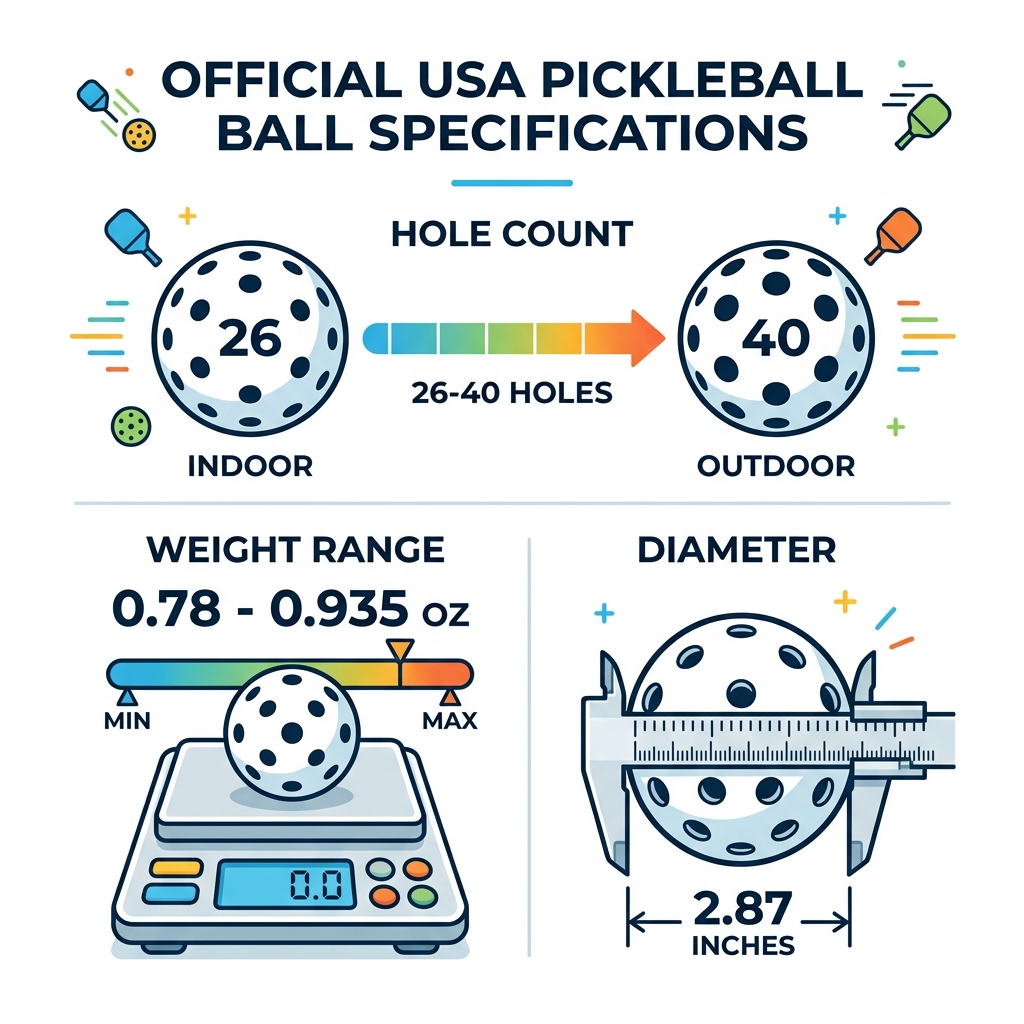
According to USA Pickleball, an approved ball must meet these specs:
- Holes: 26 to 40 circular holes.
- Weight: 0.78 to 0.935 ounces (22.1 to 26.5 grams).
- Size: 2.87 inches (73mm) in diameter.
- Bounce: When dropped from 75 inches onto concrete, it must bounce between 30 and 34 inches.
Conclusion
At Voce Economia, we believe that the best pickleball balls are the ones that let you focus on your game rather than your equipment. For 90% of players, the Franklin X-40 is the gold standard—it’s reliable, affordable, and accepted at almost every court in the country. If you’re tired of balls cracking, spend the extra few dollars on the Selkirk Pro S1.
Buying in bulk is almost always the better financial move. You can often find 100-packs of top-tier balls that bring the price per ball down to under $2.00, compared to $4.00 or more for a single 3-pack at a retail store.
Stop playing with “dead” or warped balls. Your game (and your teammates) will thank you for bringing a fresh, high-quality ball to the next session. For more tips on finding the right gear to level up your play, check out our other More info about pickleball equipment.
