
Is Your Ball Dead? Use These Simple Tests to Find Out
Is Your Pickleball Dead? Here’s How to Tell in Seconds
The pickleball balls bounce test is the fastest way to know if your ball is still game-ready — or quietly ruining your game.
Quick answer: Drop your ball from 78 inches onto a hard surface. If it bounces back between 30 and 34 inches, it passes. Below 30 inches means the ball is dead. Above 34 inches means it’s too lively for fair play.
| Bounce Height | What It Means |
|---|---|
| Below 30 inches | Ball is dead — replace it |
| 30–34 inches | Ball passes — good to play |
| Above 34 inches | Ball is too bouncy — not legal for tournament play |
This is the same standard USA Pickleball uses in official equipment testing, conducted at 70°F on a granite surface.
Here’s the thing most beginners don’t realize: a ball can look perfectly fine and still be dead. No visible cracks. No obvious dents. But the bounce is off, and suddenly your dinks are floating, your returns feel sluggish, and you can’t figure out why your game feels wrong.
The ball is the problem.
Balls wear out faster than most players expect. According to testing data, even a popular ball like the Franklin X-40 can noticeably soften after just 7 to 10 games. In hot weather above 90°F, some balls go soft even faster.
The good news? You don’t need a lab to test your ball. A measuring tape, a hard floor, and 30 seconds is all it takes.
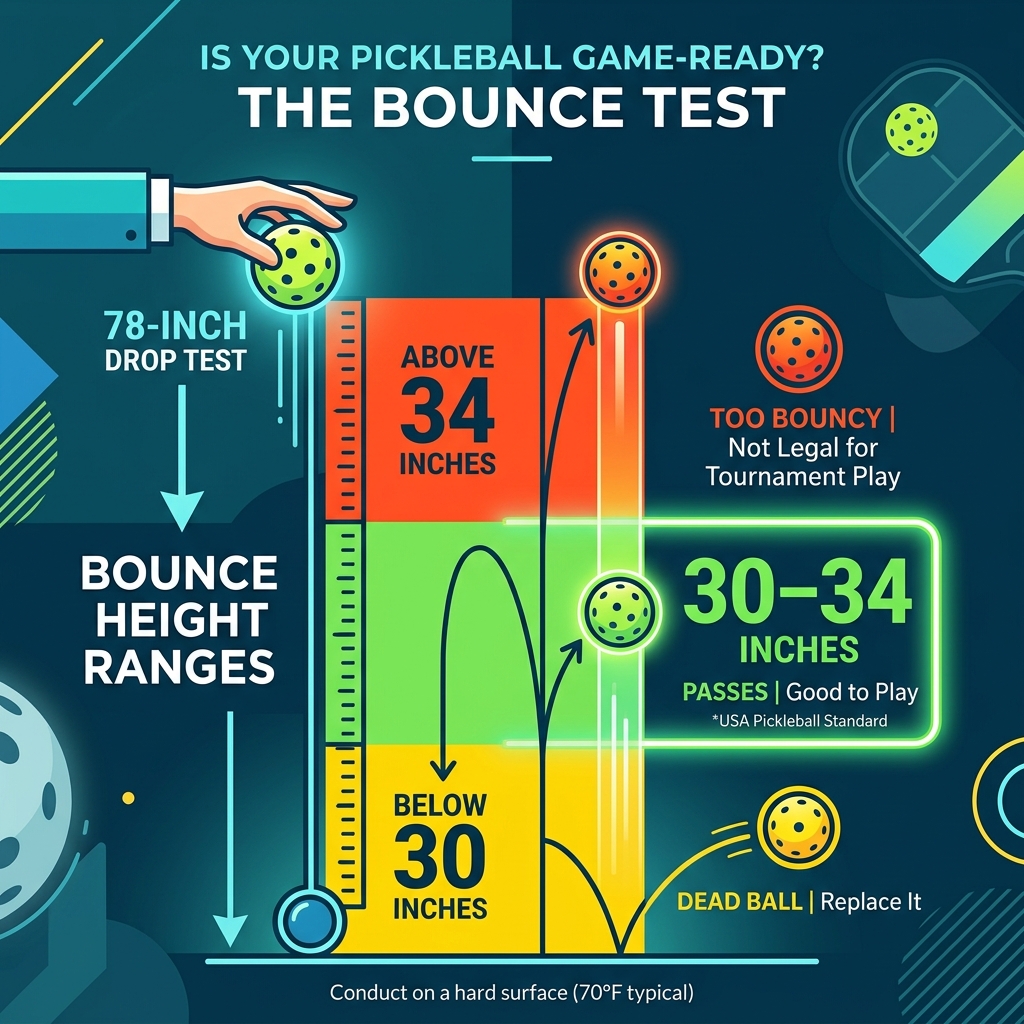
The Official USA Pickleball Balls Bounce Test Standard
When we talk about equipment integrity, we look to the USA Pickleball Equipment Standards Manual. This is the “bible” for manufacturers to ensure every ball used in a sanctioned tournament behaves exactly the same way. The goal is fairness; no player should lose because the ball they were given was “mushy” or “rocket-powered.”
The official pickleball balls bounce test is a precision science. Here are the specific requirements used in the lab:
- Drop Height: Exactly 78 inches (198.1 cm) from the bottom of the ball to the surface.
- Surface: A smooth, level granite block. Granite is used because it doesn’t absorb energy, ensuring the bounce comes entirely from the ball’s elasticity.
- Temperature: 70°F (plus or minus 5 degrees). Temperature is critical because plastic becomes more brittle in the cold and softer in the heat.
- Rebound Range: The ball must bounce back to a height of 30 to 34 inches (76.2 to 86.4 cm).
Beyond just the height, USA Pickleball checks for “out-of-round” variance. A ball cannot vary more than +/-0.020 inches in diameter. If a ball isn’t perfectly round, it will wobble in the air and bounce unpredictably, which is a nightmare for skill development.
How to Perform a DIY Evaluation
We know most of you don’t have a granite block and a climate-controlled lab in your garage. That shouldn’t stop you from checking your gear! Performing a DIY pickleball balls bounce test is essential, especially if you are finding the best pickleball balls for beginners and want to ensure you aren’t practicing with “duds.”
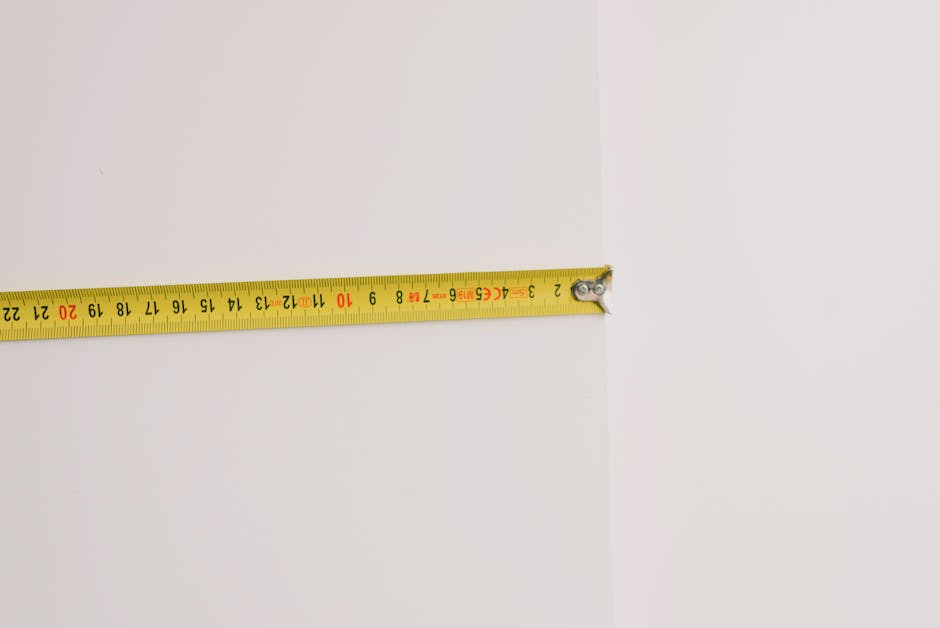
To get an accurate reading at home, you need a vertical scale (like a measuring tape taped to a wall) and a very hard, flat surface. Concrete or tile works best. Avoid wood gym floors or asphalt if possible, as these can slightly dampen the bounce compared to the official granite standard.
Setting Up Your Home Pickleball Balls Bounce Test
Follow these steps for a reliable home test:
- Find a Wall: Tape a measuring tape to a flat wall. Mark the 78-inch line (the drop point) and the 30-34 inch “Success Zone.”
- Check the Temp: Ensure your balls have been sitting at room temperature (around 70°F) for at least an hour. Testing a ball you just pulled out of a 40°F trunk will give you a false “dead” reading.
- The Drop: Hold the ball so the bottom is exactly at the 78-inch mark.
- No-Pressure Release: Do not “throw” or “flick” the ball down. Simply open your fingers and let gravity do the work.
- Eye-Level Measurement: Squat down so your eyes are level with the 30-34 inch marks. This prevents “parallax error,” where looking down at the tape makes the bounce seem higher than it actually is.
Interpreting Your Pickleball Balls Bounce Test Results
If your ball hits the 30-34 inch range, it’s in its prime. But what if it doesn’t?
- The “Dead” Ball (Below 30 inches): This indicates a loss of compression or material fatigue. The ball has lost its “energy return.” In a game, this ball will feel heavy on your paddle and won’t clear the net as easily. It’s time to stop playing with bad balls and get the best instead.
- The “Hot” Ball (Above 34 inches): Some budget balls or brand-new “fast” balls (like the Dura Fast 40 or the Life Time Pro 48) can sometimes approach or slightly exceed the upper limit. While great for power, they can be harder to control in soft dink exchanges.
- The Wobble: If the ball bounces off to the side rather than straight up, it is “out-of-round.” This usually happens after a ball has been hit hard enough to permanently deform the plastic.
Why Balls Lose Their Pop: Temperature and Degradation
Pickleballs are made of plastic, and plastic is highly sensitive to the environment. Understanding this helps us explain why a ball that passed the pickleball balls bounce test yesterday might fail today.
Temperature Sensitivity
Research shows that temperature is the biggest factor in ball performance.
- Cold Weather (<50°F): The plastic becomes brittle. While the bounce might stay consistent for a while, the ball is much more likely to develop hairline fractures or shatter completely. Balls like the Selkirk Pro S1 are specifically engineered to resist this cold-weather cracking.
- Hot Weather (>90°F): The plastic softens. A ball like the Franklin X-40 is known to get “mushy” in high heat, leading to a “lame bounce.” Interestingly, some balls like the Onix Fuse G2 actually maintain a better bounce in extreme heat compared to their competitors.
Material Fatigue
Every time you hit the ball, the plastic deforms and then snaps back. Over time, the polymer chains in the plastic break down. This is called “compression loss.” A ball might lose 10% of its stiffness after just 7 to 15 games. For a pro, that 10% is the difference between a winning put-away and a ball that gets returned.
Construction Science: Roto-Molded vs. Injection-Molded
Not all balls are created equal. The way a ball is manufactured directly impacts how it performs in a pickleball balls bounce test.
| Feature | Roto-Molded (e.g., Franklin X-40, Dura Fast 40) | Injection-Molded (e.g., Selkirk Pro S1) |
|---|---|---|
| Process | Hollow mold rotated in an oven | Two halves joined/welded together |
| Seams | Seamless (one continuous piece) | Has a visible or internal seam |
| Durability | Generally higher; resists splitting | Can split at the seam if poorly welded |
| Bounce | Very consistent and predictable | Can vary if wall thickness isn’t uniform |
| Hardness | Usually 40-50 on Shore D scale | Varies; can be engineered for “touch” |
The Role of Holes
The number of holes also plays a role. Outdoor balls typically have 40 holes, which are smaller to resist wind interference. Indoor balls have 26 larger holes. Because outdoor balls are made of harder plastic (to survive concrete courts), they naturally have a crisper bounce than the softer, lighter indoor versions.
Frequently Asked Questions about Pickleball Testing
How often should I perform a bounce test?
For casual play, we recommend testing your balls once a month or whenever the game starts to feel “slow.” If you are training for a tournament, you should test your balls before every practice session. A ball can lose significant “pop” in just 10 games of intense play.
Does the color of the ball affect its bounce?
Technically, no. The pigment used in the plastic doesn’t change the rebound characteristics. However, visibility affects your perception of the bounce. “Optic Yellow” or neon green is the industry standard because it provides the best contrast against blue and green courts, helping you track the ball’s flight and apex more accurately.
Can I use outdoor balls for indoor testing?
Yes, and many competitive players actually prefer this. Since most high-level indoor tournaments are played on “Pickleroll” or hard court surfaces (rather than wood), using an outdoor ball provides a truer, faster bounce that replicates tournament conditions. Just be aware that a hard outdoor ball will bounce much higher on a wooden gym floor than a standard indoor ball.
Conclusion
At Voce Economia, we believe that understanding your gear is the first step toward mastering the game. The pickleball balls bounce test isn’t just for the pros; it’s a vital tool for any player who wants to ensure their practice sessions are productive and their games are fair.
By keeping an eye on your ball’s rebound height, watching for out-of-round wobbles, and staying mindful of how temperature affects your equipment, you’ll develop a better “feel” for the game. Don’t let a dead ball hold back your skill development. If it doesn’t hit that 30-inch mark, toss it in the bin and grab a fresh one.
Ready to upgrade your gear? Explore more pickleball equipment guides to find the perfect ball for your playing style and local climate. Happy playing!
