
Don’t Get Blown Away: Choosing the Best Outdoor Pickleball Balls
Why the Ball You Pick Changes Everything on the Court
Outdoor vs indoor pickleball balls are not the same product — and grabbing the wrong one is one of the most common mistakes new players make.
Here’s a quick breakdown of the key differences:
| Feature | Indoor Ball | Outdoor Ball |
|---|---|---|
| Number of holes | 26 (larger) | 40 (smaller) |
| Hole diameter | ~0.43 inches | ~0.282 inches |
| Weight | ~0.917 oz | ~0.925 oz |
| Material | Soft plastic (LDPE/EVA) | Hard plastic (HDPE) |
| Best for | Gym floors, controlled play | Asphalt, concrete, wind |
| Durability mode | Softens over time | Cracks, especially in cold |
The short version: use indoor balls on gym floors, outdoor balls on hard courts outside. Mixing them up leads to shots that float, bounce unpredictably, or wear out way too fast.
If you’re just starting out, this matters more than you might think. Inconsistent bounces and balls that break after a few sessions are not a skill problem — they’re often a wrong-ball problem.
The physical differences between the two types come down to hole count, hole size, material hardness, and weight. Each of those affects how the ball flies, bounces, and holds up over time. We’ll dig into all of it below.
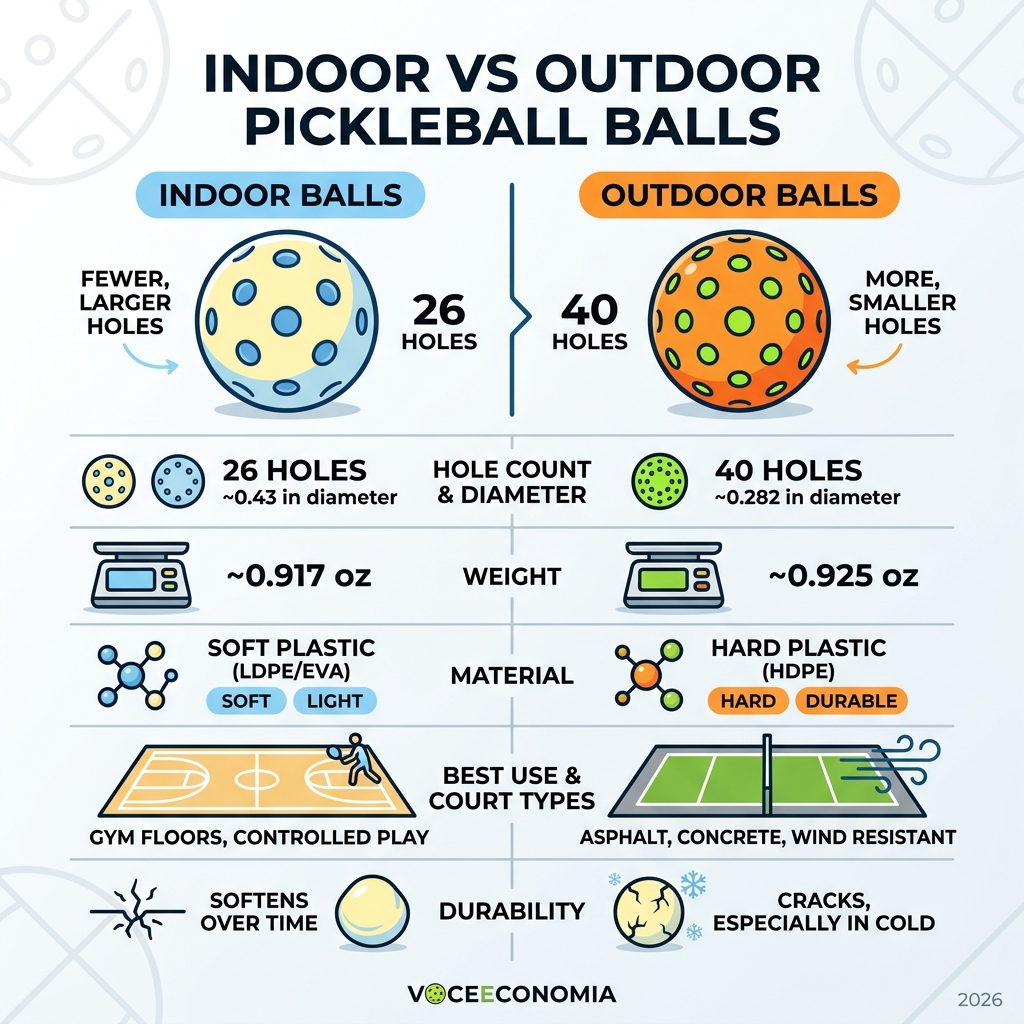
Know your outdoor vs indoor pickleball balls terms:
The Core Differences: Outdoor vs Indoor Pickleball Balls
When we first step onto a court, all pickleballs look like slightly glorified Wiffle balls. But as we soon learn, the engineering behind these plastic spheres is surprisingly precise. To understand the outdoor vs indoor pickleball balls debate, we have to look at the anatomy of the ball itself.
Hole Count: 26 vs. 40
The most immediate way to tell the difference is to count the holes—though we don’t recommend doing that mid-match! Indoor pickleballs typically feature 26 holes. These holes are significantly larger than their outdoor counterparts. Why? Larger holes create more aerodynamic drag, which naturally slows the ball down. This is perfect for indoor environments where we want more control and longer rallies.
On the other hand, outdoor pickleballs almost always have 40 holes. These holes are smaller and more closely packed. This design is all about wind neutralization. By having more, smaller holes, the ball can “cut” through the wind more effectively, preventing a sudden gust from carrying your perfect lob into the next zip code. You can learn more about these design nuances in this guide on The difference between indoor and outdoor pickleballs.
Hole Diameter and Weight
The size of those holes isn’t just for show. Indoor ball holes average about 0.43 inches in diameter, which is roughly 40% larger than the 0.282-inch holes found on outdoor balls.
Weight is another subtle but critical factor. While USA Pickleball standards allow for a range, outdoor balls lean toward the heavier side. An average indoor ball weighs approximately 0.917 oz, while an outdoor ball sits at roughly 0.925 oz. While a difference of less than 1% sounds tiny, it’s enough to make the outdoor ball feel more stable and “sturdy” when you’re battling a crosswind.
Plastic Hardness: HDPE vs. LDPE
The “feel” of the ball comes down to the chemistry of the plastic. Outdoor balls are typically made from High-Density Polyethylene (HDPE). This is a rigid, hard plastic designed to withstand the cheese-grater effect of asphalt and concrete.
Indoor balls use softer plastics like Low-Density Polyethylene (LDPE) or EVA blends. This makes them “squishier” and quieter on impact. It also means they won’t crack as easily, but they do have a tendency to lose their shape or go “mushy” after a few hours of intense play.
Technical Specifications and USA Pickleball Standards
To keep the game fair, USA Pickleball maintains a rigorous USA Pickleball approved ball list. If you’re planning on playing in any sanctioned tournament, your ball must meet these specific metrics.
Diameter and Weight Requirements
Every approved pickleball must have a diameter between 2.87 and 2.97 inches. This ensures that no matter which brand you buy, the ball fits the “standard” size we’ve all practiced with. As for weight, the official range is 0.78 to 0.935 ounces (22.1 to 26.5 grams).
The 78-Inch Bounce Test
One of the coolest (and easiest to replicate at home) tests is the bounce test. An approved ball must bounce between 30 and 34 inches when dropped from a height of 78 inches onto a granite surface at 70°F. If your ball is bouncing like a superball or dying on the floor like a wet noodle, it’s time to stop-playing-with-bad-balls-and-get-the-best-instead.
Other requirements include:
- Uniform Color: The ball must be a single, consistent color so it’s easy to track.
- Untextured Surface: No “grippy” textures are allowed; the plastic must be smooth.
- Durability: The material must be able to withstand high-velocity impacts without shattering immediately.
Performance and Gameplay: The Surface Rule
There is a common myth that “indoor” means “under a roof” and “outdoor” means “under the sun.” We like to use what we call the Surface Rule. The ball you choose should be dictated by the surface beneath your feet, not whether there’s a ceiling above your head.
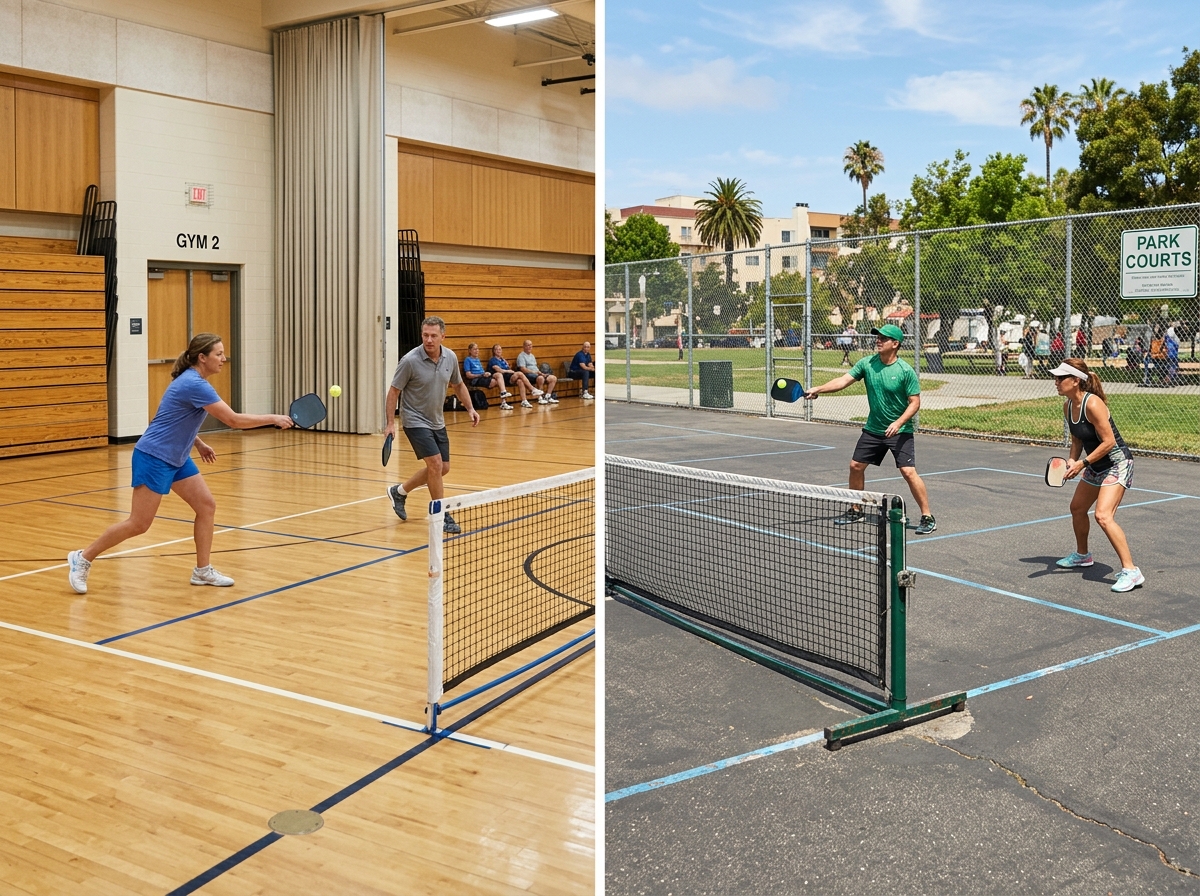
The Surface Rule in Action
If you are playing inside a converted gymnasium on a wooden or rubber floor, you need an indoor ball. The softer plastic of an indoor ball “grips” the smooth wood better, providing a predictable bounce.
However, if you are playing inside a dedicated pickleball facility that uses an acrylic “hard court” surface (the gritty stuff found on tennis courts), you should actually use an outdoor ball! An indoor ball on a gritty acrylic surface will bounce inconsistently and wear out in minutes. Conversely, an outdoor ball on a wooden gym floor will “skid” and play way too fast, making the game feel frantic and out of control.
Aerodynamics and Wind Resistance
In the outdoor vs indoor pickleball balls performance battle, wind is the ultimate decider. Outdoor balls are designed with a “turbulent boundary layer” in mind. The 40-hole pattern helps the ball maintain a straight flight path even when the wind is blowing. Indoor balls, with their 26 large holes, act like “air brakes.” They catch the air, which is great for control in a still gym but a nightmare in a breeze. Using an indoor ball outside in Kansas City or Florida is a recipe for frustration; your shots will “balloon” and sail long.
The Acoustic Reality
Let’s talk about the “pop.” Outdoor balls are harder and create a higher-pitched sound—roughly 1.2 kHz. Interestingly, this is the same frequency as a garbage truck’s backup beeper, which is why some residential communities have strict rules about which balls can be used. Indoor balls have a much more muted, lower-pitched sound that is friendlier for echo-prone gymnasiums.
For the full list of technical requirements, you can always consult the USA Pickleball Equipment Standards.
Performance Impacts of Outdoor vs Indoor Pickleball Balls
- Ball Speed: Outdoor balls are significantly faster. If you like a “power game,” the outdoor ball is your best friend.
- Control and Finesse: Indoor balls are the kings of the “soft game.” They allow for more “dwell time” on the paddle, giving you a split second more to aim that perfect dink.
- Spin Potential: Because outdoor balls are harder, they don’t “grab” the paddle face as much as a softer indoor ball. However, their speed often makes up for the slight reduction in spin.
- Reaction Time: You’ll need quicker reflexes for outdoor play. The firmer bounce and aerodynamic design mean the ball gets to you faster.
Durability, Weather, and Maintenance
Nothing ruins a good Saturday morning rally like a ball that suddenly flies sideways. Understanding how these balls fail is key to keeping your game consistent.
Cracking vs. Softening
Outdoor balls fail by cracking. Because they are made of rigid HDPE, the stress of the paddle eventually causes a hairline crack to form, usually starting at one of the holes. Indoor balls rarely crack; instead, they “go soft.” They lose their internal tension and become “mushy,” eventually developing flat spots or becoming “out-of-round” (lopsided).
The 50°F Temperature Threshold
Temperature is the natural enemy of the outdoor pickleball. When the thermometer dips below 50°F, the hard plastic becomes brittle, almost like glass. One hard overhead smash in 40-degree weather can shatter a brand-new outdoor ball instantly. If you’re playing in the cold, we recommend keeping your spare balls in your pocket or a warm bag to keep the plastic flexible.
In extreme heat (above 90°F), the opposite happens. Outdoor balls can become “mushy” and lose their bounce, making the game feel sluggish. For more on keeping your gear in top shape, check out our guide on finding-the-best-pickleball-balls-for-beginners-2.
Visibility and Color
Color isn’t just about aesthetics; it’s about contrast.
- Optic Yellow: The gold standard for outdoor play. it stands out perfectly against blue or green courts and the blue sky.
- Neon Orange/Lava Red: Often better for indoor play. In gymnasiums with light-colored wood floors and bright LED overheads, yellow balls can “wash out.” A darker orange or red ball is much easier to track against a gym wall.
Maintenance Tips
- Clean the Grit: Outdoor balls pick up dust and sand from the court. Wipe them down with a damp cloth; that grit acts like sandpaper on your expensive paddle face!
- Rotate Your Balls: Don’t just play with one ball until it dies. Rotate through a set of three or four during a session to even out the “heat cycles” and help them last longer.
- The Spin Test: Not sure if your ball is “out-of-round”? Spin it on a flat surface. If it wobbles or “eggs” instead of spinning smoothly, it’s time to retire it.
Choosing the Right Ball for Your Environment
So, which one should you put in your bag? For most of us, the answer is “both.” If you’re a regular player, you’ll likely find yourself switching between community center gyms and public park courts.
Hybrid Pickleballs
Some brands offer “hybrid” balls marketed for both indoor and outdoor play. While these are convenient, they are often a compromise. They usually have about 32 holes. We find they are often too light for a truly windy day and a bit too hard for a polished wood floor. They are great for driveway practice or casual family games, but for competitive play, we suggest sticking to dedicated indoor or outdoor balls.
Skill Level and Training Goals
If you are a total beginner, we often recommend starting with indoor balls, even if you’re playing in a garage or on a smooth driveway. The slower pace and more forgiving bounce give you more time to develop your swing mechanics. As you get more comfortable and move to the local park, you can graduate to the faster outdoor balls. You can find more tailored advice in our guide for finding-the-best-pickleball-balls-for-beginners.
Bulk Buying
Pickleballs are a consumable item. Competitive outdoor players might go through two or three balls in a single session! We always suggest buying in bulk (packs of 12, 24, or 48) to save between 15% and 25% per ball.
Selecting Between Outdoor vs Indoor Pickleball Balls for Beginners
- Choose Indoor if: You play at the YMCA, you want longer rallies, or you find the game is moving too fast for you to keep up.
- Choose Outdoor if: You play at dedicated outdoor courts, you want to practice for a local tournament, or you live in a windy area.
Frequently Asked Questions
Can you use indoor pickleballs outdoors and vice versa?
Technically, yes, but we don’t recommend it. If you take an indoor ball outside, the wind will toss it around like a balloon. If you take an outdoor ball inside to a gym, it will skid across the floor and sound like a gunshot every time you hit it. Always try to match the ball to the surface.
Why are outdoor pickleballs harder than indoor pickleballs?
Outdoor balls need to be harder to resist the abrasive surfaces of asphalt and concrete. They also need that rigidity to maintain their shape and speed when flying through the wind. Indoor balls are softer to provide better “grip” and control on smooth surfaces.
How many holes do indoor pickleballs have compared to outdoor pickleballs?
Indoor balls typically have 26 larger holes to slow the ball down. Outdoor balls have 40 smaller holes to help the ball stay stable in the wind.
Conclusion
At Voce Economia, we believe that understanding your gear is the first step toward mastering the game. The outdoor vs indoor pickleball balls distinction might seem small at first, but it defines your tactical ceiling. Choosing the right ball ensures that your dinks stay low, your drives stay true, and your equipment lasts as long as possible.
Whether you’re dinking in a climate-controlled gym or smashing overheads under the summer sun, having the right ball in your pocket changes the game. Don’t let a “wrong-ball problem” hold back your progress!
For more tips on optimizing your setup, check out More info about pickleball equipment. See you out on the court!
