
Advanced Pickleball Transition Shots: Don’t Get Pickled in the Middle
The Transition Zone Is Where Pickleball Matches Are Actually Won or Lost
Advanced pickleball transition shots are the strokes you play in the space between the baseline and the kitchen line (officially known as the Non-Volley Zone) — and mastering them is what separates a 3.5 player from a 5.0.
Here’s a quick breakdown of what you need to know:
- Reset shot: A soft, controlled shot that neutralizes a hard incoming ball and drops it into the kitchen
- Hybrid roll: A low, forward-spinning third-shot drop that arrives faster and stays lower than a traditional drop
- Split step: A small hop that stops your momentum so you can react in any direction
- Attack or reset decision: Based on ball height — chest-high or above means attack, below the waist means reset
- Transition to kitchen: Takes 2-3 shots against a good opponent, not one
Most recreational players lose points trying to get to the kitchen — not at the kitchen itself. They rush forward, make panicky shots, and get caught mid-stride by an aggressive opponent.
The good news? The transition zone doesn’t have to be dangerous. With the right shots, footwork, and decision-making, it can actually become your biggest offensive weapon.
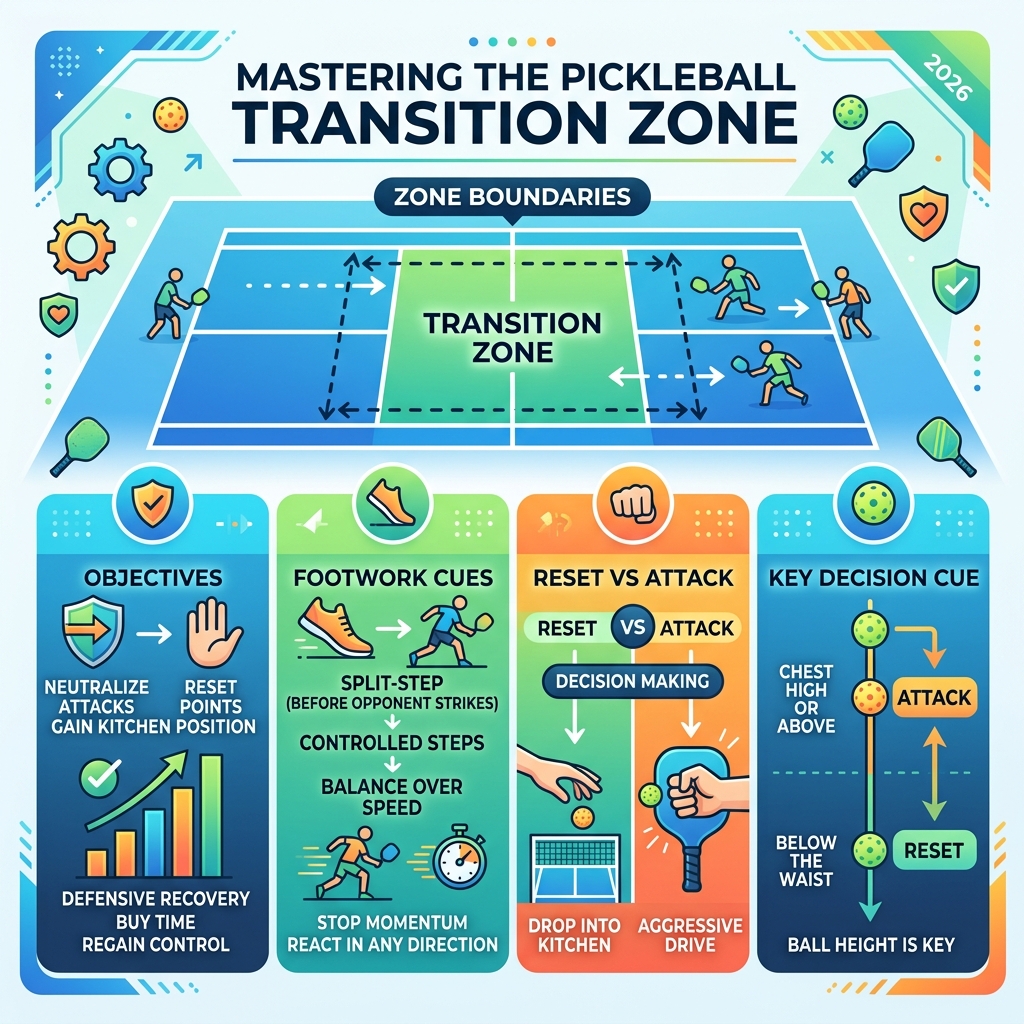
The Anatomy of the Transition Zone: Why It’s Not “No Man’s Land”
In many racket sports, the middle of the court is a place of doom. In pickleball, we often hear it called “No Man’s Land,” a term that suggests you should never be caught there. However, at the advanced level, we view this area differently. It is the “Transition Zone,” a strategic bridge that allows us to move from a defensive position at the baseline to an offensive one at the kitchen.
The primary objective in this zone is defensive recovery. When we hit a third-shot drop or a reset, we aren’t just hitting a ball; we are buying time. If you treat this area like a radioactive wasteland and sprint through it, you lose your balance. Understanding understanding-court-positions-in-pickleball-for-seniors is vital because it teaches us that court positioning is about the relationship between where the ball is and where our feet are.
Neutralizing attacks is the name of the game here. If an opponent blasts a drive at your feet while you are halfway to the net, you can’t keep running. You must stop, stabilize, and use an advanced pickleball transition shot to drop the ball softly into the opponent’s kitchen. This forces them to hit upward, giving you the “green light” to finally earn your stay-out-of-the-kitchen-with-this-printable-pickleball-rules-pdf access. Strategic movement means realizing that getting to the net is often a two or three-shot process, not a single mad dash.
Mastering the Reset: The Core of Advanced Pickleball Transition Shots
The “reset” is perhaps the most important shot in a high-level player’s arsenal. It is a soft block intended to take all the pace off an opponent’s attack. Think of it as the ultimate “delete” button for your opponent’s power.
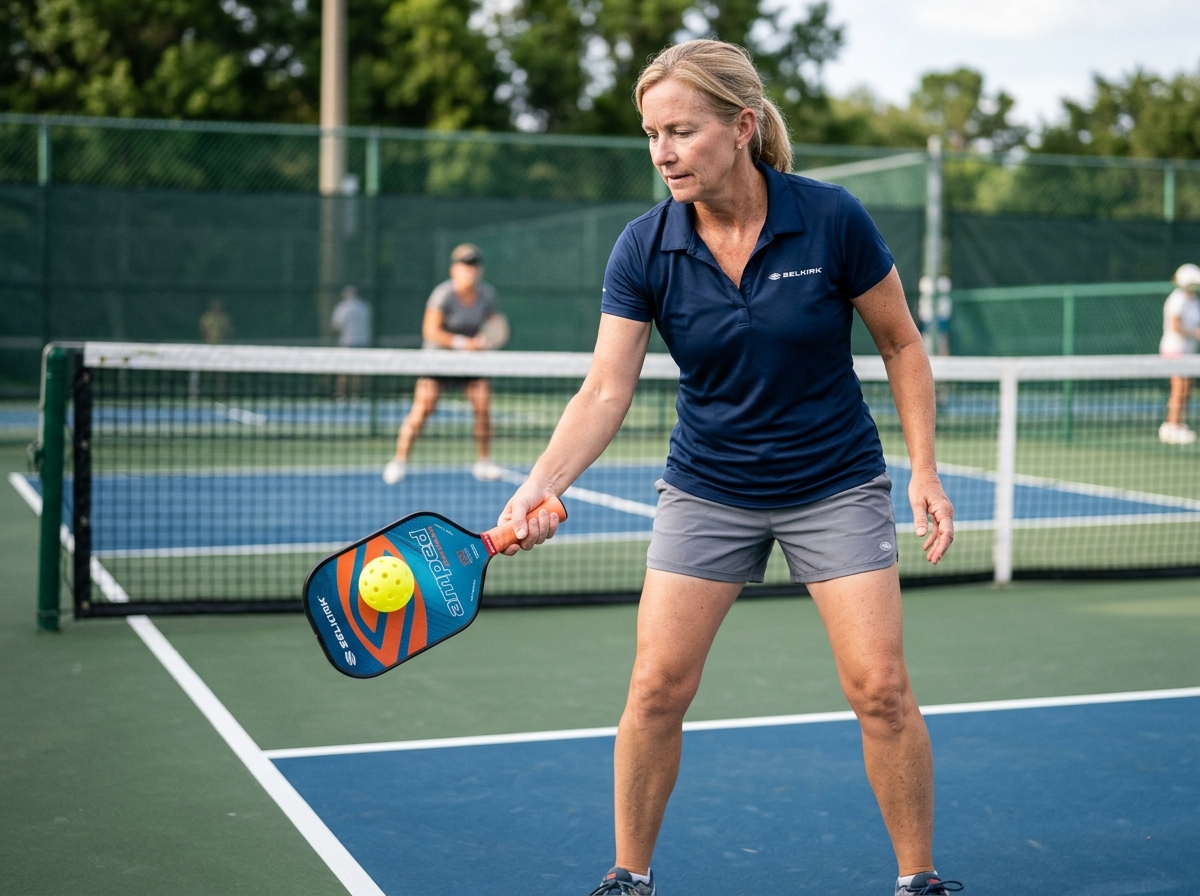
A great mental model for the reset is a basketball chest pass. In a basketball pass, you aren’t winding up and swinging; you are pushing the ball away from your body with controlled force. In pickleball, “soft hands” are required to absorb the energy of a 50-mph drive. If your grip is too tight (a common 10/10 tension), the ball will trampoline off your paddle and pop up for an easy overhead smash. We want a grip tension of about 3 or 4 out of 10.
By mastering this shot, you can take a point where you are being “hammered” and instantly return it to a neutral dink rally. If you are still working on the basics, our beginners-guide-to-pickleball-shots covers the foundational mechanics, but for the transition zone, the reset requires a specialized “push not swing” motion.
Executing the Perfect Reset: Technical Adjustments for Advanced Pickleball Transition Shots
To stop popping the ball up, we need to make three major technical adjustments:
- Stop the Swing: The biggest mistake is taking a backswing. In the transition zone, the ball is coming fast. You don’t have time to swing, and doing so adds too much power. Keep the paddle in your peripheral vision at all times.
- Active Legs: You cannot be a “statue” in the transition zone. You need to stay low, with knees bent, ready to absorb the ball. If the ball is hit hard at your feet, you might even need to take a small step back to create space.
- Body Rotation: Instead of using your arm to move the paddle, rotate your core. This keeps the paddle face stable and allows you to “push” the ball back over the net using your larger muscle groups.
| Feature | Forehand Reset | Backhand Reset |
|---|---|---|
| Grip | Eastern or Continental | Continental (often 2-handed) |
| Contact Point | Out in front, slightly to the side | Directly in front of the belly button |
| Stability | Relies on wrist control | Higher stability (especially with 2 hands) |
| Common Error | Over-swinging the arm | Reaching and losing balance |
For the backhand reset, many pros recommend using two hands. This provides extra stability and prevents the paddle from twisting when hit by a heavy drive. It also limits your range of motion, which is actually a good thing—it forces you to “push” rather than swing.
Modern Midcourt Aggression: Offensive Advanced Pickleball Transition Shots
While the reset is defensive, modern pickleball has introduced a way to stay aggressive even from the midcourt. Enter the Hybrid Roll.
The hybrid roll is a specialized third-shot drop that uses linear forward spin rather than a heavy upward brush. While a traditional drop arcs high and lands soft, the hybrid roll stays low—ideally only 3 to 6 inches over the net. Statistics show that having a reliable hybrid roll can be worth up to three points per game. It forces opponents to deal with pace at their feet while they are trying to unstack or move to the kitchen.
Beyond the roll, advanced players look for “speed-up” opportunities from the transition zone. If an opponent hits a transition ball that sits up chest-high, don’t just reset it! This is your chance to “bomb away” or aim for an ATP (Around the Post) if the angle allows. Midcourt volleys should be hit with a short, punchy motion to keep the pressure on the opponents.
Footwork and Positioning: The Engine of the Transition Game
You can have the best hands in the world, but if your feet are tangled, you’re going to get “pickled.” The secret to the transition zone is the split step.
A split step is a neutral hop that you perform the moment your opponent’s paddle contacts the ball. This stops your forward momentum and allows you to spring in any direction. If you are sprinting toward the net while your opponent is smashing a ball at you, you are a sitting duck. You must “stop and pop.”
We recommend taking small, “creeping” steps. Instead of two giant strides to reach the kitchen, take four or five small, controlled steps. This keeps your weight on the balls of your feet and ensures you are always in an athletic stance. For more on the basics of movement, check out footwork-fundamentals-in-pickleball-for-beginners.
Remember: Slow is fast. By slowing down your physical movement, you give your brain more time to process the ball’s flight, leading to better shot selection.
Strategic Decision Making: When to Attack, Reset, or Retreat
The transition zone is a game of “Green Light, Red Light.” You have to make a split-second decision based on three factors:
- Ball Height: This is the “Golden Rule.” If the ball is at chest height or higher, you have the Green Light to attack. If it is between the waist and chest, it’s a “Yellow Light”—weigh the risk. If it’s below the waist, it’s a Red Light; you must reset.
- Opponent Paddle Height: Use the “Seesaw Effect.” If your opponent’s paddle is low (below the net), they have to hit up. This is your cue to move forward. If their paddle is high, they are about to hit down. You should stop or even take a step back.
- The Net Plane Rule: A great tip from pro coaches is to stop moving the moment your ball crosses the plane of the net. This ensures you are set and balanced before the opponent strikes back.
Communication is also key. In doubles, calling “Go!” or “Stay!” helps your partner know whether to charge the net or hold their ground. If you hit a poor drop that sits up high, don’t be afraid to retreat. There is no ego in pickleball—sometimes taking two steps back toward the baseline is the only way to stay in the point.
Drills to Perfect Your Advanced Pickleball Transition Shots
Mastering advanced pickleball transition shots requires muscle memory. You can’t think your way through a 60-mph drive; you have to train your body to react.
- Dink Dink Bang: Start at the kitchen dinking. Suddenly, one player hits a “bang” (a hard shot) at the other player who is backing into the transition zone. The defender must reset the ball into the kitchen.
- Split Step Freeze: Have a partner hit balls to you while you move from the baseline to the kitchen. Your partner can yell “Freeze!” at any time, and you must be in a perfect, balanced split step.
- 7-11 Drill: The transition player starts at the midcourt and must play the point out against a player at the kitchen. The transition player wins if they reach 7 points; the kitchen player wins if they reach 11.
- Red Light Green Light: Practice moving forward only when you hit a “quality” drop. If the drop is too high, you must stay put or retreat.
Shadow transitions are also helpful. Practice the footwork without a ball. Move forward, split step, simulate a reset, and move again. This builds the “stop and go” rhythm required for real matches.
Frequently Asked Questions about Transition Shots
What is the most common mistake in the transition zone?
The most frequent error is “camping.” This happens when a player gets stuck in the middle and stops trying to reach the kitchen. Another big one is “running through the shot.” If you are still moving while hitting, your accuracy drops by 50%. You must stop, hit, and then move again.
Why do my reset shots keep popping up?
Pop-ups are usually caused by three things: a grip that is too tight, a “swinging” motion instead of a “pushing” motion, or standing too tall. If you don’t bend your knees, you’ll be forced to reach down with your paddle, which naturally opens the paddle face and sends the ball high.
Is the backhand reset harder than the forehand?
For many, yes. The backhand requires better spacing because you can’t “reach” as easily as you can on the forehand side. However, the backhand is often more stable. Using a two-handed grip can help beginners and seniors alike maintain a solid paddle face. For more senior-specific tips, see drills-for-senior-beginners-in-pickleball.
Conclusion
Mastering advanced pickleball transition shots is the “final frontier” for many players. It turns a chaotic part of the court into a place of control and opportunity. By focusing on the “push not swing” reset, utilizing the split step, and making smart “Green Light” decisions, you’ll find yourself winning those grueling midcourt battles.
At Voce Economia, we want to see you progress from the basics to competitive dominance. The transition zone isn’t a place to fear—it’s the place where you earn your victory. Keep practicing those resets, stay low, and we’ll see you at the kitchen line!
