
Why Your Lob Shot Is Costing You Points (And How to Fix It)
Improving your pickleball lob accuracy comes down to five key things you can start working on today:
- Open your paddle face – tilt it upward to create lift under the ball
- Swing low to high – contact the ball below waist height with a smooth upward arc
- Aim deep – target the last three feet of your opponent’s baseline
- Clear by about 2 feet – you don’t need a sky-high shot, just enough to get over your opponent
- Use it sparingly – mix lobs with dinks and drives so opponents can’t predict it
There’s a reason the lob makes opponents groan. When it works, it sends them scrambling backward from the kitchen line, completely disrupting their rhythm. When it doesn’t work, it floats up like a gift and gets smashed back at you.
For many beginners, the lob feels like a coin flip. Sometimes it lands perfectly in the back court. Other times it sails out of bounds or drops too short for an easy overhead smash.
The good news? The lob is actually simpler than most players think. It’s not about power. It’s about paddle angle, contact point, and knowing exactly when to pull the trigger.
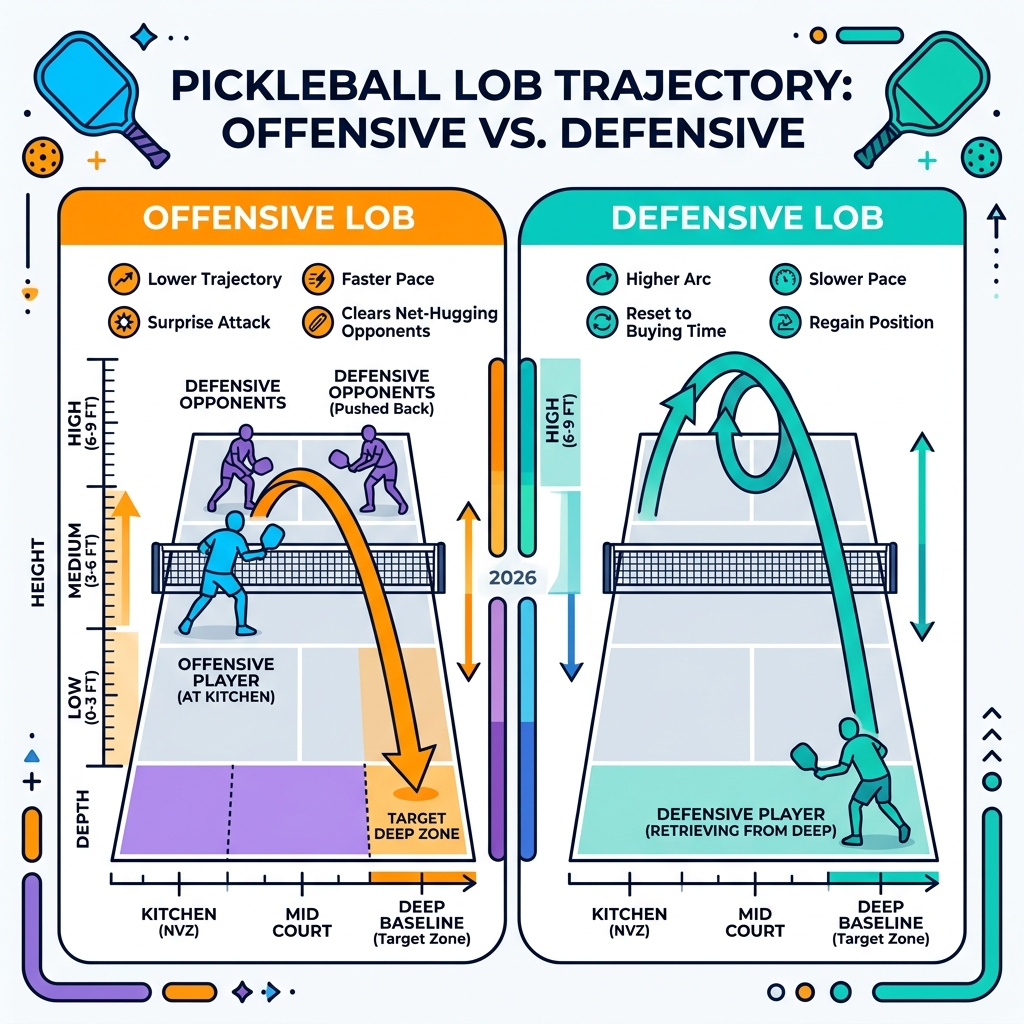
Whether you want to use it as a defensive reset to buy time when you’re out of position, or as an offensive surprise to catch a net-hugger flat-footed, the same core mechanics apply. This guide walks you through everything step by step.
Glossary for improve pickleball lob accuracy:
Mastering the Mechanics to Improve Pickleball Lob Accuracy
To truly improve pickleball lob accuracy, we have to look at the shot as a controlled lift rather than a frantic hit. Many of us make the mistake of trying to “muscles” the ball into the air, which leads to those frustrating shots that sail ten feet past the baseline.
The Foundation: Grip and Stance
The journey to a better lob starts before the paddle even touches the ball. Most pros recommend a Continental grip (the “hammer” grip), which allows for the most versatility. However, some players find success with a Semi-Western grip to help generate topspin. Regardless of your choice, the key is to keep your grip pressure relaxed—about a 3 or 4 on a scale of 10. A tight grip kills your “touch,” making it nearly impossible to regulate power.
Your stance should be balanced with feet roughly shoulder-width apart. We always suggest keeping your knees slightly bent and your weight on the balls of your feet. This athletic posture allows you to get under the ball, which is essential for creating that high-arcing trajectory. If you’re interested in how this fits into your overall development, check out our guide on simplifying pickleball shots for beginner level.
The Swing Path and Contact Point
The “secret sauce” of a successful lob is the swing path. Think of it as a smooth, low-to-high arc. You want to contact the ball out in front of your body, ideally slightly below waist height. By opening the paddle face (pointing it toward the sky), you use the paddle’s surface to “scoop” the ball upward.

| Feature | Offensive Lob | Defensive Lob |
|---|---|---|
| Trajectory | Flatter, faster arc | High, towering arc |
| Purpose | Surprise the opponent; win the point | Buy time; reset the rally |
| Paddle Angle | Slightly open | Very open (facing the sky) |
| Follow-Through | Toward the baseline | Straight up toward the sky |
| Height | ~2 feet above opponent’s reach | 15–20 feet high |
Using Spin to Improve Pickleball Lob Accuracy
Adding spin is the difference between a “moonball” that anyone can return and a professional-grade shot that dies in the back corner.
- Topspin: This is the gold standard for offensive lobs. By using a “windshield wiper” motion—pronating your wrist and elbow upward and forward at contact—you make the ball dip sharply once it clears the opponent. This allows you to hit the ball harder while ensuring it stays within the lines.
- Backspin: Often used on defensive lobs, backspin (or “slice”) helps the ball “float” a bit longer, giving you precious seconds to scramble back into position. It also causes the ball to “bite” or skid when it hits the ground, making the return more difficult for your opponent.
According to the USA Pickleball Official Rules, the ball must remain in bounds, and mastering spin is your best insurance policy against the wind or a slightly over-powered swing.
Practical Drills to Improve Pickleball Lob Accuracy
You can’t expect to master the lob just by reading about it; you need “court time.” Here are three drills we love:
- The Wall Target Drill: Find a flat wall and mark a target about 15 feet up. Stand 10–15 feet away and practice hitting lobs that hit the target and land within a designated “deep zone” on the ground. This builds muscle memory for paddle angle. For more ideas, see the ultimate guide to beginner pickleball and volley drills.
- The “Three-Zone Challenge”: With a partner, divide the back court into three sections (left, center, right). Try to land five lobs in each section consecutively. This forces you to focus on directional accuracy, not just height.
- The “Dink-to-Lob” Transition: This is a game-simulator. Have a partner dink with you at the kitchen. Every 4 or 5 dinks, one of you must execute a surprise offensive lob. This teaches you how to disguise the shot. This is especially helpful for those looking for senior friendly beginner pickleball drills.
Strategic Execution: When and Where to Lob
Knowing how to hit a lob is only half the battle; knowing when to hit it is what separates the winners from the “lob-and-pray” players. To improve pickleball lob accuracy in a match, you must develop a high “Pickleball IQ.”
The “Net Hugger” Opportunity
The absolute best time to use an offensive lob is when your opponents are “hugging” the Non-Volley Zone (NVZ) line. If they are leaning forward, anticipating a fast drive or a soft dink, they are vulnerable. A quick lob that clears their reach by just two feet will leave them flat-footed and scrambling. If you’re new to these concepts, our beginners guide to pickleball shots can help clarify court positioning.
Targeting the Backhand
In almost every skill level, a player’s backhand overhead is significantly weaker than their forehand smash. When you lob, aim for the opponent’s non-paddle side. Even if your lob is a little short, they will likely struggle to put the ball away with a backhand overhead, giving you a second chance at the point. This strategic targeting requires good footwork fundamentals in pickleball for beginners.
Environmental Factors: Wind and Sun
Outdoors, the elements are your best friend or your worst enemy.
- Wind: The golden rule is to lob into the wind. The wind will act as a brake, keeping your ball in the court. Avoid lobbing with the wind at your back, as it will almost certainly carry the ball out of bounds.
- Sun: If the sun is at your back, a high lob forces your opponents to look directly into the glare to track the ball. This is a perfectly legal (though slightly “mean”) way to induce an error.
The Art of the Disguise
To improve pickleball lob accuracy, you must hide your intentions. If you stand tall and take a huge backswing, your opponents will see the lob coming from a mile away and start backing up before you even hit the ball. Keep your preparation identical to your dink or drop shot. Only at the last millisecond should you open the paddle face and accelerate through the ball. This prevents you from making common beginners mistakes in pickleball.
Common Pitfalls and Defensive Counters
Even the best players occasionally “mess up” a lob. Recognizing these errors is the first step toward fixing them.
The “Escape Button” Panic
The most common mistake is using the lob as a “panic button.” You’re out of position, the ball is at your feet, and you just “throw it up” in hopes of survival. This rarely works because you lack the balance needed for accuracy. Instead of a desperate lob, try a “reset dink” to the middle of the kitchen. Only lob when you have a stable base.
Overhitting and Telegraphing
We often see players hit lobs that are “sky-high” but land mid-court. This is usually due to a lack of follow-through. To improve pickleball lob accuracy, you must follow through toward your target. If you “stab” at the ball, you lose control. Similarly, don’t telegraph your shot by looking at the back court before you hit. Keep your eyes on the ball!
Following the dont get pickled 10 essential rules for beginners will help you stay within the strategic bounds of the game while you refine these skills.
How to Defend Against the Lob
While you’re working to improve pickleball lob accuracy, your opponents might be doing the same.
- The Overhead Smash: If the lob is short, pivot your body sideways, point at the ball with your non-paddle hand, and snap your wrist at contact to hit a downward smash.
- The Drop Shot Counter: If the lob is deep and well-executed, don’t try to smash it from the baseline. Instead, hit a high “drop shot” back into their kitchen to reset the point.
Understanding mastering pickleball scoring a comprehensive guide for beginners is also vital because the risk-reward ratio of a lob changes depending on whether you are serving or receiving.
For those interested in the “why” behind the ball’s flight, scientific research on projectile motion in sports shows that the angle of release (paddle angle) and initial velocity (swing speed) are the only two factors determining where that ball lands.
Frequently Asked Questions about Lob Precision
How high should I hit my lob for maximum effectiveness?
For an offensive lob, you only need to clear the opponent’s reach by about 2 feet. This keeps the ball’s flight time short, giving them less time to react. For a defensive lob, aim for a 15–20 foot arc. This “moonball” height buys you the maximum amount of time to get back to the kitchen line.
Is a forehand or backhand lob more accurate?
For 90% of players, the forehand lob is significantly more accurate. The body mechanics of a forehand allow for a more natural “scooping” motion and better power regulation. We recommend shifting your footwork to take lobs on your forehand whenever possible.
How do I stop my lobs from going out of bounds?
The secret is power regulation and follow-through. Instead of a full “tennis-style” swing, use a gentle “push” or “lift.” Visualize “floating” the ball into the back third of the court. Also, check your paddle face at contact—if it’s angled too far back, the ball will go long every time.
Conclusion
At Voce Economia, we believe that every player has the potential to master the “plot twist” of the pickleball lob. By focusing on a relaxed grip, a low-to-high swing path, and strategic targeting, you can transform this shot from a risky gamble into a reliable weapon.
The goal isn’t just to hit the ball high; it’s to hit it with purpose. Whether you’re using it to reset a rally or to surprise a net-hugging opponent, accuracy is your greatest ally. Keep practicing those drills for senior beginners in pickleball and stay up to date with the essential beginner guide to official pickleball rules.
The more you practice, the more you’ll realize that when it comes to your game, the sky truly is the limit. Master your game at Voce Economia and we’ll see you on the court!
