
The Ultimate Guide to Beginner Pickleball and Volley Drills
Why Drills Are the Fastest Way to Improve at Pickleball
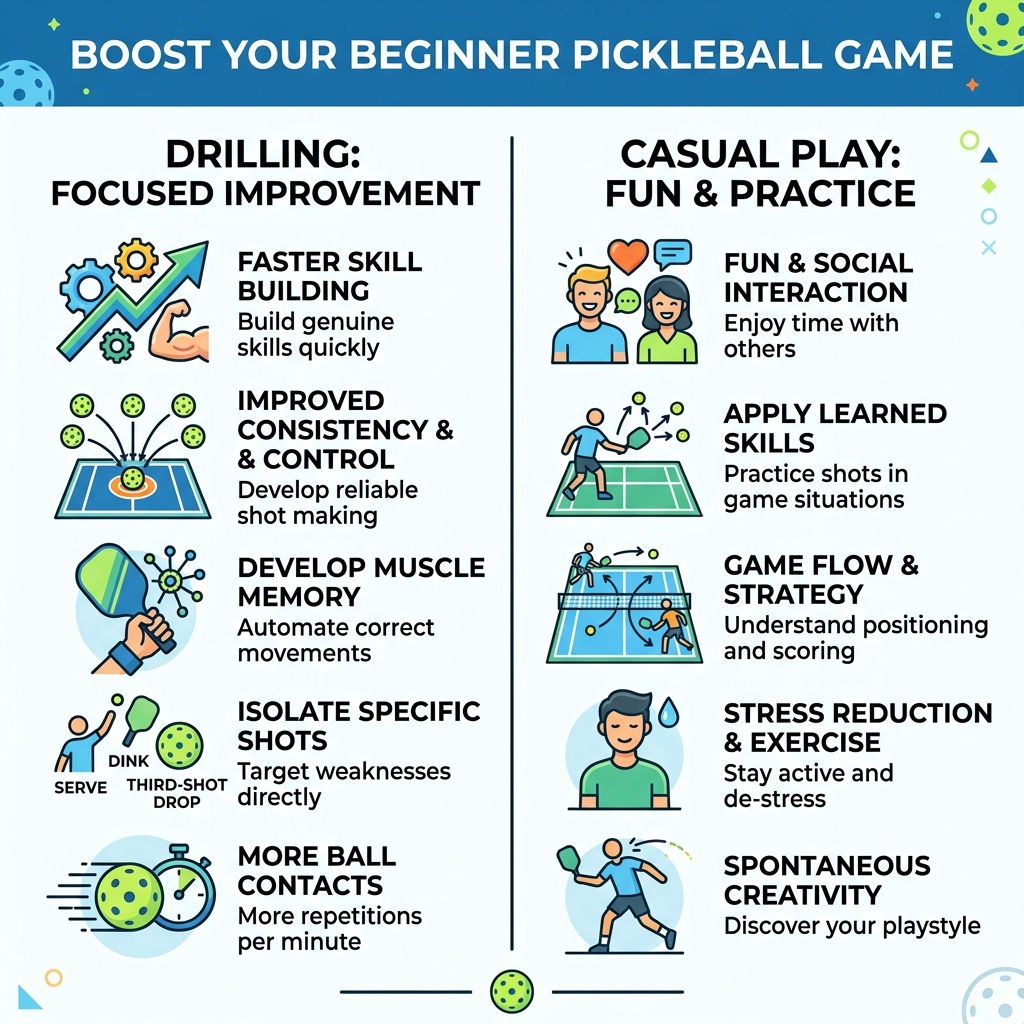
Pickleball drills for beginners are the single most effective way to build real skills on the court — faster than just playing casual games.
Here are the most important beginner drills to start with:
- Selfie ball bounce — tap the ball up from your paddle face to build control
- Wall target drill — rally against a wall with a net-height line taped at 36 inches
- Shadow swings — practice strokes without a ball to lock in form and footwork
- Cross-court dinking — soft shots with a partner at the kitchen line
- Serve repeats — serve a full bucket of balls to the same target spot
- Third-shot drop — drop the ball softly into the opponent’s kitchen from the baseline
- Drive, Drop, and Reset — a partner drill that teaches you how to reach the net faster
Pickleball is one of the easiest sports to pick up. Most beginners can keep a rally going in their very first session. But there’s a gap that shows up quickly — between just hitting balls and actually improving.
That gap is filled by drills.
When you repeat a motion correctly, your brain wraps nerve fibers in a substance called myelin, which speeds up the signal between brain and muscle. In plain terms: the more you repeat a good shot, the more automatic it becomes.
Even 15–20 minutes of focused drilling before a casual game can make a noticeable difference in your consistency and control.
This guide covers every drill you need — solo, partner, kitchen, and serve drills — so you can build a real foundation from day one.
Essential Equipment for Pickleball Drills for Beginners
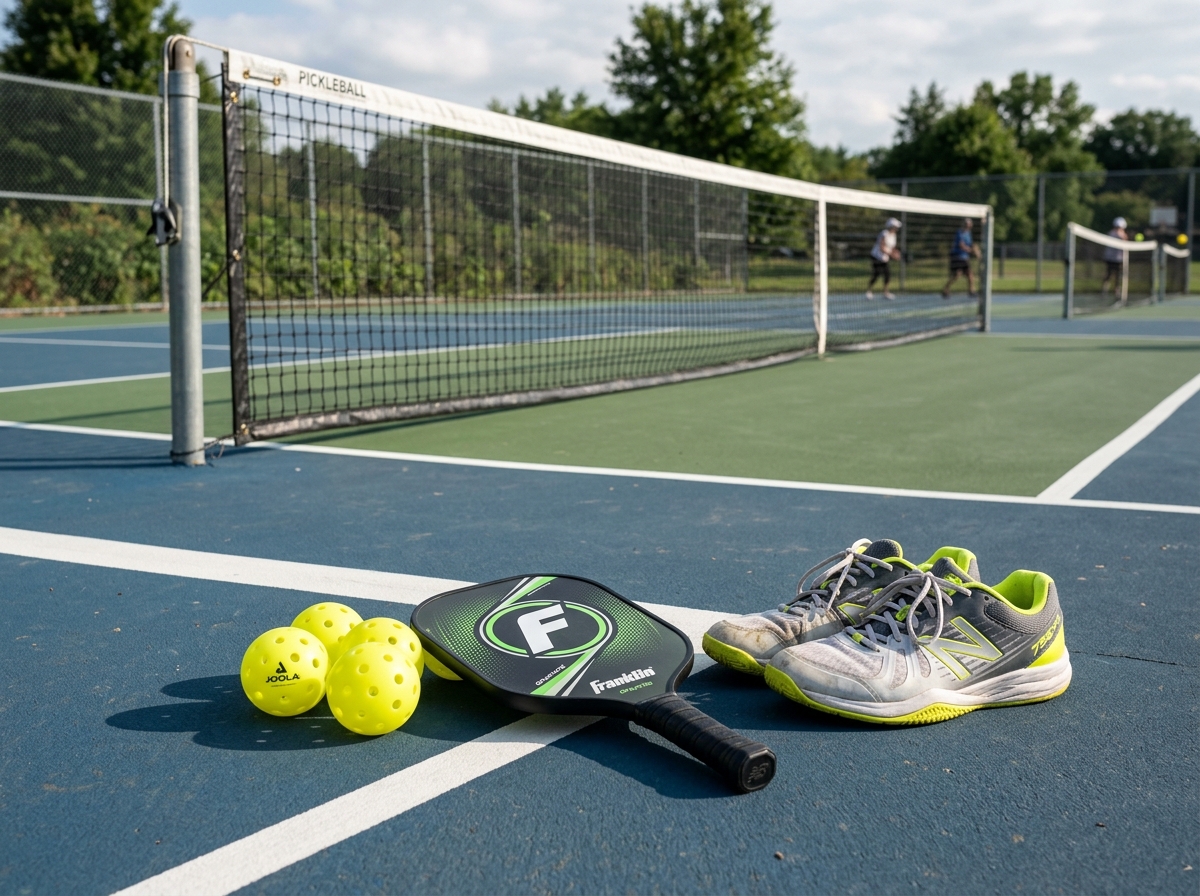
Before we dive into the specific movements, we need to make sure your “toolkit” is ready. You don’t need a mountain of gear to start pickleball drills for beginners, but having the right basics ensures you aren’t fighting your equipment while trying to learn.
The Paddle and Grip
Your paddle is an extension of your arm. For beginners, a paddle with a large “sweet spot” (the center area where the ball hits truest) is vital. If you hit the ball near the edges, you lose power and directional control. How you hold it matters just as much. Most pros recommend a “Continental grip”-think of it like a light handshake with the paddle’s edge.
We recommend keeping your grip tension at about a 4 or 5 out of 10. If you squeeze too hard, you’ll “pop” the ball up high, giving your opponent an easy smash. For a deeper look at how to handle your equipment, check out our Beginner’s guide to pickleball shots.
The Right Balls and Shoes
Not all balls are created equal. If you are practicing in a gym, you need indoor balls (fewer, larger holes); if you’re at the local park, you need outdoor balls (more, smaller holes). Using the wrong ball can mess with your rhythm and bounce height. If you want a quick rules-based explanation of the sport’s equipment and court setup, the Pickleball article on Wikipedia is a useful general reference.
| Feature | Indoor Practice Balls | Outdoor Practice Balls |
|---|---|---|
| Hole Count | 26 large holes | 40 small holes |
| Weight | Lighter, softer | Heavier, harder |
| Durability | Long-lasting on smooth floors | Prone to cracking on asphalt |
| Wind Resistance | Low | High |
Don’t forget your feet. Standard running shoes are designed for forward motion, but pickleball is a game of lateral (side-to-side) movement. Proper court shoes help prevent rolled ankles. If you’re just starting out, follow our step-by-step guide to learning pickleball to ensure you have the right foundation.
Practice Accessories
- Cones: Great for marking targets and footwork paths.
- Tape: Use painter’s tape to mark a 36-inch “net line” on a wall.
- A Practice Wall: This is your most patient partner. It never misses and always hits the ball back!
Solo Practice: Mastering Fundamentals Without a Partner
Can’t find a partner today? No problem. Some of the most effective pickleball drills for beginners are done solo. These drills focus on hand-eye coordination and “paddle feel.”
Selfie Ball Bounce
This is the “Fry the Egg” drill. Hold your paddle flat like a frying pan. Bounce the ball up and down on the paddle face without letting it hit the ground.
- Easy version: Use the top face of the paddle.
- Advanced version: Use the bottom face (like dribbling a basketball) or alternate sides of the paddle between hits.
Shadow Swings
Shadow drills involve mimicking the motion of a shot without actually hitting a ball. This allows you to focus entirely on your footwork fundamentals in pickleball for beginners and your swing path. Stand in front of a mirror and practice your forehand and backhand swings, ensuring your paddle stays in front of your body and your “split step” (a small hop to balance yourself) is timed correctly.
Improving Accuracy with Wall-Based Pickleball Drills for Beginners
The wall is the ultimate coach for building muscle memory. Tape a line 36 inches from the ground to simulate the net.
- Forehand/Backhand Alternating: Hit the ball against the wall, let it bounce once, and return it. Focus on hitting the “sweet spot” every time.
- Target Hitting: Tape small squares on the wall. Try to hit each square five times in a row. This builds incredible accuracy for real games.
- The Volley Wall: Stand 7 feet back (the distance of the kitchen line) and hit the ball against the wall without letting it bounce. This sharpens your reaction time.
For those concerned about safety while practicing alone, especially older players, we have a guide on safe court movement for senior beginners to help you stay injury-free.
Partner Drills for Dinking, Volleys, and Groundstrokes
When you do have a partner, your goal should be “cooperative” play rather than “competitive” play. In other words, try to keep the ball going as long as possible!
The Figure 8 Drill
This is a classic for improving dink placement. You and your partner stand at the kitchen line. Partner A hits the ball straight across. Partner B hits it back diagonally (cross-court). Partner A hits it straight again. The ball moves in a “Figure 8” pattern. This forces you to move your feet and adjust your paddle angle constantly. If this feels too complex, we have a resource on simplifying pickleball shots for beginner level players.
Volley-to-Volley
Stand 7 feet back from the net. Gently volley the ball back and forth without letting it touch the ground. Focus on “soft hands”—don’t swing at the ball; just “block” it back. This is where the Continental grip shines, as you don’t have to change your grip between forehand and backhand volleys.
Drive, Drop, & Reset Drill
This is the gold standard for reaching the kitchen line.
- The Drive: From the baseline, hit a hard, low shot (the drive).
- The Drop: On the next ball, hit a soft “drop” shot that lands in the opponent’s kitchen.
- The Reset: If the opponent hits a hard ball back, “reset” it by deadening the pace so it lands softly in the kitchen. This sequence teaches you how to transition from the back of the court to the net safely.
Mastering the Kitchen with Pickleball Drills for Beginners
The “Kitchen” (or Non-Volley Zone) is where most pickleball points are won or lost. Beginners often make the mistake of staying at the baseline. These drills help you get comfortable at the net.
- Dink Exchanges: Practice hitting “unattackable” dinks—balls that stay so low the opponent has to hit up on them.
- Speed-Ups: During a dink rally, wait for a ball that is slightly high (above net height) and practice a controlled “speed-up” toward your partner’s shoulder.
- Block Volleys: Have your partner hit hard “drives” at you while you stand at the kitchen line. Your goal is to keep your paddle still and let the ball’s energy bounce it back over the net.
For more age-specific advice, see our drills for senior beginners in pickleball and our overview of understanding court positions in pickleball for seniors.
Advanced Beginner Techniques: Serves and Transition Movement
Once you’ve mastered the basics, it’s time to work on the “Third Shot” and the transition zone.
Serving and Returning
The serve is the only shot you have 100% control over. Your goal as a beginner isn’t to hit an “ace,” but to hit a deep serve that pushes the opponent back.
- Serve Repeats: Take a bucket of balls and aim for the back third of the service box.
- Deep Return Reps: Practice returning the serve as deep as possible. This buys you time to get to the kitchen line. For more on the mechanics, read our pickleball serving basics for senior beginners.
The Third-Shot Drop
This is often called the hardest shot in pickleball. After the serve and return, the serving team must hit a “third shot.” Instead of smashing it, you try to “drop” it softly into the kitchen. This neutralizes the opponents who are already waiting at the net. Practice this by having a partner stand at the net while you try to land 10 drops in a row into the kitchen from the baseline.
The T-Drill and Split Steps
Movement in pickleball is about efficiency. The “T-Drill” involves moving from the baseline to the kitchen line, stopping to do a “split step” (a balanced hop) every time your partner is about to hit the ball. Never be caught running while the ball is being hit! This is a core part of understanding the basic gameplay of pickleball for senior beginners.
If you’re playing with a partner, it’s also the perfect time to learn the basics of playing doubles in pickleball for beginners.
Common Mistakes to Avoid During Practice
Even with the best pickleball drills for beginners, bad habits can creep in. Here is what we see most often:
- Death Grip: Squeezing the paddle too hard. Relax! Think of it like holding a bird—firm enough so it doesn’t fly away, but soft enough so you don’t hurt it.
- Over-swinging: Beginners often try to use a “tennis swing” with a big backswing. Pickleball requires short, compact motions.
- Moving While Hitting: If your feet are moving when you strike the ball, your shot will be unstable. Stop, hit, then move.
- The “No-Man’s Land” Trap: Many beginners get stuck in the middle of the court (the transition zone). Use your drills to practice getting all the way to the kitchen line.
- Popping Up the Ball: This usually happens because your paddle face is too open or your grip is too tight.
For a comprehensive list of what to watch out for, check out our guide on avoiding common beginners mistakes in pickleball. We also offer senior-friendly beginner pickleball drills that focus on low-impact movements to avoid strain.
Frequently Asked Questions about Beginner Drills
How often should beginners practice drills and for how long?
We recommend drilling 2–3 times per week. Quality is much more important than quantity. A focused 30–60 minute session where you hit 500 intentional balls is worth more than three hours of “just playing.” If you can, spend 15 minutes drilling your weakest shot before every match.
What are shadow drills and why are they useful for beginners?
Shadow drills are “dry runs.” You practice the swing and the footwork without the distraction of the ball. They are incredibly useful for beginners because they allow you to focus on your body mechanics—like keeping your paddle up and stepping with the correct foot—without the “stress” of trying to make contact.
How can beginners gamify drills to keep practice fun?
Drills don’t have to be boring! Try these games:
- Battleships: Place cones (ships) in the kitchen. Try to “sink” them by hitting them with your dinks.
- Skinny Singles: Play a game using only half the court (long-ways). This forces you to be accurate and improves your conditioning.
- Fry the Egg Race: See who can walk across the court the fastest while balancing a ball on their paddle.
- Dink to 11: Play a game where every shot must land in the kitchen. If it lands outside, you lose the point!
Conclusion
At Voce Economia, we believe that anyone can become a proficient pickleball player with the right approach. Mastery isn’t about having the hardest serve; it’s about consistency, control, and muscle memory. By incorporating these pickleball drills for beginners into your weekly routine, you’ll find yourself winning more rallies and, more importantly, having more fun on the court.
Ready to take the next step? Dive into our step-by-step guide to learning pickleball for seniors or explore our more beginner tips and gear guides to find the perfect paddle for your new skills. Happy drilling!
