
Easy Pickleball Consistency Tips for Error-Free Play
Why Consistency — Not Power — Is the Real Game-Changer in Pickleball
Easy pickleball consistency tips can transform your game faster than any new paddle or athletic ability ever will. Most beginner players lose points not because their opponent hit an amazing shot, but because of unforced errors — balls hit into the net, popped up too high, or sailing out of bounds.
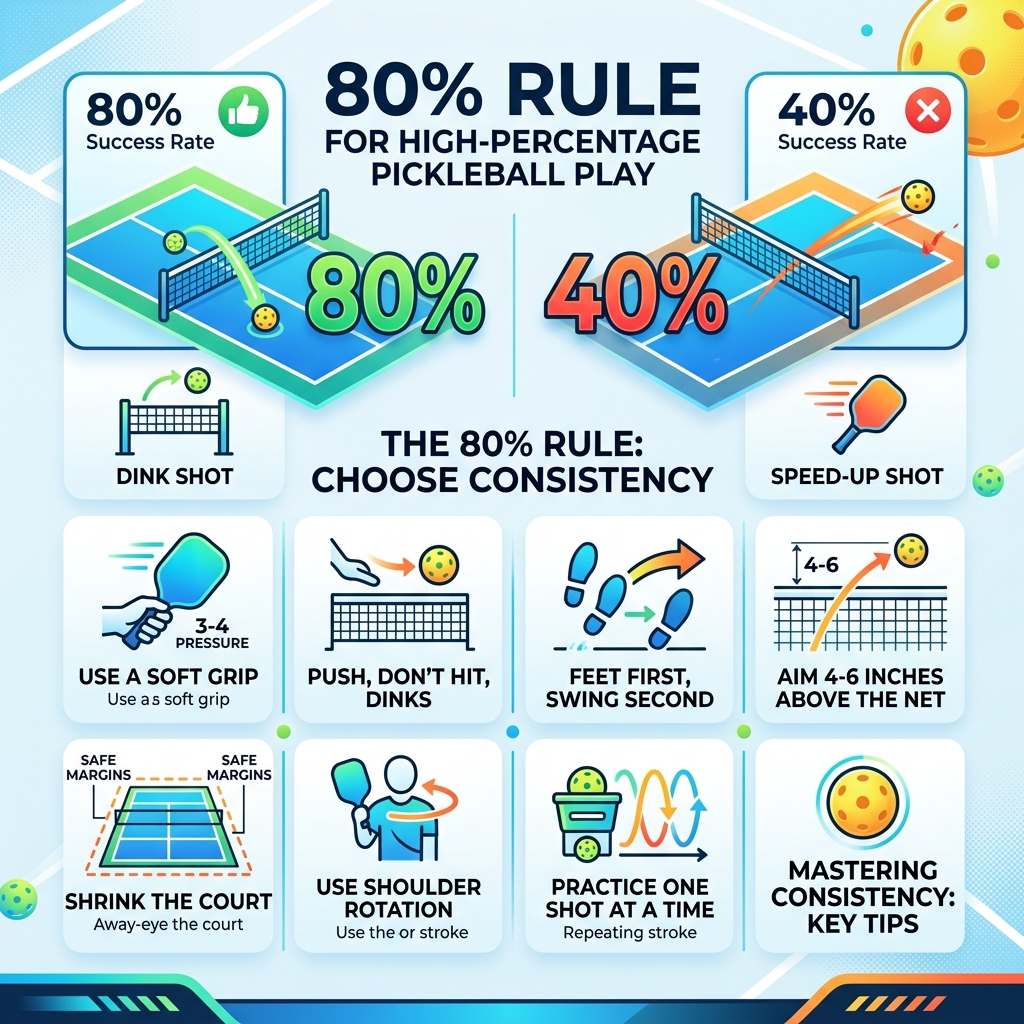
Here are the most important consistency tips to start using right away:
- Choose high-percentage shots — a dink with an 80% success rate beats a risky speed-up with a 40% chance every time
- Use a soft grip — hold your paddle at a 3-4 out of 10 pressure for touch shots near the kitchen
- Push, don’t hit, your dinks — a pushing motion gives you more control and keeps the ball low
- Feet first, swing second — always get your feet set before you swing
- Aim 4-6 inches above the net — this simple habit eliminates most net errors instantly
- Shrink the court — aim 2-3 feet inside the lines instead of going for the edges
- Use shoulder rotation, not your wrist — your shoulder drives consistent, repeatable strokes
- Practice one shot at a time — mastering shots individually builds muscle memory faster
The difference between a beginner and an intermediate player isn’t raw power or speed. It’s shot selection, mechanics, and smart decision-making. As one common coaching principle puts it: the jump from a 3.5 to a 4.5 rating is almost entirely about consistency and court awareness — not athleticism or gear.
The good news? These are learnable skills. And small adjustments in how you hold your paddle, move your feet, and choose your shots can produce noticeable results quickly.
Mastering the Fundamentals: Footwork and Body Positioning
If you want to hit a reliable shot, you have to start from the ground up. We often see players reaching or lunging for the ball, which is a recipe for a pop-up. The golden rule we follow is “feet first, swing second.” This means your priority is moving your body into position before you even begin your backswing.
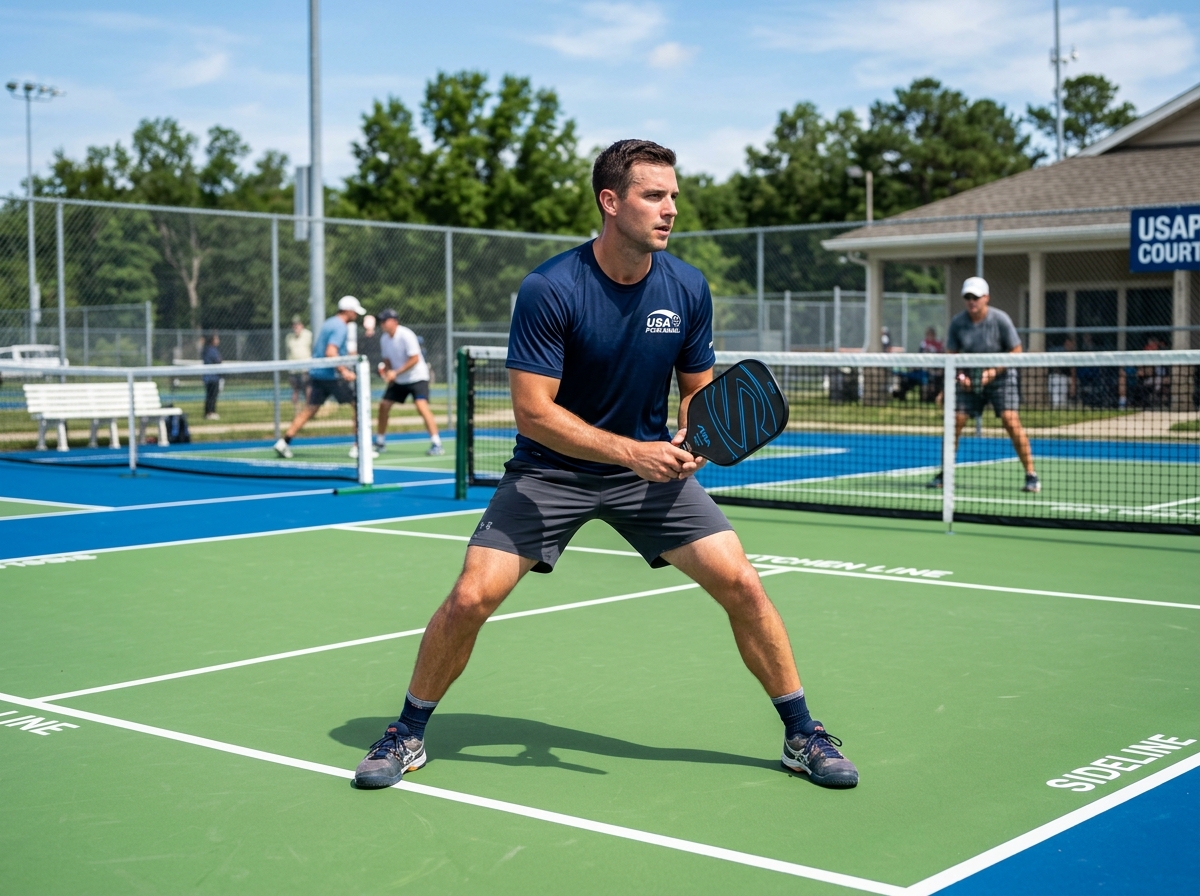
A wide, athletic stance is the foundation of balance. By keeping your knees slightly bent and your feet more than shoulder-width apart, you create a stable platform. This stability is backed by scientific research on the role of balance in athletic performance, which highlights how a centered COG (center of gravity) reduces errors in precision sports.
To stay consistent, we recommend mastering the split step. This is a small hop onto the balls of your feet just as your opponent is about to strike the ball. It neutralizes your momentum, allowing you to spring in any direction. Without a split step, you are often caught leaning the wrong way, leading to off-balance shots.
Proper weight transfer is also vital. You should generally feel your weight shifting from your back foot to your front foot as you strike the ball. This provides “quiet” power—power that comes from your legs and core rather than a wild arm swing. For more on moving safely, check out our guide on Footwork Fundamentals in Pickleball for Beginners. Once you hit the ball, your job isn’t done; you must immediately move to a recovery position (usually toward the kitchen line) to be ready for the next return.
Easy Pickleball Consistency Tips for the Kitchen Line
The “Kitchen” or Non-Volley Zone (NVZ) is where most pickleball games are won or lost. To stay consistent here, you must abandon the “hitting” mindset and adopt a “pushing” mindset. Instead of a full swing, think of a dink as a gentle shove or a lift. This controlled motion minimizes the variables that cause errors.
A major key to this control is your grip pressure. We use a 1-10 scale, where 1 is holding a baby bird and 10 is a death grip. For dinking, you want to be at a 3 or 4. A soft grip acts like a shock absorber, allowing the paddle to “soak up” the ball’s energy rather than bouncing it off like a trampoline. This is one of the best ways of Avoiding Common Beginners Mistakes in Pickleball.
We also suggest the “Pinching” strategy. This involves consistently targeting one corner of your opponent’s kitchen. By repeatedly hitting to the same spot, you simplify your own decision-making and force your opponent into awkward, high-pressure angles. This builds court awareness and prevents you from over-complicating your strategy.
Easy pickleball consistency tips for dinking
To master dinking, you need to maximize “dwell time”—the tiny fraction of a second the ball stays on your paddle face. By using a lifting motion driven by the shoulder hinge (keep that elbow and wrist still!), you can guide the ball with extreme precision.
One professional-level tactic we love is the “AL Dinks” strategy. This involves occasionally stepping an inch or two back from the kitchen line. This slight retreat gives you more room to handle deep dinks, reducing the need for difficult “short hops” and allowing you to find your range.
| Shot Type | Recommended Grip Pressure (1-10) | Primary Power Source |
|---|---|---|
| Dinks | 2-4 | Shoulder/Legs |
| Third Shot Drop | 3-4 | Shoulder |
| Volley Resets | 2-3 | Absorb with Body |
| Power Drives | 7-9 | Hips/Core |
| Serves | 6-8 | Full Body Rotation |
Eliminating high balls and net errors
Nothing is more frustrating than a “dead dink” that hits the net or a pop-up that gets smashed back at you. To fix this, we use the “Catch and Stick” method for resets. Imagine you aren’t hitting the ball, but literally catching it with your paddle. By keeping the paddle face stable and “sticking” the finish, you kill the ball’s momentum, making it drop softly into the kitchen.
The “Net Rule” is another essential habit: have your paddle prepared and your feet set before the ball even crosses the net. If you are still moving when you hit, your paddle face angle will fluctuate, leading to inconsistency. Finally, utilize the “Freeze Frame” technique. Try to be completely stationary for a split second right before contact. This stillness ensures your eyes are level and your contact point is out in front.
Grip Control and Stroke Mechanics for Reliable Shots
How you hold your paddle dictates the trajectory of every shot. Most pros recommend the Continental grip (like holding a hammer) because it works for both forehands and backhands without needing to switch mid-rally. However, some players prefer the Eastern forehand for more power on drives. Regardless of your choice, the goal is to minimize wrist flicking. A “floppy” wrist is the number one cause of directional errors.
We advocate for shoulder-driven strokes. Think of your arm as a pendulum where the shoulder is the hinge. This creates a much larger, more reliable lever than the small muscles in your wrist. For senior players, Optimizing Pickleball Grip for Senior Players is especially important to prevent strain while maintaining this firm-wrist technique.
Keep your swings compact. On a small pickleball court, a big “tennis-style” backswing is actually a disadvantage. It takes too long to execute and increases the margin for error. A short, punchy stroke with a consistent follow-through toward your target will always be more reliable.
Strategic Shot Selection and Mental Preparation
Consistency is as much about the brain as it is about the body. We call this active patience. It means being willing to hit twenty dinks in a row while waiting for the perfect ball to attack. Most unforced errors happen because a player gets bored or impatient and tries to “speed up” a ball that is too low.
One of our favorite easy pickleball consistency tips is “shrinking the court.” Instead of aiming for the white lines, pretend the court is two feet smaller on every side. By aiming for this “inner court,” you give yourself a massive safety margin. If you miss your target by a foot, the ball is still in!
In doubles, communication is the glue that holds consistency together. Using “mine” and “yours” calls early—ideally as soon as the ball leaves the opponent’s paddle—prevents the dreaded “middle-third” confusion where both players watch the ball sail between them. For more on where to stand, see Understanding Court Positions in Pickleball for Seniors.
When transitioning, you must decide between a 3rd shot drop or a drive. A drive is great for drawing a weak volley, but a drop is the “gold standard” for getting your team safely to the net. A consistent 3rd shot drop doesn’t have to be perfect; it just needs to be unattackable.
Building Muscle Memory with Targeted Drills
You can’t think your way to consistency during a fast rally; you have to train your muscles to do it automatically. We recommend structured repetition over just playing games.
The “Dink, Dink, Boom” drill is a classic. You and a partner dink cross-court at the kitchen. You are only allowed to “boom” (speed up) the ball if it is lifted above the net height. This trains your eyes to recognize attackable balls versus balls you should just dink back.
For serving, try the two-ball serve drill. Place two balls (or cones) three feet in front of the baseline in the opponent’s court. Your goal is to land every serve behind those markers. This forces you to hit deep serves, which are much harder for opponents to return aggressively. For more practice ideas, check out Drills for Senior Beginners in Pickleball.
Easy pickleball consistency tips for serving and returning
The serve is the only shot where you have 100% control. Don’t waste it by trying to hit an “ace.” Instead, aim for 90% depth. A deep, mid-paced serve is far more effective than a fast serve that hits the net. Use a smooth, low-to-high motion to impart natural topspin, which helps the ball “dive” into the court.
On the return of serve, the goal is simple: get it deep and get to the kitchen. A deep return keeps your opponents pinned at the baseline, making their 3rd shot much harder. We suggest a ritual consistency—bounce the ball a set number of times, take a breath, and use the same motion every single time. For the basics, see Pickleball Serving Basics for Senior Beginners.
Frequently Asked Questions about Pickleball Consistency
Why do I keep popping up my dinks?
The most common reason for pop-ups is too much “swing” and too much grip pressure. If you “hit” the ball with a firm wrist and a fast paddle, it will fly. Switch to a “push” motion and soften your grip to a 3/10. Also, ensure you aren’t hitting “short hops”—let the ball reach the apex of its bounce before you touch it.
What is the best grip for consistency?
For most players, the Continental grip is the best for overall consistency because it handles all shot types without adjustment. However, ensuring you have a firm wrist (not a tight grip!) is more important than the specific style. Your wrist should be locked so the paddle acts as an extension of your forearm.
How can I stop hitting the ball into the net?
Net errors usually come from “peeking” (looking at your target instead of the ball) or trying to hit the ball too low over the tape. Start aiming for a 4-6 inch margin above the net. It might feel like you’re giving the opponent an easier ball, but staying in the point is always better than hitting the mesh.
Conclusion
At Voce Economia, we believe that mastering easy pickleball consistency tips is the fastest way to enjoy the sport and start winning more matches. By focusing on your footwork, softening your grip, and choosing high-percentage shots, you take the “luck” out of the game and replace it with skill.
Consistency isn’t about being flashy; it’s about being reliable. When you stop beating yourself with unforced errors, you force your opponents to play “perfect” pickleball to win—and very few people can do that for long. Keep your swings compact, your eyes on the ball, and your patience high.
For more deep dives into improving your game and choosing the right gear, check out More info about pickleball guides. See you on the court!
