
Why Your Best Pickleball Partner is Actually a Brick Wall
The Fastest Way to Get Better at Pickleball (No Partner Needed)
A pickleball wall drill is one of the most efficient ways to build real skills — fast. Here’s a quick overview of the best wall drills to get you started:
Top Pickleball Wall Drills at a Glance:
- Moving Volley Drill – Hit to right, middle, and left taped squares without letting the ball bounce
- Dink-Speedup-Reset Pattern – Soft dink, hard speed-up, soft reset, repeat
- Continuous Dink Control – Alternate forehand and backhand soft dinks from 5-7 feet away
- Fast Hands Drill – Rapid alternating forehand/backhand volleys to build reflex speed
- Forward-Backward Footwork Drill – Move in and out from the wall while maintaining control
Most pickleball players feel stuck waiting — waiting for a free court, a free partner, or decent weather. Sound familiar?
Here’s the thing: your best practice partner doesn’t cancel, doesn’t have a schedule conflict, and never has a bad day. It’s a wall.
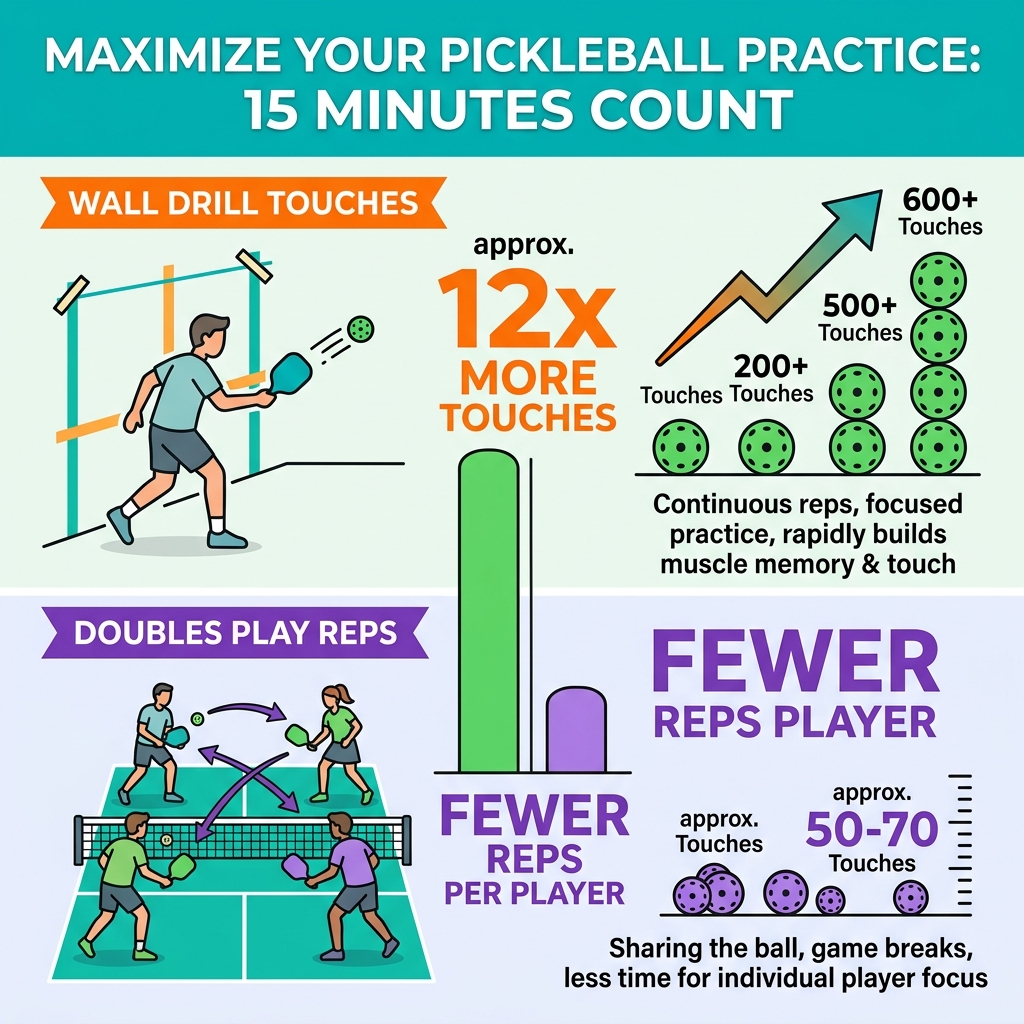
Pro player Ava Ignatowich put it simply: when practicing on a court, you’re only hitting around 25% of the shots compared to solo wall practice. That gap is enormous, especially when you’re still building muscle memory and touch.
Just 15 minutes against a wall gives you roughly the same number of ball contacts as three full hours of doubles play. That’s not a small advantage — that’s a complete rethink of how you practice.
Whether you’re struggling with inconsistent dinks, slow hands at the kitchen line, or just want more reps without the hassle of booking a court, wall drills are the shortcut you’ve been overlooking.
The Science of the Rep: Why Wall Drills Outperform Court Time
We often hear that “practice makes perfect,” but in pickleball, it’s more accurate to say “purposeful repetitions build champions.” When we play a standard game of doubles, we are sharing the ball with three other people. Between serves, side-outs, and our partner taking shots, our actual “paddle-on-ball” time is surprisingly low.
Research shows that practicing on a wall can yield 12 times more touches than a standard game. If you spend just 15 minutes doing a pickleball wall drill, you are getting the same amount of work in as you would in three hours of competitive doubles play. This is why pros like Shea Underwood and Ava Ignatowich swear by the wall; it compresses hours of learning into minutes.
Beyond just the volume of hits, the wall provides immediate feedback. If your paddle angle is off by even a fraction of a degree, the wall will tell you instantly by sending the ball into the ground or over your head. This constant loop of action and reaction can increase your reaction time by up to 25%. Furthermore, regular wall practice can improve your overall versatility and shot placement by up to 20%.
Before jumping into these high-intensity reps, it is vital to prepare your body. We recommend checking out warm-up-exercises-for-senior-pickleball-players/ to ensure your joints are ready for the quick lateral movements wall drills require.
Wall Work vs. Doubles Play: The Numbers
| Feature | 15 Minutes of Wall Drills | 3 Hours of Doubles Play |
|---|---|---|
| Total Touches | ~250 – 400 | ~250 – 400 |
| Consistency | High (Ball always returns) | Low (Depends on rallies) |
| Skill Isolation | Excellent (You choose the shot) | Poor (Game dictates shots) |
| Reaction Time | Boosted by up to 25% | Standard game speed |
Setting Up Your Home Pickleball Wall Drill Station
The beauty of a pickleball wall drill is that you don’t need a fancy facility. We have found that a garage wall, a basement, or even a sturdy brick exterior works perfectly. The key is to make your practice area mimic a real court as closely as possible.
To set up an effective station, follow these steps:
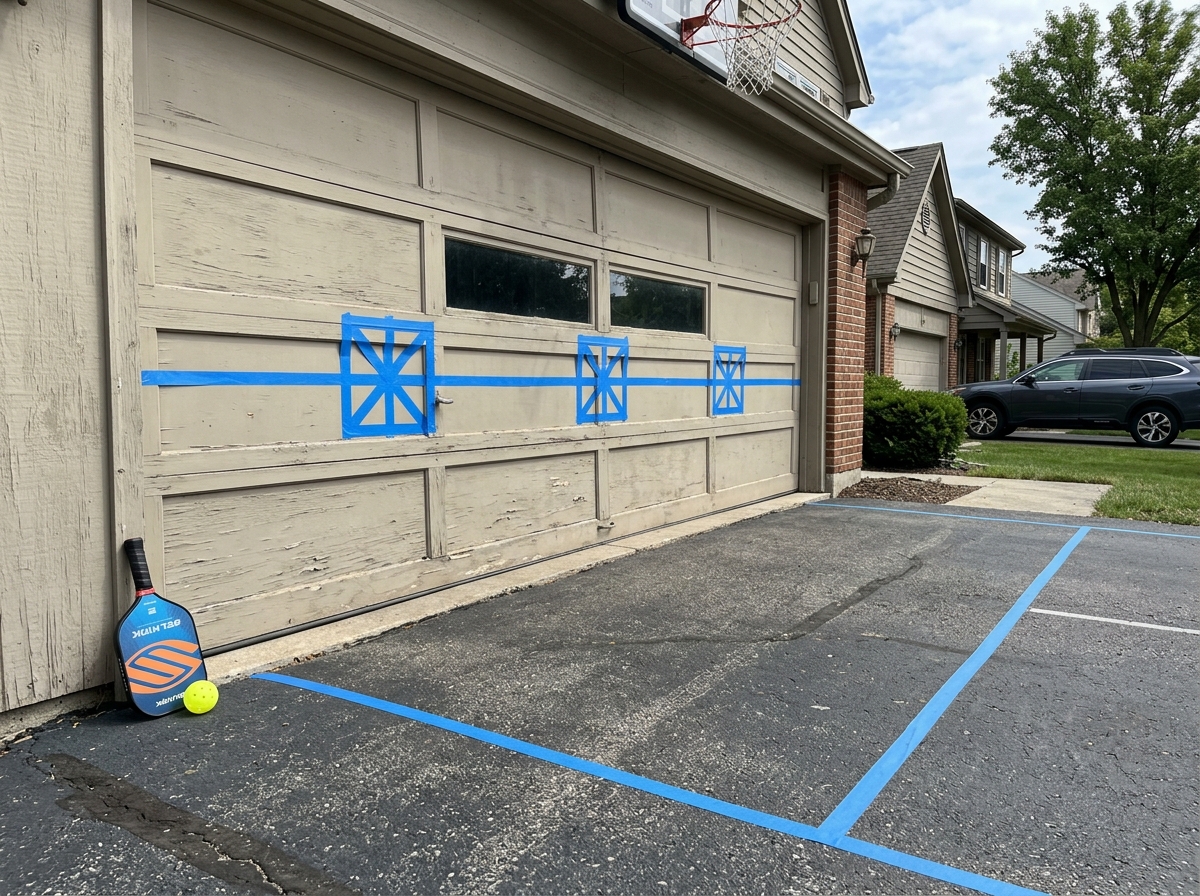
- The Net Line: Use painter’s tape to mark a horizontal line 35 inches off the ground. This represents the height of the pickleball net.
- The Targets: Create three evenly distributed squares (about 12×12 inches) along that 35-inch line. These give you specific targets to aim for, preventing “mindless hitting.”
- The Kitchen Line: Measure 7 feet back from the wall and place a line of tape on the ground. This is your Non-Volley Zone (NVZ) line.
- Distance Markers: For more advanced drills, mark lines at 12, 17, and 22 feet to practice your transition zone resets and drops.
If you are practicing in a tight space like a basement, ensure you have clear footing. Safety is paramount, so we suggest reviewing safe-court-movement-for-senior-beginners/ to avoid trips or falls during your solo sessions. If your wall isn’t perfectly smooth, a large sheet of plywood leaned against a frame can serve as a great DIY substitute.
Essential Equipment for Your Pickleball Wall Drill
You don’t need much to get started, but having the right gear makes a difference.
- The Paddle: Use your primary game paddle to ensure the “feel” translates to the court.
- The Ball: If you are indoors on a smooth floor, an indoor ball with larger holes might bounce more true. However, most players prefer using the ball they play with most often (like the Dura Fast 40 or Franklin X-40).
- Tape: Blue painter’s tape is our favorite because it’s easy to see and won’t damage your walls or floors.
- Lead Tape: Some pros, including Ava Ignatowich, suggest adding lead tape to your paddle during wall drills. This increases the weight, helping to strengthen your forearm and wrist muscles during those rapid-fire exchanges.
For those just starting their journey, our guide on senior-friendly-beginner-pickleball-drills/ offers additional equipment tips tailored for comfort and ease of use.
Essential Pickleball Wall Drills for Every Skill Level
Once your wall is taped and your paddle is ready, it’s time to drill. The goal isn’t just to hit the ball hard; it’s to develop “soft hands” and a rhythmic consistency. The wall is the ultimate coach because it never misses—if you hit a bad shot, you have to deal with the consequences immediately.
A great starting point is the Moving Volley Drill. Stand at the 7-foot kitchen line and volley the ball into the right square, then the middle, then the left, all without letting the ball bounce. This forces you to adjust your paddle face and footwork constantly. For a challenge, try the pattern: Right-Middle-Left-Left-Middle-Right.
If you are looking for more structured routines, we have compiled several drills-for-senior-beginners-in-pickleball/ that focus on balance and controlled contact.
Mastering the Foundation with a Beginner Pickleball Wall Drill
For beginners, the most important skill to master is the dink. Dinking against a wall builds the muscle memory needed to keep the ball low and unattackable.
- Forehand Dinks: Stand 7 feet from the wall. Hit 20 consecutive forehand dinks into a target square. Focus on a “lifting” motion from the shoulder rather than a “flick” of the wrist.
- Backhand Dinks: Repeat the process with your backhand. Many of us find the backhand side trickier, so don’t be afraid to spend extra time here.
- Alternating Dinks: Hit one forehand, then one backhand. This forces you to shift your weight and reset your paddle position.
Remember to stay in a low, athletic stance. Before you start these repetitive motions, a good flexibility routine is essential. Take a look at stretching-routines-before-pickleball-for-older-adults/ to keep your muscles limber and prevent strain.
Advanced Progressions: Improving Hand Speed and Resets
As you become more comfortable, you need to increase the “chaos” of your pickleball wall drill. Advanced players use the wall to simulate the “firefights” that happen at the kitchen line.
Pro player Ava Ignatowich emphasizes that wall drills are less about seeing where the ball lands (since you can’t see the “other side” of the net) and more about developing “feel.” One of her favorite methods is the Fast Hands Drill. Stand slightly closer than 7 feet and alternate forehand and backhand volleys as fast as possible. Because the wall returns the ball instantly, your brain is forced to speed up its processing time.
Another excellent progression is the 2-Touch Volley. Instead of hitting the ball back immediately, use your first touch to “deadened” the ball (catching it on your paddle) and the second touch to volley it back. This simulates absorbing a hard drive from an opponent and resetting the point.
To excel at these advanced levels, your feet must be as fast as your hands. We recommend studying footwork-fundamentals-in-pickleball-for-beginners/ to ensure you are using small, efficient steps rather than lunging.
The Pro-Level Pickleball Wall Drill: Dink-Speedup-Reset
This is the “holy grail” of wall drills. It teaches you to transition from a defensive dink to an offensive attack, and then back to a defensive reset.
- Step 1: Hit a soft, controlled dink to your target.
- Step 2: On the next ball, hit a hard “speed-up” volley.
- Step 3: The wall will fire that speed-up back at you quickly. Your goal is to “reset” it with a soft touch so that the next ball would land in the opponent’s kitchen.
This drill is exhausting but incredibly rewarding. It builds the “transition” skills that separate 3.5 players from 4.5+ players.
Common Mistakes and Pro Tips for Solo Practice
Even the best pickleball wall drill can be ineffective if done with poor form. We see three common mistakes that hold players back:
- Watching the Wall, Not the Ball: Many players stare at the target on the wall. Instead, keep your eyes glued to the ball until the moment of contact. This is how you develop “the sweet spot” feel.
- The “Big Swing”: On the court, you have room to swing. Against a wall, the ball comes back too fast for a big backswing. Keep your paddle out in front and use short, compact “punch” motions.
- Rigid Grip: If you hold your paddle like a hammer, your resets will fly off the paddle and go long. Use a light grip (about a 3 or 4 out of 10) for dinks and resets to absorb the ball’s energy.
Always return to your “ready position” (paddle up, knees bent) after every single hit. This builds the habit of being ready for the next shot, which is vital in games.
Frequently Asked Questions about Pickleball Wall Drills
Can wall drills replace playing with a partner?
While a pickleball wall drill is superior for building “touches” and mechanical consistency, it cannot replace a partner entirely. A wall doesn’t have a strategy, it doesn’t lob you, and it doesn’t move around the court. Use the wall to sharpen your tools, but use court time to learn how to use those tools in a tactical setting.
How much time should I dedicate to wall drills?
Consistency is better than intensity. We recommend 15 minutes a day. Because the rep count is so high, 15 minutes is often enough to fatigue your forearm and brain. If you do this daily, you’ll see a significant improvement in your hand speed and “touch” within just two weeks.
What is the best surface for practicing wall drills?
A smooth concrete or brick wall is ideal for a consistent bounce. If you are worried about noise or vibration, a sheet of 3/4-inch plywood is an excellent alternative. It provides a slightly “softer” bounce that mimics the pace of a real pickleball court better than solid stone.
Conclusion
At Voce Economia, we believe that the path to becoming a better player doesn’t always require a $50-an-hour coach or a crowded local park. Sometimes, all you need is a roll of tape, a paddle, and a bit of determination.
The pickleball wall drill is the ultimate “equalizer.” It allows you to out-work your competition from the comfort of your own garage. By committing to just 15 minutes of daily practice, you are giving yourself the gift of thousands of extra touches per month. You’ll walk onto the court with faster hands, a more reliable dink, and the confidence that comes from knowing you’ve put in the work.
For more advice on how to level up your game, explore our More beginner tips and drills section. Now, grab your paddle and head to the nearest wall—your “partner” is waiting!
