
How to Block Hard Hits Without Breaking a Sweat
Why a Simple Pickleball Blocking Technique Can Save Your Game
A simple pickleball blocking technique can completely change how you handle hard, fast shots at the kitchen line. As noted by USA Pickleball, the governing body for the sport, defensive positioning is crucial for neutralizing aggressive opponents. Here’s the quick answer:
How to block in pickleball (fast summary):
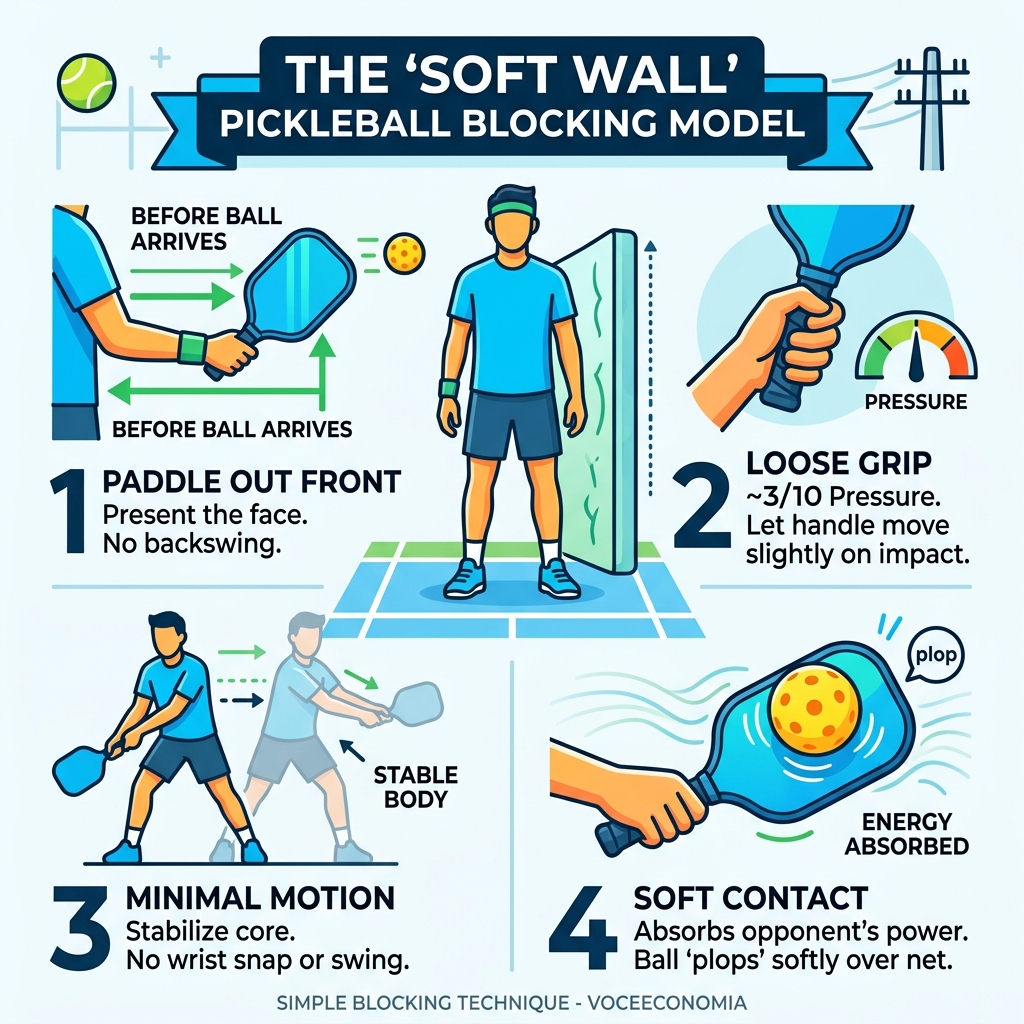
- Get your paddle out front at navel height before the ball arrives
- Loosen your grip to about 3 out of 10 pressure
- Keep your elbow down and let motion come from your shoulder
- Don’t swing – present the paddle and let the ball rebound off it
- Angle the face slightly open so the ball clears the net and drops softly into the kitchen
If you’ve ever had a hard drive zip past you before you could react, you’re not alone. At close range, swinging at a fast shot is almost always the wrong move – it’s like asking a baseball batter to face a pitcher from just 10 feet away. There simply isn’t enough time.
The good news? You don’t need fast hands or perfect timing to block well. You need less motion, not more.
The goal of a block isn’t to win the point. It’s to absorb your opponent’s power and drop the ball softly back into the kitchen – buying yourself time and resetting the rally on your terms.
What is a Block Shot and When to Use It?
In our experience, many beginners think every shot needs a full swing to be effective. However, a block shot is a defensive volley where we use the opponent’s own pace against them. Instead of adding power, we act as a “soft wall” or a mattress, absorbing the energy of a fast-moving ball so it “plops” harmlessly into the opponent’s kitchen.
We primarily use this shot when we are under attack. If you are standing at the kitchen line and an opponent rips a drive at your chest, you don’t have time for a backswing. This is where the beginners-guide-to-pickleball-shots becomes essential; understanding that the block is your primary “banger defense” allows you to stay calm when the game gets fast.
You should use a block shot when:
- Resetting the rally: You’ve been pulled out of position and need to slow the game down.
- Defending against “Bangers”: Your opponents love to hit hard from the baseline, and you need to neutralize that power.
- Caught off-guard: The ball is coming at your body faster than you can prepare a full stroke.
- Maintaining kitchen line stability: You want to stay at the Non-Volley Zone (NVZ) rather than being pushed back by aggressive shots.
The beauty of a simple pickleball blocking technique is that it transitions the game from a chaotic “bang-bang” exchange into a controlled dinking battle, where we have the advantage.
The 5 Fundamentals of a Simple Pickleball Blocking Technique
To master the block, we have to fight our natural instinct to “hit” the ball. Think of it more as “paddle presentation.” Here are the five pillars that make a block successful.
1. The Ready Position and Athletic Stance
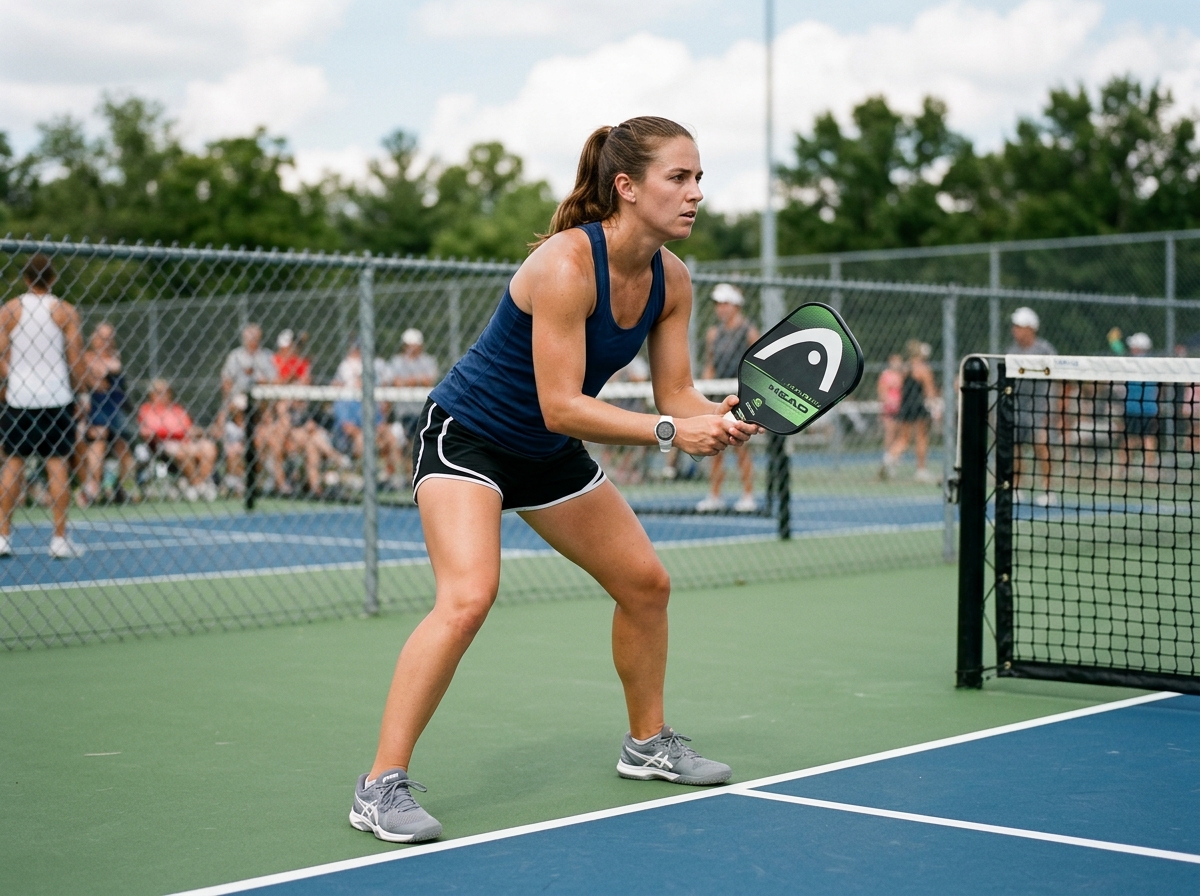
Everything starts with your base. We recommend a low, athletic stance with your knees bent and feet slightly wider than shoulder-width apart. This is often called the “split step” stance. By staying on the balls of your feet, you can react much faster to incoming shots. Your paddle should be out in front of your body at roughly navel or chest height. If your paddle is hanging by your knees, you’ve already lost the point against a hard hitter.
2. The Continental Grip and Grip Pressure
We suggest using the Continental grip (often called the “hammer grip”) because it allows you to switch between forehand and backhand blocks without adjusting your hand. The secret sauce, however, is grip pressure. On a scale of 1 to 10 (where 10 is a death grip), you want to be at a 3 or 4. A loose grip acts like a shock absorber. If your grip is too tight, the ball will bounce off the paddle with too much energy, causing a “pop-up” that your opponent can easily smash.
3. The “Frozen Elbow” Rule
One of the most common mistakes we see is players flaring their elbows out like chicken wings or tucking them too tightly against their ribs. To execute a simple pickleball blocking technique, keep your elbow “frozen” in front of your body. Any movement should come from the shoulder. This keeps the shot compact and prevents the “swinging” motion that leads to errors. This is one of the essential-pickleball-techniques-for-seniors because it relies on stability rather than raw wrist strength.
4. Quiet Hands and Minimal Motion
In pickleball, “quiet hands” means no wrist flicks and no backswing. When the ball hits your paddle, it should feel like a “catch and release.” You are simply providing a surface for the ball to land on. The less you move, the less can go wrong.
5. Shoulder-Driven Motion
Since we aren’t using our wrists or elbows, the tiny adjustment needed to direct the ball comes from the shoulder. Think of your arm and paddle as one solid unit that moves just an inch or two forward to meet the ball.
Mastering the Backhand for a Simple Pickleball Blocking Technique
While you can block with your forehand, we almost always prefer the backhand for defense. Why? Because the backhand covers more of your body. If an opponent attacks your torso or “chicken wing” area (your paddle-side shoulder), a backhand-ready posture allows you to protect yourself with very little movement.
Keeping the elbow down and the paddle face slightly tilted toward the backhand side is one of the safe-pickleball-techniques-for-seniors because it reduces the need for frantic, wide-reaching movements. It creates a stable shield in front of your most vulnerable areas.
Step-by-Step: Executing the Perfect Block
Now that we have the fundamentals, let’s walk through the actual execution.
- Anticipate the Attack: Watch your opponent’s paddle face and body language. If they are winding up for a big drive, get into your split step immediately.
- Present the Paddle: Move your paddle to the path of the ball before it gets to you. Contact should always be made well in front of your body.
- The 3-6 Inch Rule: Your paddle should only move 3 to 6 inches during the entire shot. There is no follow-through. You are simply meeting the ball.
- Angle the Face: To ensure the ball clears the net, angle your paddle face slightly upward (about 10-20 degrees). This adds a bit of “loft” and backspin, helping the ball land softly in the kitchen.
- Absorb and Reset: Imagine the ball is an egg and you don’t want to break it. “Catch” the ball with the paddle and let the pace of the incoming shot do the work of sending it back over the net.
This process is part of simplifying-pickleball-shots-for-beginner-level, focusing on efficiency over power.
Soft Reset vs. Punch Block: Choosing Your Defense
Not all blocks are created equal. Depending on how early you see the ball and where it is aimed, you’ll need to choose between a Soft Reset and a Punch Block.
| Feature | Soft Reset | Punch Block |
|---|---|---|
| Goal | Neutralize pace; drop ball in NVZ | Direct ball to feet; apply pressure |
| When to Use | When you’re late or ball is low/heavy | When you’re early and ball is chest-high |
| Grip Pressure | Very loose (2-3/10) | Slightly firmer (4-5/10) |
| Motion | Almost zero; “absorb” | Small forward push; “punch” |
| Outcome | Slows the game down | Forces opponent to hit up |
Mastering the difference helps in avoiding-common-beginners-mistakes-in-pickleball, such as trying to punch a ball that is too low, which usually results in hitting the net. If you are off-balance or the ball is dipping at your feet, always default to the Soft Reset.
Drills to Refine Your Simple Pickleball Blocking Technique
You can’t learn to block just by reading; you need muscle memory. Here are our favorite drills:
- The Human Wall Drill: Have a partner stand at the kitchen line and dink with you. Occasionally, have them “speed up” the ball directly at you. Your goal is to block it back softly into the kitchen. This is a staple in senior-friendly-beginner-pickleball-drills.
- The Double Hit Volley Drill: This is great for developing “soft hands.” Try to hit the ball up to yourself once (a tiny pop-up) and then hit it over the net. This teaches you how to absorb the ball’s energy.
- The Banger Defense Drill: Have a partner hit hard drives from the baseline while you stand at the kitchen. Focus on keeping your grip loose and resetting every single drive into their kitchen. Check out more drills-for-senior-beginners-in-pickleball for similar exercises.
- Wall Reps: Find a flat wall and hit volleys against it from about 7 feet away. Focus on “quiet hands” and minimal paddle movement.
Troubleshooting Common Blocking Mistakes
Even with a simple pickleball blocking technique, things can go wrong. If you find yourself struggling, check for these common errors:
The “Pop-Up” Error
If your blocks are consistently sitting high and getting smashed, it’s usually because of one of two things:
- Death Grip: You are holding the paddle too tight. Loosen up!
- Open Face: You are flaring the paddle face too far back. Keep it more vertical.
The “Net Dump”
If the ball keeps hitting the net, you might be contacting the ball too late (behind your body) or your paddle face is too “closed” (tilted toward the ground). Reach out and meet the ball earlier!
Paddle Stability Issues
Sometimes, it’s not you—it’s the gear. If your paddle twists in your hand when a fast ball hits the edge, you might need a paddle with a higher “twist weight.” You can also add lead tape to the sides of your paddle to increase stability. We cover this in the-ultimate-guide-to-picking-your-first-pickleball-paddle.
For those using lightweight-pickleball-paddles-a-guide-for-senior-beginners, be aware that very light paddles can sometimes vibrate or “flutter” against heavy drives. Adding a small amount of lead tape can help without making the paddle too heavy to swing.
Frequently Asked Questions about Blocking
Why do my blocks always pop up for a smash?
As we mentioned, this is almost always due to tension. When we see a fast ball, our natural reaction is to tense our shoulders and grip the paddle harder. This turns your paddle into a trampoline. To fix this, think about having “long neck” and relaxed shoulders. Imagine you are catching the ball in a basket rather than hitting it.
Should I use my forehand or backhand to block body attacks?
Always backhand. It is much faster to move your backhand across your chest than to try and tuck your elbow in for a forehand block. If you keep your paddle in a “backhand-biased” ready position (tilted slightly toward your non-paddle side), you can protect your entire torso with a simple tilt of the wrist.
How loose should my grip really be?
Think of holding a small bird or an egg. You want to hold it firmly enough that it doesn’t fly away, but gently enough that you don’t crush it. On a scale of 1-10, aim for a 3.
Conclusion
At Voce Economia, we believe that mastering a simple pickleball blocking technique is the fastest way to move from a beginner to an intermediate player. By learning to “calm the chaos” at the kitchen line, you take away the banger’s biggest weapon: their power.
The best blocks are often the most “boring” ones. They don’t look like much, but they force your opponent to hit a difficult shot from their feet, eventually leading to a mistake you can capitalize on. Keep your hands quiet, your grip loose, and your paddle out front.
For More beginner pickleball tips and strategies, stay tuned to our latest guides and gear reviews. See you on the court!
