
How to Approach the Net Without Getting Pickled
Why the Easy Pickleball Approach Shot Changes Everything
The easy pickleball approach shot is the shot you hit while moving toward the kitchen (the Non-Volley Zone line), with the goal of landing it safely and advancing to the net.
Here’s the quick version of how to do it:
- Hit the ball deep into your opponent’s court with a controlled stroke
- Keep your grip loose and your swing compact
- Aim for the kitchen on drop shots, or deep on drives
- Move forward immediately after contact toward the kitchen line
- Split step as your opponent prepares to hit
That’s the core of it. Everything else is just making it more consistent.
Most beginner pickleball players focus on hitting the ball hard. But pickleball success is actually built on positioning — getting to the kitchen line before your opponent can take control of the point.
The approach shot is the bridge between the baseline and the net. Get it right, and you take away your opponent’s advantage. Get it wrong, and you’re stuck in the dreaded middle of the court, where most points are lost.
There’s a reason coaches say consistency on the return separates 3.5 players from 4.0 players. It’s not about power. It’s about placement, patience, and moving forward with purpose after every shot.
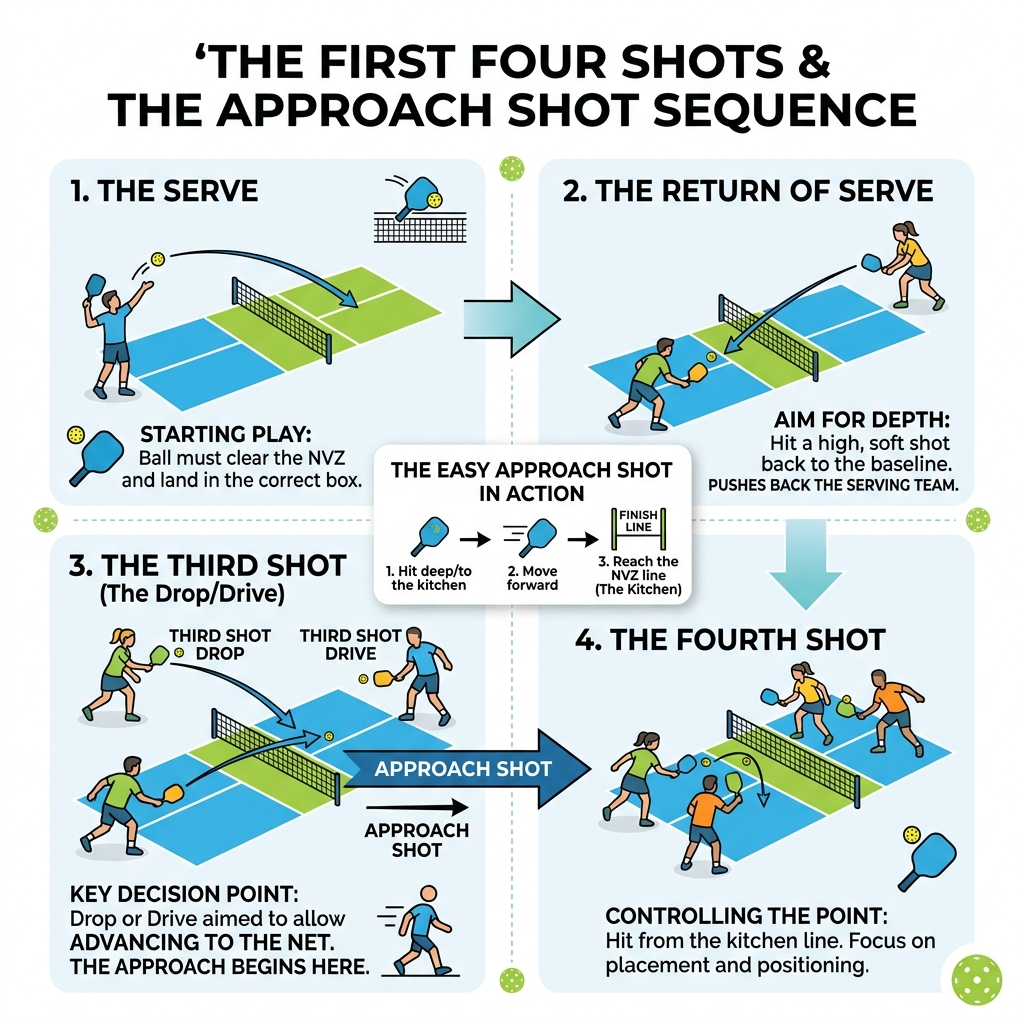
The first four shots of every pickleball rally — the serve, the return, the third shot, and the fourth shot — set the tone for the entire point. The approach shot sits right at the heart of that sequence.
The Fundamentals of an Easy Pickleball Approach Shot
To master the easy pickleball approach shot, we first need to understand the mechanics of the paddle and the geography of the court. In pickleball, the “Transition Zone” (often called the “No-Man’s Land”) is the area between the baseline and the Non-Volley Zone (NVZ) line. Staying here too long is a recipe for disaster because the ball will often land at your feet, forcing difficult half-volleys.
The approach shot is your ticket out of this zone. Whether you are hitting a return of serve or a third shot drop, the goal remains the same: hit a ball that allows you to safely reach the kitchen line.
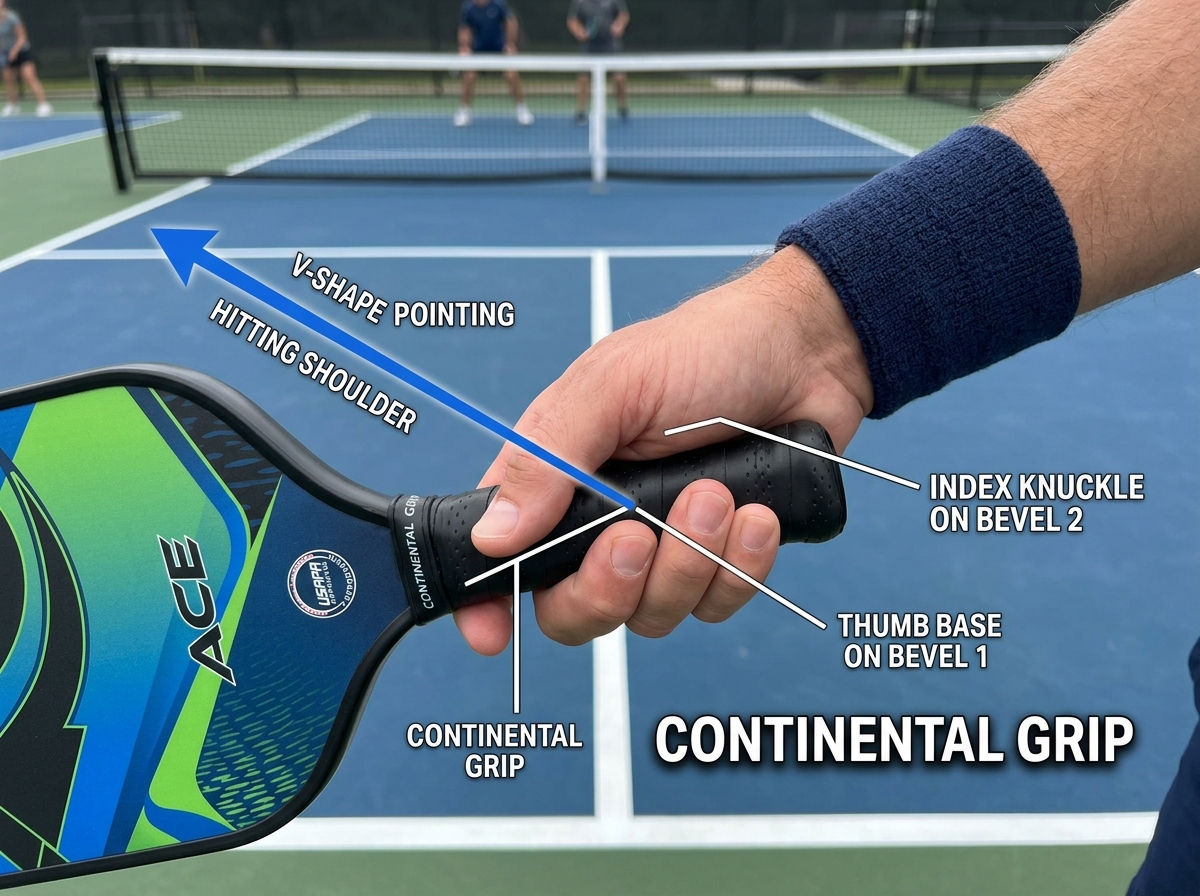
For beginners, we highly recommend using the Continental Grip. Imagine you are shaking hands with your paddle. The “V” shape formed by your thumb and index finger should point toward your hitting shoulder. This grip is the gold standard because it allows you to handle forehands, backhands, and volleys without having to shift your hand in the middle of a fast rally. If you want a broader rules-based overview of how the kitchen and non-volley restrictions affect this transition, the USA Pickleball Official Rulebook is a useful external reference.
When we compare an approach shot to a standard groundstroke, the differences are subtle but vital for your success.
TABLE: Approach Shots vs. Standard Groundstrokes
| Feature | Standard Groundstroke | Easy Pickleball Approach Shot |
|---|---|---|
| Primary Goal | Stay in the rally/Win from baseline | Transition to the kitchen line |
| Swing Length | Full follow-through | Compact, controlled lift |
| Movement | Often stationary or lateral | Forward momentum toward the net |
| Target | Deep baseline or corners | Kitchen (Drop) or Deep Middle (Drive) |
If you are just starting out, check out our beginners guide to pickleball shots to see how the approach fits into the wider variety of hits you’ll use on the court.
Defining the Approach in Modern Play
In the modern game, an easy pickleball approach shot isn’t just a defensive “get-it-over” shot. It is a tool for neutralizing the opponent’s advantage. When you are the serving team, you start at a disadvantage because the receiving team is already at the kitchen. A well-executed third shot drop-a classic approach shot-forces your opponent to hit the ball up, which gives you the time to move forward into an offensive position.
Learning to read the rhythm of the game is essential. If you hit a weak, short return, you shouldn’t blindly charge the net; you’ll likely get “pickled” by a hard drive. However, if you hit a deep, looping return, that is your green light to sprint forward. For a deeper dive into the sequence of play, see our step-by-step guide to learning pickleball.
The “Three L’s” of Technique
When we teach the easy pickleball approach shot, we focus on the “Three L’s.” This simple framework helps strip away the “tennis brain” tendency to over-swing.
- Loose Grip: On a scale of 1 to 10, your grip pressure should be about a 3 or 4. A tight grip makes the paddle face too “springy,” causing the ball to pop up too high. A loose grip acts like a shock absorber, giving you that soft “touch.”
- Less Swing: We want to minimize the backswing. The power should come from your legs and a gentle shoulder hinge, not a big wind-up. Keep the paddle in front of your body at all times.
- Lift Motion: Instead of hitting through the ball like a tennis drive, think about lifting the ball. You want the apex (the highest point of the ball’s arc) to be on your side of the net. This ensures it clears the tape and then drops steeply into the opponent’s kitchen.
By simplifying pickleball shots for beginner level players, we focus on the shoulder as the primary hinge. Your wrist should remain “quiet”-no flicking or snapping-to maintain maximum consistency.
Strategy Selection: Drive and Charge vs. Chip and Charge
Once you have the mechanics down, you need to decide which type of approach to use. The old-school method was the “chip and charge,” where you’d slice the ball to keep it low and slow. However, many modern pros prefer the “drive and charge.”
Targeting for Maximum Effectiveness
Where should you aim your easy pickleball approach shot?
- The Middle: In doubles, hitting down the middle is often the smartest play. It creates confusion between partners (“Yours!” “No, yours!”) and exploits the fact that the net is lowest in the center.
- The Backhand: Most players have a weaker backhand. In singles, targeting the backhand is a must. In doubles, aim for the opponent’s left foot (if they are right-handed).
- Depth is King: On a return of serve, depth is more important than pace. A deep return keeps the server pinned at the baseline, making their third shot much harder to execute.
Understanding where to stand is just as important as where to hit. Seniors and beginners should review our guide on understanding court positions in pickleball for seniors to avoid being caught out of place.
Choosing Between a Drop, Drive, or Lob
How do you decide in the heat of the moment?
- The Drop: Use this when you want to neutralize a strong opponent at the net. It’s the “gold standard” for moving from baseline to kitchen.
- The Drive: If the return is short or high, “drive and charge.” Hit a hard, low shot to force a pop-up, then move in to finish the point.
- The Lob: Use this sparingly. It’s a great “reset” if your opponents are crowding the net and smashing everything, but a short lob is an easy overhead for them.
If you’re feeling adventurous, you can even learn how to hit an aggressive pickleball drop shot by adding a bit of topspin. This makes the ball dip faster once it clears the net. Also, knowing when to speed up the ball in pickleball can help you turn a defensive approach into an offensive winner.
Essential Footwork to Master the Easy Pickleball Approach Shot
You can have the best hands in the world, but if your feet are stuck in cement, you won’t make it to the kitchen. Footwork is the engine of the easy pickleball approach shot.
Footwork for an Easy Pickleball Approach Shot
The most important footwork element is the split step. As your opponent is about to make contact with the ball, you must stop your forward momentum and hop slightly into a wide, balanced stance. This allows you to react to the ball whether it’s hit to your left, your right, or directly at your feet.
- Forward Momentum: Don’t just stand and watch your shot. Hit, then immediately take two or three purposeful steps toward the net.
- Stay Balanced: Never hit while running. Move, stop (split step), hit, and move again.
- Weight Transfer: Ensure your weight is moving forward as you contact the ball. This adds “free” power without needing a big swing.
For those just starting, our guide on footwork fundamentals in pickleball for beginners is a great resource. We also have specific advice on safe court movement for senior beginners to ensure you stay agile without risking injury.
Integrating the First Four Shots
The approach shot doesn’t exist in a vacuum. It is part of a four-shot “blueprint” that defines most pickleball rallies:
- The Serve: Goal is depth and consistency. Move forward slightly after the serve.
- The Return: This is your first real easy pickleball approach shot. Hit it deep and get to the NVZ line immediately.
- The Third Shot: The serving team’s chance to transition. Usually a drop or a drive.
- The Fourth Shot: The receiving team’s chance to keep the opponents back. Volley aggressively but smartly.
Mastering these four shots is the quickest way to improve your win rate. If you play mostly doubles, understanding the basics of playing doubles in pickleball for beginners will help you coordinate these shots with your partner.
Troubleshooting Your Easy Pickleball Approach Shot
Even the pros mess up their approach shots. The key is identifying why the error happened so you can fix it.
Troubleshooting Your Easy Pickleball Approach Shot
- Hitting into the net: This usually happens because of a “fear poke”—a hesitant, jerky motion. Remember the “Lift” in our Three L’s. Aim for a higher margin over the net (4-8 inches).
- The “Floater” (hitting it too long): This is often caused by too much backswing or a grip that is too tight. If the ball is sailing out, check your grip pressure.
- Getting caught in “No-Man’s Land”: If you find yourself constantly getting hit in the feet, you aren’t moving forward fast enough after your shot, or you’re forgetting to split step.
For senior players, we have a tailored step-by-step guide to learning pickleball for seniors that addresses these common hurdles with a focus on longevity and ease of play.
Fixing the “Floater” Problem
A “floater” is a high, slow ball that your opponent can easily smash. To fix this:
- Contact Point: Make sure you are hitting the ball out in front of your body.
- Hit on the Descent: Don’t try to “short hop” the ball if you don’t have to. Let the ball reach its apex and hit it as it starts to come down.
- Topspin Brush: Instead of a flat hit, try brushing up the back of the ball. This creates topspin, which pulls the ball down toward the court after it clears the net.
Drills for Consistency and Confidence
Knowledge is great, but “muscle memory” is what wins games. We recommend these drills to make your easy pickleball approach shot second nature.
The Slinky and Rope Drills
- The Slinky Drill: Start at the kitchen line with a partner. Hit a few dinks. Then, take one step back after every shot until you reach the baseline, all while trying to land the ball in the kitchen. Then, work your way back in. This teaches you how to adjust your “lift” based on your distance from the net.
- The Rope Drill: Tie a piece of string or a “rope” about 6-12 inches above the net. Practice hitting your approach shots under the rope but over the net. This forces you to find that perfect “aggressive drop” trajectory.
We have many more drills for senior beginners in pickleball and senior-friendly beginner pickleball drills that focus on building these specific skills without overtaxing the body.
The 3-5-7 Ladder System
This is a sequencing drill.
- Shot 3: Hit a third shot drop.
- Shot 5: If the third shot was too high and you couldn’t get all the way to the net, hit a fifth shot “reset” drop from the transition zone.
- Shot 7: If needed, hit a seventh shot to finally earn your spot at the kitchen.
The goal is to reach the net by the 7th shot at the latest. This drill teaches patience—you don’t always have to get to the net on the first try!
Frequently Asked Questions about Approach Shots
What is the most common mistake in a pickleball approach shot?
The most common mistake is over-swinging. Many players try to “kill” the ball, which leads to unforced errors. Remember: the approach shot is a transition tool, not a finishing move. Keep it compact and focused on placement.
Should I always aim for the kitchen on my approach?
Not necessarily. While the “drop” is the most common approach, a deep “drive” to the opponent’s feet can be just as effective if they are slow to react. The goal is to hit a ball that they cannot hit down at you.
How does the “push drop” differ from a slice approach?
A “push drop” is a linear, flat-faced motion where you “push” the ball forward. It’s often more consistent for beginners than a slice, which requires more precise timing to avoid “popping” the ball up too high.
Conclusion
At Voce Economia, we believe that mastering the easy pickleball approach shot is the single most important step you can take to move from a “beginner” (3.0) to an “intermediate” (3.5-4.0) player. It’s about shifting your mindset from “hit it hard” to “move smart.”
By focusing on the Three L’s—Loose grip, Less swing, and Lift—and practicing your transition footwork, you’ll find yourself winning more rallies and feeling much more confident at the net. Pickleball is a game of patience. Don’t rush the process, and don’t be afraid to hit a fifth or seventh shot if the third one wasn’t perfect.
Ready to take your game even further? Master more skills with our beginner tips and keep practicing those drops! See you on the court!
