
How to Pick Your First Paddle Without Breaking a Hip
Your Senior Pickleball Paddle Beginners Guide: Start Playing Today
This senior pickleball paddle beginners guide gives you everything you need to pick your first paddle and get on the court fast.
Quick answer for seniors just starting out:
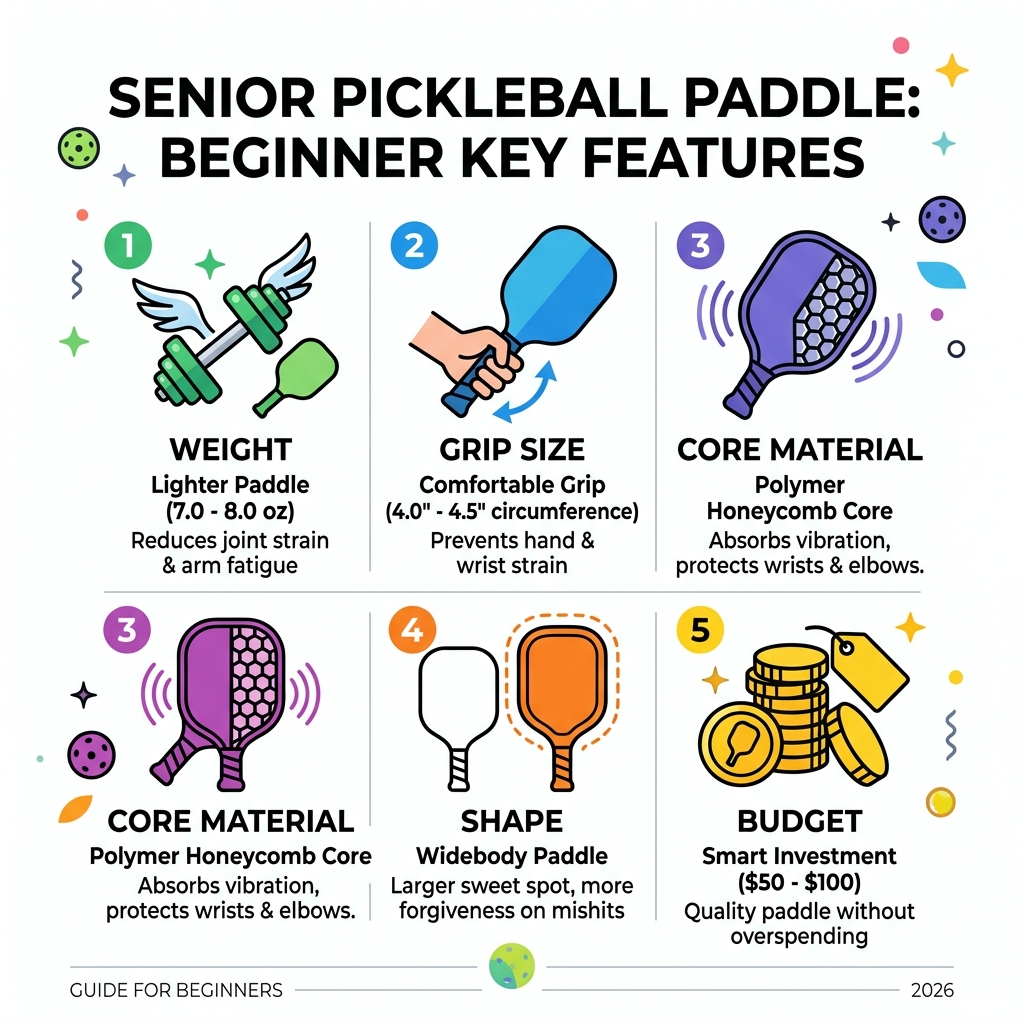
- Weight: Choose a lightweight paddle between 7.0 and 8.0 ounces to reduce joint strain and arm fatigue
- Grip size: Look for a 4 to 4.5 inch circumference for comfortable control
- Core material: Polymer honeycomb core absorbs vibration and protects your wrists and elbows
- Face material: Composite or graphite face for better control and consistency
- Shape: Widebody paddle for a larger sweet spot and more forgiveness on mishits
- Budget: Spend $50 to $100 to get a solid beginner paddle without overpaying
Pickleball is America’s fastest-growing sport — and seniors are leading the charge.
It is easy to see why. The game combines elements of tennis, badminton, and ping-pong on a smaller court. Games are shorter. The movements are gentler on your body. And you can be competitive within weeks of picking up a paddle.
But here is the part most beginners get wrong: the first paddle you choose matters more than you think.
The wrong paddle can cause elbow pain, wrist fatigue, and frustration. The right one helps you build skills faster, play longer, and actually enjoy yourself from day one.
The good news? You do not need to spend a lot of money or understand complicated specs. You just need to know what to look for — and that is exactly what this guide covers.
Why Pickleball is the Ideal Sport for Active Seniors
We often hear that staying active is the “fountain of youth,” and in racket sports, pickleball is the closest thing we have to a magic potion. It is not just about the game; it is about the lifestyle. For many of us, the local court has become a daily social ritual, a place where we find community and laughter while getting our heart rates up.
From a health perspective, the benefits are backed by more than just anecdotal evidence. Engaging in regular play significantly improves cardiovascular health, helping to keep our hearts strong without the high-impact stress of long-distance running. Because pickleball requires quick lateral movements and hand-eye coordination, it is also a fantastic way to enhance balance and coordination. This is particularly vital as we age, as better balance directly leads to a reduced risk of falls.
Furthermore, the weight-bearing nature of the sport contributes to improved bone health. Every time we move across the court or plant our feet for a shot, we are helping to maintain bone density. Beyond the physical, the cognitive stimulation of keeping score and strategizing mid-rally keeps the mind sharp. If you are looking for a deeper dive into the medical side of things, you can explore this Scientific research on pickleball health benefits for seniors.
Key Physical Considerations in a Senior Pickleball Paddle Beginners Guide
When we step onto the court, our equipment acts as an extension of our bodies. For senior players, this means the paddle needs to do more than just hit a ball; it needs to protect our joints. Unlike tennis, where a heavy racket can help plow through a heavy ball, pickleball uses a light, perforated plastic ball. However, the repetitive nature of the “dink” and the “drive” can still lead to micro-trauma in the wrist and elbow.
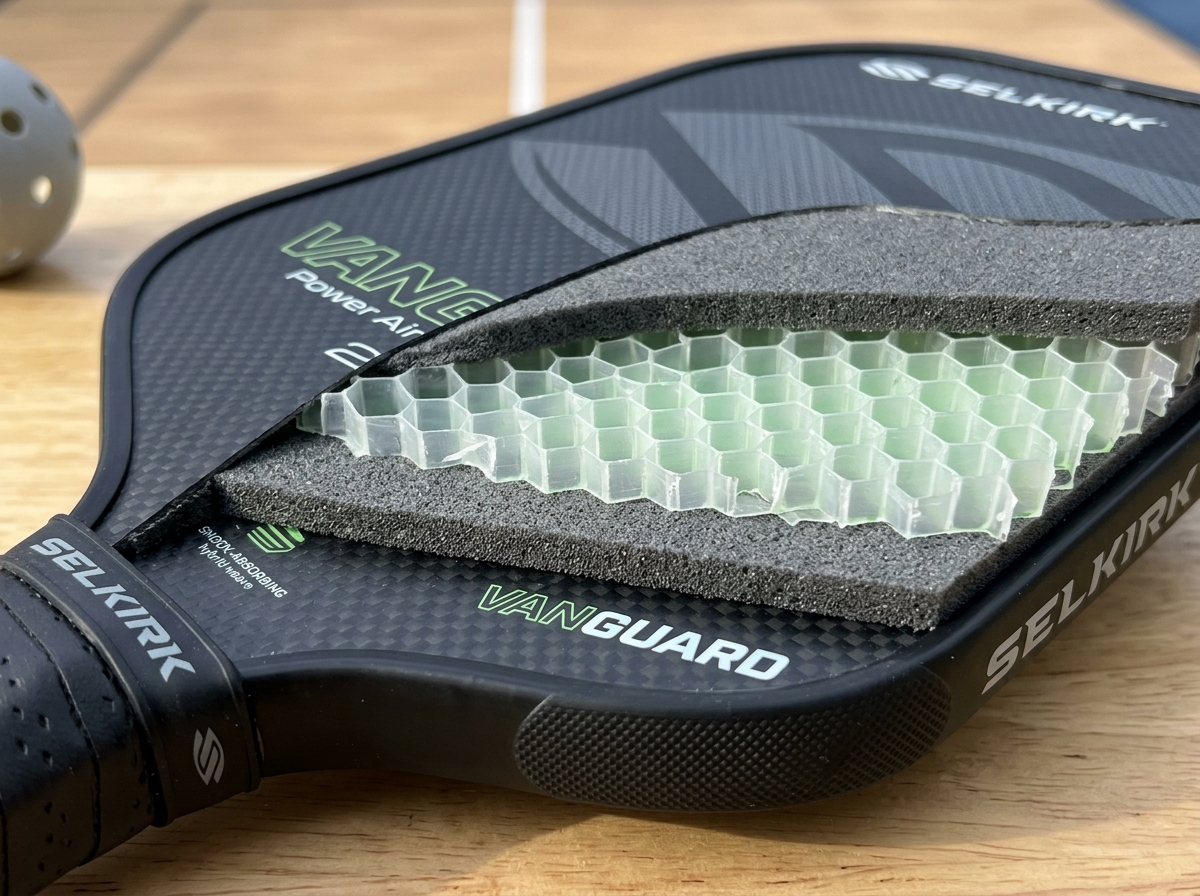
One of the most critical factors we emphasize in this senior pickleball paddle beginners guide is vibration dampening. When a ball strikes a paddle, a shockwave travels from the face, through the core, and up into your arm. If your paddle is too stiff or lacks a quality core, that energy ends up in your elbow, often resulting in the dreaded “tennis elbow” (or “pickleball elbow”).
Fatigue reduction is another major goal. A paddle that feels like a lead weight after thirty minutes of play will ruin your afternoon. We want you to be able to play three or four games in a row without feeling like your shoulder is on fire. Choosing the right weight is the first step in managing this. For a deeper look at how weight specifically affects your body, check out our guide on navigating-pickleball-paddle-weights-a-guide-for-senior-players.
Technical Specifications: Weight, Grip, and Materials
Understanding the “specs” of a paddle can feel like learning a new language, but we can break it down into three simple categories: weight, grip, and what the thing is actually made of.
Finding the Perfect Weight in Your Senior Pickleball Paddle Beginners Guide
Weight is arguably the most important decision you will make. In the pickleball world, paddles generally fall into three buckets:
- Lightweight: Under 7.3 ounces
- Midweight: 7.3 to 8.4 ounces
- Heavyweight: 8.5 ounces and up
For most senior beginners, we recommend staying in the 7.0 to 8.0 ounce range. Why? Because a lighter paddle is significantly easier to maneuver at the “kitchen” line (the area near the net). It allows for faster “hands” during quick volleys and reduces the strain on your rotator cuff.
While some players think a heavier paddle provides more power, it often comes at the cost of control and swing speed. If you have any history of arthritis or joint sensitivity, leaning toward the lighter side of midweight is your safest bet. You can find more specific recommendations in our article on lightweight-pickleball-paddles-a-guide-for-seniors.
Grip Size and Material Selection
If the weight is right but the grip is wrong, you are still headed for trouble. A grip that is too small requires you to squeeze the handle tighter to keep it from twisting, which leads to forearm fatigue. A grip that is too large can prevent you from using your wrist effectively.
Most seniors find their “sweet spot” with a grip circumference between 4 and 4.5 inches. A quick way to test this is the “index finger test”: when you hold the paddle in a normal grip, you should be able to fit the index finger of your other hand in the gap between your fingertips and the base of your thumb. For more details on getting this measurement right, see understanding-pickleball-paddle-grip-size-for-seniors.
As for materials, look for a polymer honeycomb core. This is the industry standard for a reason — it is durable, relatively quiet, and excellent at absorbing shock. For the “face” (the hitting surface), we recommend carbon fiber or graphite. These materials offer a more uniform feel across the paddle face, meaning the ball will react consistently even if you don’t hit it perfectly in the center every time. You can learn more about these components in our guide on decoding-pickleball-paddle-materials-for-beginners-2.
Selecting the Best Shape and Sweet Spot for Consistency
In your early days of playing, your biggest enemy isn’t the opponent — it is the “mishit.” This happens when the ball strikes the edge of the paddle, causing it to die or fly off in an unintended direction.
This is why we strongly suggest a widebody shape for beginners. Widebody paddles are typically about 8 inches wide and 15.5 to 16 inches long. This shape maximizes the “sweet spot,” which is the area on the paddle face that produces the most consistent and powerful response.
Compare this to “elongated” paddles, which are longer and narrower. While pros love elongated paddles for the extra reach and “whip” they provide, the sweet spot is often smaller and located further away from the hand, making them harder for beginners to control.
| Feature | Widebody Paddle | Elongated Paddle |
|---|---|---|
| Best For | Beginners & Seniors | Advanced & Tennis Converts |
| Sweet Spot Size | Large & Forgiving | Smaller & High-set |
| Maneuverability | Excellent | Moderate |
| Reach | Standard | Extended |
| Primary Benefit | Consistency | Power & Reach |
If you want to dive deeper into how different surfaces affect your game, read our breakdown on decoding-pickleball-paddle-materials-for-beginners.
Budgeting and Essential Gear for New Players
You do not need to take out a second mortgage to start playing pickleball, but you should avoid the “bargain bin” wood paddles often found at big-box retailers. Wood paddles are heavy, vibrate excessively, and offer almost no control.
Price Tiers in Your Senior Pickleball Paddle Beginners Guide
We generally categorize paddle pricing into three tiers for beginners:
- The Starter Set ($50 – $80): Often includes two paddles, a few balls, and a carrying bag. These are great for couples starting together. Look for sets that specifically mention “USAPA Approved” to ensure they meet quality standards.
- The Intermediate Step-Up ($80 – $130): This is where you find high-quality carbon fiber faces and better edge guards. If you know you are going to play at least twice a week, this is the best value tier.
- The Premium Investment ($150+): These paddles feature the latest technology, like foam-injected edges for stability. While nice, they aren’t strictly necessary for your first six months of play.
We recommend starting in that middle tier if your budget allows. It ensures the paddle can grow with you as your skills improve. For a comprehensive look at making your first purchase, check out the-ultimate-guide-to-picking-your-first-pickleball-paddle.
Additional Equipment Needs
While the paddle is the star of the show, you cannot play in flip-flops. Court shoes are the most important safety investment you can make. Running shoes are designed for forward motion; court shoes are designed for the lateral (side-to-side) movements of pickleball, providing the ankle support needed to prevent rolls and trips.
You will also need balls. Outdoor balls are harder, heavier, and have smaller holes to cut through the wind. Indoor balls are softer and easier to control on gym floors. Lastly, never forget a high-quality water bottle. Dehydration is a common issue on the courts, especially during summer months. For more on the “little things” that make a big difference, see how-to-choose-your-first-pickleball-without-losing-your-mind.
Avoiding Common Selection Mistakes and Injuries
One of the most frequent mistakes we see is the “Pro-Level Trap.” A beginner sees a professional player on TV using a specific $250 paddle and assumes it will make them play like a pro. In reality, pro-level paddles are often designed for maximum power and spin, which can be very difficult for a beginner to control. They are the “sports cars” of the pickleball world — fast, but not necessarily what you want to use when you are just learning to drive.
Another mistake is ignoring the “thunk.” If you hit a ball and feel a sharp “sting” in your hand, that paddle is likely too stiff or has a cheap core. Over time, that sting leads to inflammation.
To keep yourself on the court and out of the doctor’s office, follow these simple injury prevention tips:
- Warm up for 10 minutes: Do some light stretching and “shadow” swings before hitting a ball.
- Don’t over-reach: It is better to lose a point than to lunge and pull a muscle.
- Hydrate and rest: Take breaks between games, even if you feel like you can keep going.
- Check your grip: If you find yourself death-gripping the paddle, take a breath and relax your hand.
Scientific research has shown that racket sports are among the best activities for fall prevention because they train the brain and body to react quickly to changing environments. By choosing the right gear, you are ensuring that you can reap these benefits for years to come.
Frequently Asked Questions about Senior Pickleball
Can I use a tennis racket for pickleball?
No. A tennis racket is much longer, heavier, and uses strings rather than a solid surface. Using one on a pickleball court would not only be against the rules but would likely lead to immediate wrist injury due to the different physics of the ball impact.
How often should a senior beginner replace their paddle?
For most recreational players, a paddle will last about 12 to 18 months. Over time, the honeycomb core can begin to break down (known as “dead spots”) and the surface texture will wear away, making it harder to control the ball. If your paddle starts sounding like a hollow “clack” instead of a solid “thump,” it is time for a new one.
Is there a difference between indoor and outdoor paddles for seniors?
Technically, you can use the same paddle for both. However, some paddles are marketed as “indoor” because they have a smoother surface that works better with the softer indoor ball. “Outdoor” paddles often have a grittier texture to help generate spin on the harder outdoor balls. For a beginner, a good “all-court” paddle is perfectly fine for both environments.
Conclusion
At Voce Economia, we believe that pickleball is more than just a sport — it is a gateway to a healthier, more connected life. Choosing your first paddle shouldn’t be a source of stress. By focusing on a lightweight design, a comfortable grip, and a forgiving widebody shape, you are setting yourself up for success.
The “best” paddle is the one that feels comfortable in your hand and allows you to play pain-free. As you progress from a 2.0 beginner to a 3.5 intermediate player, your preferences may change, but the fundamentals of joint protection and control will always remain the same.
We are excited to see you out there on the court! For more tips on gear, strategy, and staying active, explore our More info about pickleball equipment. Welcome to the community!
