
The Newbie Guide to Pickleball Court Manners and Dos and Don’ts
Why Pickleball Etiquette for Beginners Matters More Than You Think
Pickleball etiquette for beginners is the set of unwritten social rules that keep every game friendly, fair, and fun for everyone on the court.
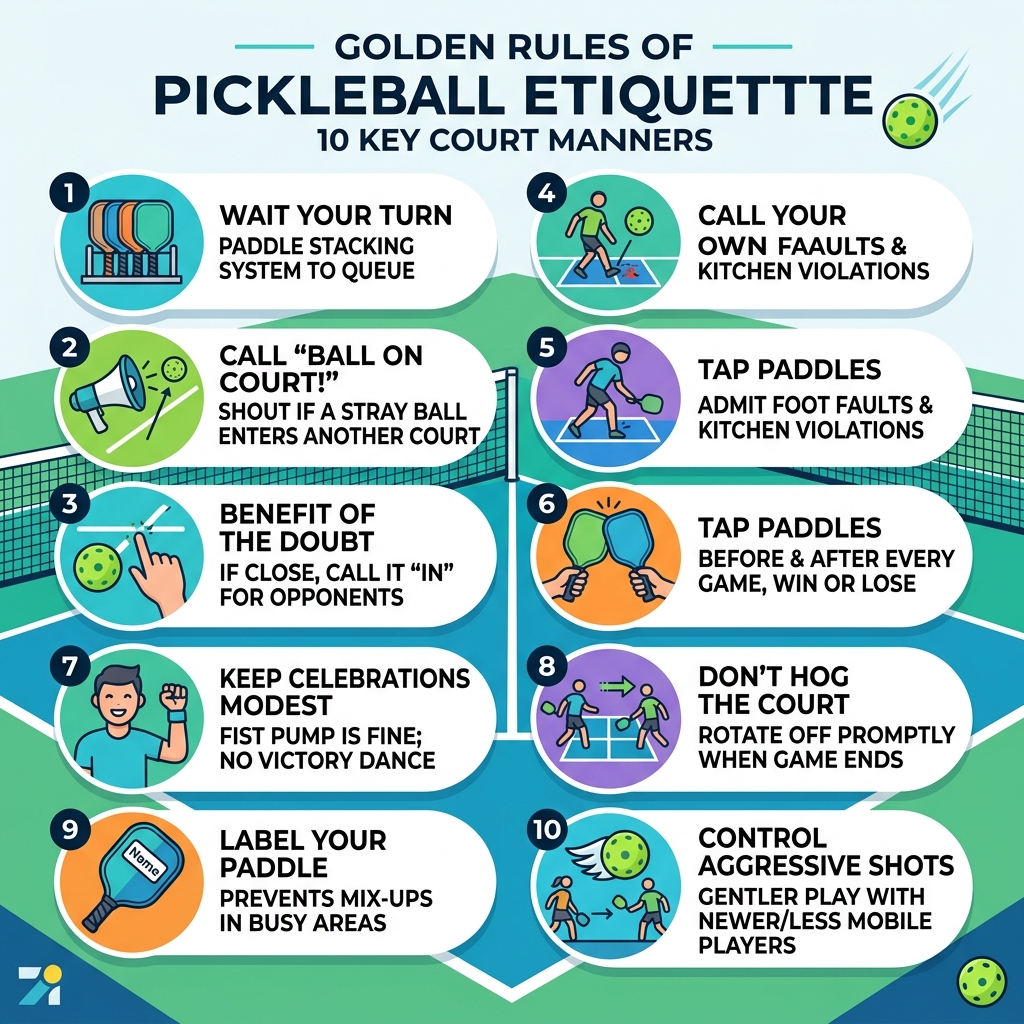
Here are the core rules you need to know before your first game:
- Wait your turn – Use the paddle stacking system to queue for the next game
- Call “Ball on court!” – Shout loudly if a stray ball enters another court
- Give the benefit of the doubt – If a line call is close, call it “in” for your opponent
- Call your own faults – Admit foot faults and kitchen violations honestly
- No unsolicited coaching – Only offer advice if someone asks for it
- Tap paddles – Before and after every game, win or lose
- Keep celebrations modest – A fist pump is fine; a victory dance is not
- Don’t hog the court – Rotate off promptly when your game ends
- Label your paddle – Prevents mix-ups in busy court areas
- Control aggressive shots – Especially when playing with newer or less mobile players
More than 99% of pickleball is played in casual, social settings — not tournaments. That means the way you carry yourself on the court matters far more than your backhand.
Think about walking into a party where you don’t know anyone. There’s that mix of excitement and nerves. Stepping onto a pickleball court for the first time feels a lot like that. The game is easy to pick up. The social rules? A little less obvious.
The good news: pickleball has a genuinely welcoming culture. The sport was invented over 60 years ago as a backyard family game, and that friendly spirit never left. Players aren’t looking to embarrass you. But they do notice whether you’re playing by the unspoken code.
This guide breaks down every rule you need to know — clearly and simply — so you can show up with confidence.
Pickleball etiquette for beginners glossary:
Essential Pickleball Etiquette for Beginners: The Unwritten Rules
When we talk about sportsmanship in pickleball, we aren’t just talking about following the rulebook. We are talking about an “ethic of play” that prioritizes respect, inclusion, and camaraderie. Even the Sportsmanship Guide | USA Pickleball acknowledges that this game requires cooperation and courtesy.
For us at Voce Economia, the most important part of being a “newbie” isn’t having the most expensive paddle; it’s understanding the court rhythm. This means knowing when to step on, how to interact with players of different skill levels, and how to keep the atmosphere light. If you are attending Introduction to Pickleball Social Events for Beginners, you’ll find that the social side of the game often carries more weight than your actual skill level.
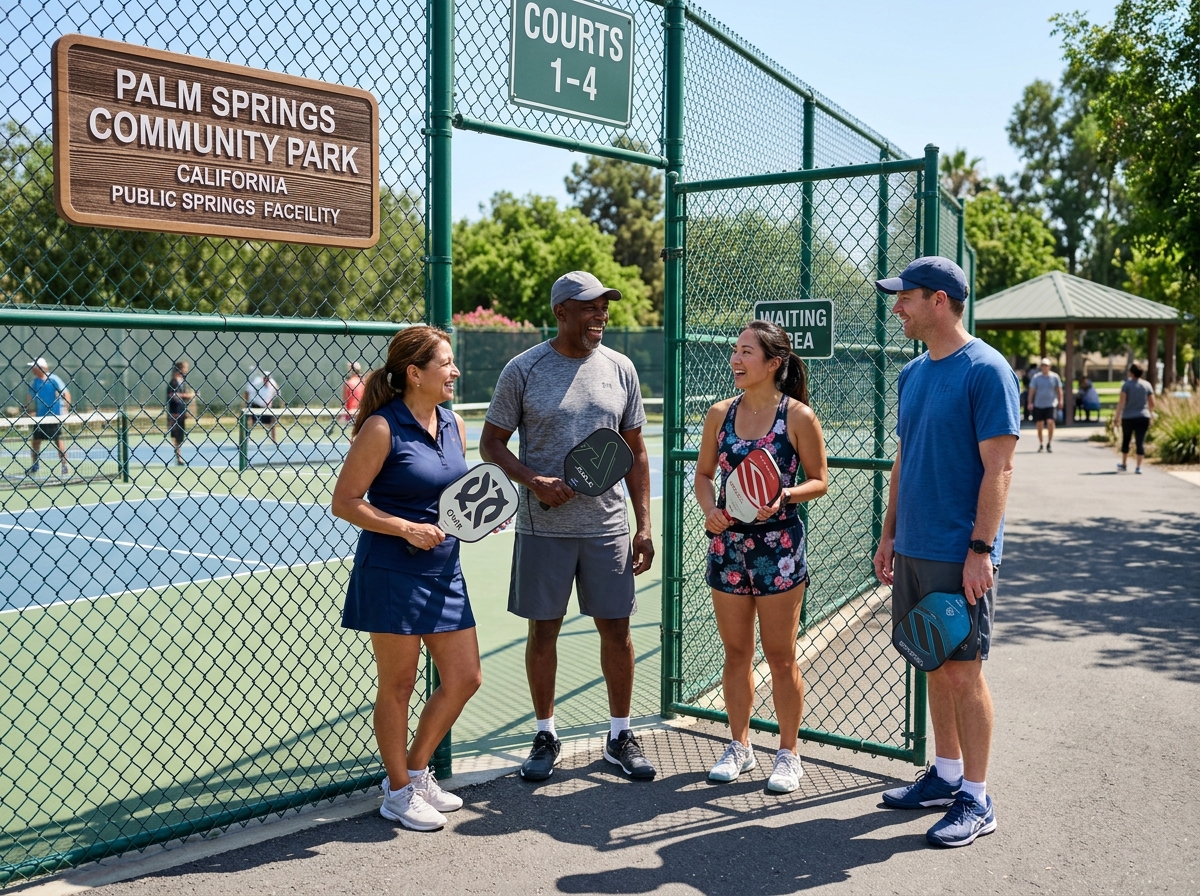
Mastering the Paddle Stacking System
If you show up to a public park and see a row of paddles leaning against a fence or sitting in a rack, you’ve found the “paddle stacking” system. This is the community’s unofficial way of managing busy courts. Instead of hovering awkwardly or shouting “I’ve got next!”, you simply place your paddle in the queue.
There are a few variations of this system:
- Four on, Four off: When a game ends, all four players leave the court, and the next four paddles in the stack take over.
- Winners Stay: The winning team stays on, and the next two paddles in the stack join them (though many social courts discourage this if the line is long to ensure everyone gets to play).
- Skill-based Stacks: Some courts have separate stacks for “Beginner,” “Intermediate,” and “Advanced” play.
As a beginner, don’t be shy. If you aren’t sure how the local rotation works, just ask a regular, “How do you all handle the paddle rotation here?” They will be happy to show you the ropes.
Handling Stray Balls and Safety Calls
Safety is the absolute priority on the court. Because pickleball courts are often packed closely together, balls will inevitably fly into neighboring games.
If your ball rolls onto another court, stop your play immediately and yell “Ball on court!” loudly. This isn’t just to get your ball back; it’s to prevent a player on the other court from stepping on it and rolling an ankle. You can find more on this in our guide to Safe Court Movement for Senior Beginners.
When returning a ball that has rolled onto your court:
- Wait for the other court to finish their rally.
- Make eye contact with one of the players.
- Gently roll or toss the ball back to them.
Never just blindly swat the ball back while they are in the middle of a point. It’s distracting and potentially dangerous.
Fair Play and Line Call Protocol
In pickleball, there are no referees in recreational play. This means you are the official for your side of the net. Integrity is the name of the game. According to USA Pickleball, you only call the lines on your side of the court.
When making calls, follow these “honesty” rules:
- The “Gap” Rule: If you can see a sliver of green (or court color) between the ball and the line, it’s out. If you can’t see a gap, it’s in.
- Promptness: Calls must be made instantly. If you hesitate for three seconds and then say “out,” the ball is technically considered in.
- Be Clear: Use both your voice and a hand signal (pointing up for out, or palm down for in) to avoid confusion, especially if the wind is blowing.
For a deeper dive into how these calls affect the game, check out Mastering Pickleball Scoring: A Comprehensive Guide for Beginners.
Giving the Benefit of the Doubt in Pickleball Etiquette for Beginners
One of the most important aspects of pickleball etiquette for beginners is the “benefit of the doubt” rule. If you and your partner aren’t 100% sure if a ball was in or out, you must call it in.
In pickleball, “maybe out” equals “definitely in.” Being generous toward your opponents is much better for the community than arguing over a fraction of an inch in a recreational game. If you are playing with older adults, you might find more tips on this in Navigate the Pickleball Rules for Beginners Over 60.
If your partner thinks it was out but you saw it as in, the ball is in. The “benefit” always goes to the team that hit the shot.
Calling Your Own Faults and Kitchen Violations
Integrity doesn’t stop at line calls. You are also responsible for calling your own faults. This includes:
- Kitchen (NVZ) Violations: If your toe touches the kitchen line while you are volleying the ball, call it on yourself.
- Service Faults: If you realize your server’s arm wasn’t moving in an upward arc or your contact point was above the waist, admit it.
- The “Double Hit”: If the ball hits your paddle twice or hits your clothing, speak up.
Self-reporting these mistakes earns you immediate respect from veteran players. It shows you value the game more than a single point. To help you stay on the right side of the rules, read about Avoiding Common Beginners Mistakes in Pickleball.
Social Dynamics and Partner Interaction
Pickleball is a team sport, and how you treat your partner is just as important as how you treat your opponents. We’ve all seen “that player” who rolls their eyes when their partner misses a shot. Don’t be that person!
Effective communication is key. Use short, decisive words like “Mine!”, “Yours!”, “Me!”, or “Out!” (to tell your partner not to hit a ball that is sailing long). After every point — whether you won it with a spectacular slam or lost it by hitting the net — meet your partner for a quick paddle tap. It keeps the energy positive and the connection strong. You can learn more about these dynamics in The Basics of Playing Doubles in Pickleball for Beginners.
Recreational vs. Tournament Targeting
| Feature | Recreational Play | Tournament Play |
|---|---|---|
| Primary Goal | Fun, social, skill building | Winning the match |
| Targeting | Spread the ball to both players | Hit 90% of balls to the weaker player |
| Atmosphere | Inclusive and encouraging | Competitive and intense |
| Etiquette | Avoid “body bagging” (aiming at the person) | Using body shots as a valid tactic |
The Dos and Don’ts of Pickleball Etiquette for Beginners Coaching
We have a saying in pickleball: unsolicited advice is like unrequested kale chips — most people don’t want it.
Even if you’ve spent hours Understanding Court Positions in Pickleball for Seniors, resist the urge to coach your partner or opponents during a game. It can feel patronizing or critical, especially to a fellow beginner.
The Golden Rule of Coaching:
- DON’T say: “You need to stay at the kitchen line.”
- DO say: “Hey, do you mind if I share a tip that helped me with my positioning?”
- ALWAYS wait for them to say “Yes” before offering the advice.
If you are the one receiving advice, be gracious. A simple “Thanks, I’ll keep that in mind” is the perfect way to acknowledge the tip without letting it distract you from your game.
Celebrating Points and Ending the Game
We love a player with gusto, but keep your celebrations “pickleball-chill.” A fist pump or a quiet “Yes!” is great. A 60-second victory dance or screaming at the top of your lungs is generally considered distasteful in a social setting.
When the game ends:
- Meet all players at the net.
- Offer a friendly paddle tap (tap the bottom of the handles or the faces gently).
- Say “Good game” or “Thanks for the fun.”
- If it was a great match, you might even offer a handshake.
Remember to respect the equipment! Don’t smash your paddle against the net or the ground if you’re frustrated. Not only is it bad manners, but it can also damage the court surface. For more on getting started in low-pressure environments, see Get Sporty: Friendly Competitions for Newbie Pickleball Players.
Frequently Asked Questions about Pickleball Manners
Is it okay to target the weaker player in open play?
In a tournament, targeting the weaker player is a smart strategy. In open play, it’s considered poor pickleball etiquette for beginners. If you constantly hit to the person who is struggling, they don’t get to learn, and the stronger player gets bored. To keep the game inclusive, try to spread the ball around. If you are the stronger player, use the opportunity to practice your own “soft game” by hitting to the more experienced opponent. This ensures everyone has a good time, which is the core of Understanding the Basic Gameplay of Pickleball for Senior Beginners.
How do I properly cross behind an active court?
Never, ever walk across or behind a court while a rally is in progress. It is distracting and dangerous.
- Wait for the point to end.
- Make eye contact with the players on that court or wait for them to wave you through.
- Move quickly across the back of the court.
- If you have a large group, cross all at once rather than one by one.
This is a key part of maintaining Safe Court Movement for Senior Beginners.
Why should I label my pickleball paddle?
Pickleball paddles are expensive — some Selkirk or Joola models cost over $300! Because many players use the same popular models, it is incredibly easy for someone to accidentally pick up your paddle from a rack or stack.
Put a small piece of tape on the edge guard or write your name/initials on the grip or the face of the paddle. This respects everyone’s property and prevents a very expensive mix-up.
Conclusion
At Voce Economia, we believe that the “pickleball bug” is one of the best things you can catch. By mastering pickleball etiquette for beginners, you aren’t just learning rules; you are joining a community. You don’t need to be the best player on the court to be the person everyone wants to play with — you just need to be the most respectful and fun.
Ready to find your local crew? Check out Want to Connect with Senior Pickleball Players? Here’s How. For more tips on gear and gameplay, explore our More info about pickleball guides. See you on the court!
