
Pickleball Balls 101 for the Freshly Pickled
Why the Right Ball Makes or Breaks Your Pickleball Start
A solid beginner pickleball balls guide starts with one simple truth: not all pickleball balls are created equal, and picking the wrong one will make learning the game much harder than it needs to be.
Here’s a quick-start answer for new players:
Best pickleball balls for beginners at a glance:
| Priority | What to Look For |
|---|---|
| Playing surface | Indoor ball (26 holes) for gyms; outdoor ball (40 holes) for concrete/asphalt |
| Weight | 0.78–0.935 oz; lighter balls (~0.85 oz) give beginners more control |
| Construction | Seamless for consistent bounce |
| Color | Optic yellow or neon green for best visibility |
| Approval | USA Pickleball approved for any league or structured play |
| Budget | Start with a 3-6 ball pack; expect $2–$4 per ball |
The ball you pick affects how fast the game plays, how predictable the bounce feels, and how quickly your skills develop. A softer, slower indoor ball gives you more reaction time. A hard outdoor ball on a rough court will punish every mishit.
Think of it this way: using the wrong pickleball ball is a bit like trying to learn to ride a bike with flat tires. You can do it, but everything feels harder than it should.
This guide walks you through everything — from understanding what a pickleball actually is, to choosing the right one for where you play, to making your balls last as long as possible.
Understanding the Basics: What is a Pickleball Ball?
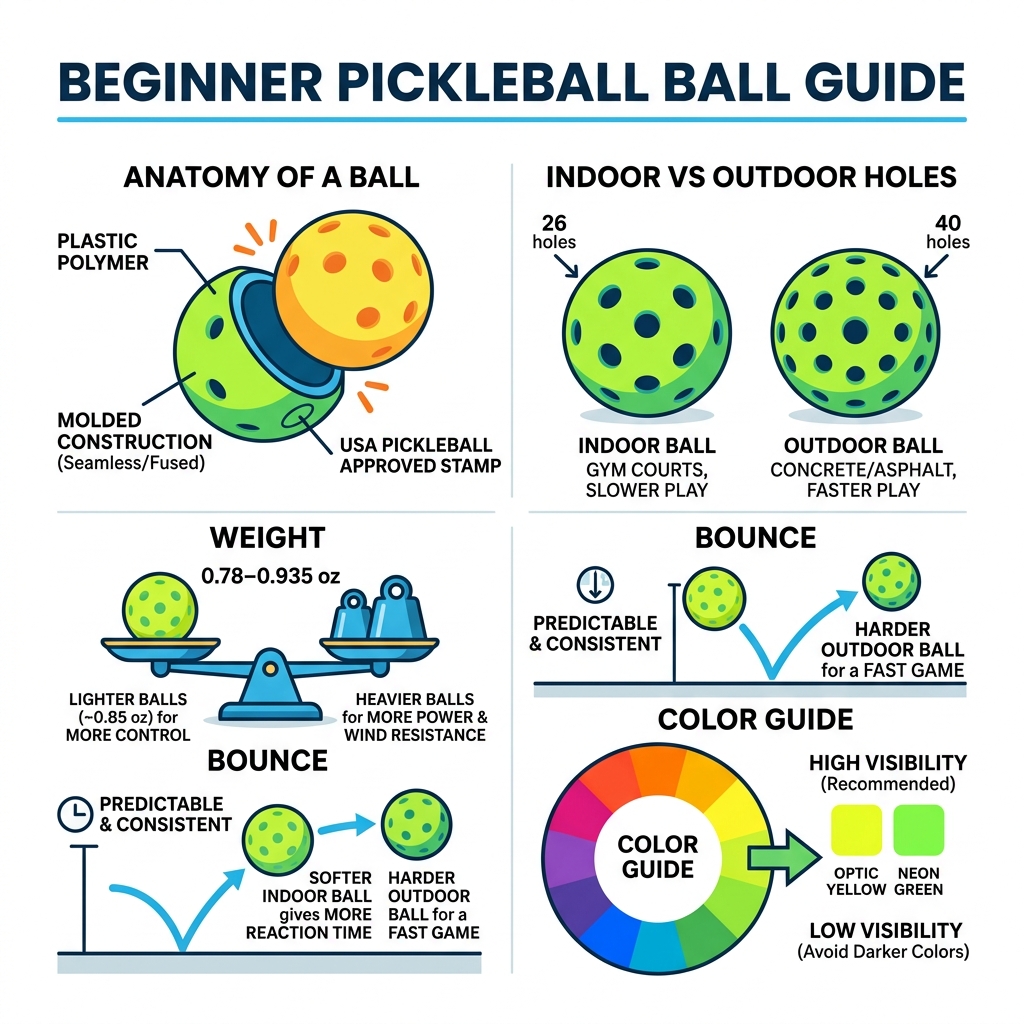
At first glance, a pickleball looks like a wiffle ball’s sturdier cousin. However, these are precision-engineered pieces of equipment designed to meet strict standards. Most pickleball balls are made from a plastic polymer, chosen for its ability to withstand high-velocity impacts while maintaining a consistent shape.
According to USA Pickleball specifications, a regulation ball must adhere to several key metrics to ensure the game remains fair and predictable:
- Weight: Between 0.78 and 0.935 ounces. For those of us just starting out, we often find that balls on the lighter end of this spectrum (around 0.85 oz) are easier to control.
- Diameter: 2.87 to 2.97 inches. This size is specifically designed to interact with the paddle face to allow for both “pop” and spin.
- Bounce Height: When dropped from 78 inches onto a granite surface, the ball must bounce between 30 and 34 inches. This consistency is vital for developing your timing.
- Hardness: Measured on the Shore D scale, the plastic’s density affects how much the ball “skids” or “grabs” the court.
The perforations, or holes, are not just for decoration. They are strategically drilled or molded to create drag, which keeps the ball at a manageable speed. Without these holes, a pickleball would fly through the air like a tennis ball, making the small court nearly impossible to defend. The aerodynamics of the hole pattern also help stabilize the flight, preventing the ball from wobbling mid-air.
The Great Debate: Indoor vs. Outdoor Beginner Pickleball Balls Guide
One of the most common points of confusion for “freshly pickled” players is the difference between indoor and outdoor balls. While you can technically hit any ball on any surface, using the wrong one is like wearing hiking boots to a ballet recital—it just doesn’t work well.
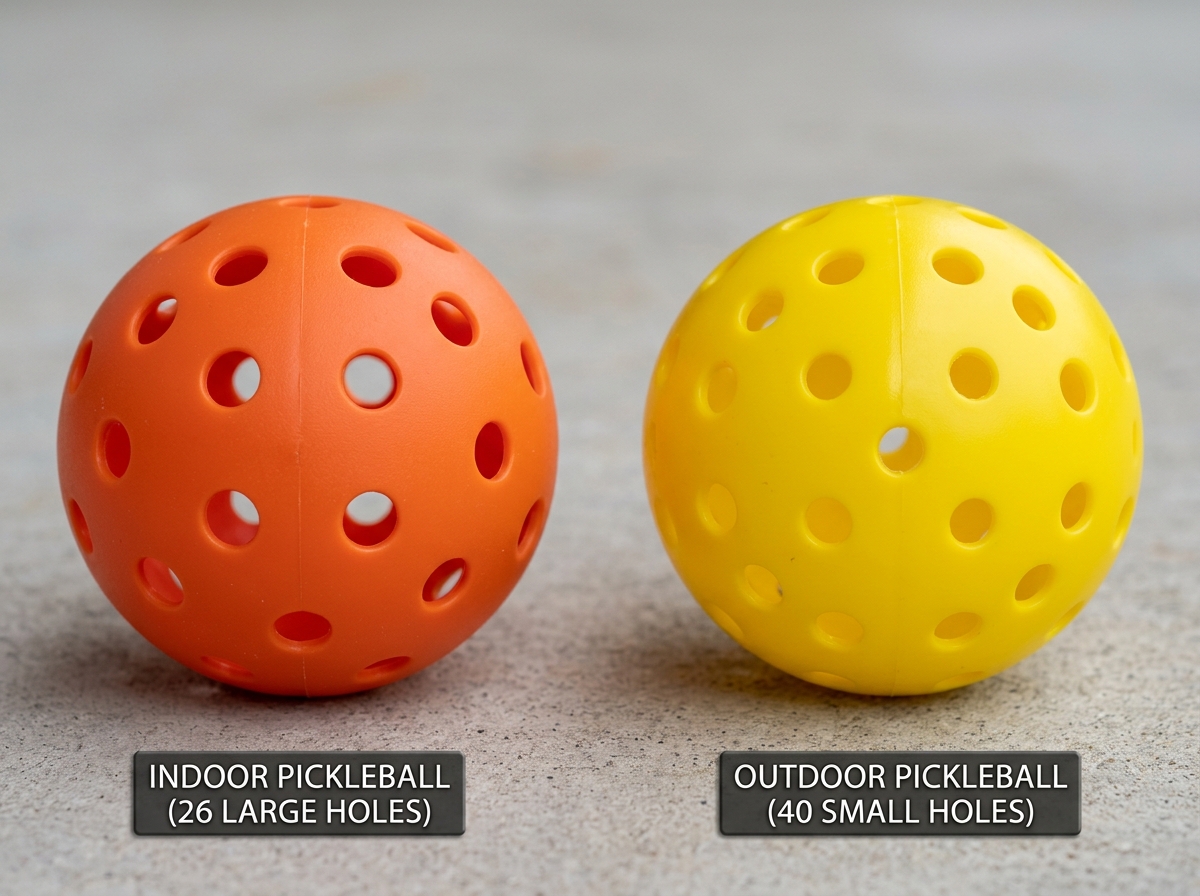
The primary difference lies in the hole count. Indoor balls typically have 26 larger holes, while outdoor balls feature 40 smaller holes. This design choice is all about wind resistance. Smaller holes allow outdoor balls to cut through breezes without being blown off course, whereas larger holes on indoor balls provide more drag to slow the game down in a windless environment.
| Feature | Indoor Balls | Outdoor Balls |
|---|---|---|
| Hole Count | 26 (Larger) | 40 (Smaller) |
| Material | Softer Plastic (EVA/Polyethylene) | Harder Plastic (HDPE) |
| Weight | Lighter (approx. 0.81–0.92 oz) | Heavier (approx. 0.90–1.02 oz) |
| Durability | High (less likely to crack) | Lower (prone to cracking/abrasion) |
| Bounce | Higher and softer | Lower and faster |
| Noise | Quieter “thud” | Louder “pop” |
Why Indoor Balls are a Beginner Pickleball Balls Guide Essential
If you are playing in a gymnasium or a dedicated indoor facility with wood or smooth tile floors, an indoor ball is your best friend. These balls are crafted from a softer plastic, which makes them much more “forgiving.”
For beginners, the slower pace of an indoor ball is a massive advantage. It gives you those extra milliseconds to react, get your feet in position, and execute a proper stroke. We recommend starting with indoor balls because they offer a predictable bounce and allow you to focus on finding-the-best-pickleball-balls-for-beginners that match your emerging playstyle. They are also less noisy, which can make the learning environment feel a bit less chaotic.
Transitioning to Outdoor Play with a Beginner Pickleball Balls Guide
Outdoor pickleball is a different beast entirely. Since most outdoor courts are made of asphalt or concrete, they are incredibly abrasive. Outdoor balls are made of harder plastic to resist this wear and tear, but that hardness also makes them more prone to cracking, especially in cold weather.
The heavier weight and 40 smaller holes are essential for wind stability. If you tried to use an indoor ball on a windy outdoor court, you’d find it dancing around like a leaf. When you are finding-the-best-pickleball-balls-for-beginners-2, look for outdoor balls that mention “rotational molding.” This manufacturing process creates a seamless ball that flies straighter and lasts longer on rough surfaces.
How to Choose Your First Set of Balls
When you’re standing in the sports store or browsing online, the sheer number of options can be overwhelming. Here is our expert advice on narrowing it down.
1. Prioritize Visibility As a new player, your eyes are still adjusting to the speed of the game. Optic yellow and neon green are the gold standards for a reason—they offer the highest contrast against most court surfaces. However, if you’re playing on a bright blue court under heavy sunlight, you might find that neon orange or pink balls are easier to track.
2. Look for Seamless Construction Balls are generally made in two ways: injection molding (two halves joined together) or rotational molding (one solid piece). For beginners, rotational molding is superior. Seamless balls provide a much more consistent bounce. There is nothing more frustrating than a ball hitting a seam and taking a “bad hop” just as you’re about to swing. We always tell our readers to stop-playing-with-bad-balls-and-get-the-best-instead to avoid these early-game frustrations.
3. Check for USA Pickleball Approval Even if you aren’t planning on playing in a tournament tomorrow, buying “Approved” balls ensures you are practicing with the correct weight and bounce. It helps your “muscle memory” develop accurately.
4. Buy in Bulk (But Not Too Much) Pickleball balls are consumables. They will break, lose their bounce, or get lost in the bushes. Starting with a 6-pack or a 12-pack is usually the sweet spot for a beginner. It’s more cost-effective than buying single balls but doesn’t leave you with a lifetime supply of a ball you might eventually decide you don’t like.
Maintenance and Longevity: Making Your Gear Last
It’s a sad day when your favorite ball finally gives up the ghost. While outdoor balls typically last between 20-30 games of recreational play, their lifespan can be much shorter if you don’t take care of them.
Temperature Impact
Plastic hates extreme temperatures. In cold weather (below 50°F), the plastic becomes brittle. One hard overhead smash in the cold can cause a hairline crack instantly. Conversely, extreme heat can make the balls too soft, causing them to go “out-of-round” (losing their perfect sphere shape).
Storage and Care Tips:
- Keep them inside: Don’t leave your balls in a hot car or a freezing garage. Store them at room temperature.
- Use a mesh bag: This allows the balls to air out and prevents moisture buildup, which can affect the plastic’s integrity.
- Rotate your stock: Don’t just play with the same two balls until they explode. If you have a 6-pack, cycle through all of them so they wear down at the same rate.
- Clean them up: A quick wipe with a damp cloth to remove court dust can actually help maintain the “grip” of the ball on your paddle.
When to replace a ball:
- You see a visible crack (even a tiny one).
- The ball makes a “flat” or “dull” sound when hit.
- The ball wobbles when you spin it on a flat surface (it’s out-of-round).
- You notice “soft spots” when squeezing the ball.
Frequently Asked Questions about Beginner Pickleball Balls
Can I use indoor balls outdoors or vice versa?
Technically, yes, but we don’t recommend it. Using an indoor ball outdoors will result in a very “dead” bounce on rough concrete, and the wind will blow it everywhere. Using an outdoor ball indoors can be dangerous; they are much harder and faster, meaning they can skid on gym floors and potentially cause trips or harder-than-expected impacts if a player is hit.
How long do pickleball balls typically last?
For a beginner playing at a moderate intensity, a high-quality outdoor ball like the Franklin X-40 should last about 20 to 30 games. Indoor balls usually last much longer—often months—because they aren’t being scraped against abrasive asphalt. However, they will eventually develop soft spots and lose their “pop.”
Does the color of the ball really matter for new players?
Absolutely. Visibility is one of the biggest hurdles for new players. If you can’t see the ball clearly against the background (like a green fence or a dark gym wall), your timing will suffer. Always try to pick a color that “pops” against your specific playing environment.
Conclusion
At Voce Economia, our goal is to make your entry into racket sports as smooth as possible. Choosing the right ball might seem like a small detail, but it is the foundation of every rally you’ll play. By selecting a ball that matches your environment and skill level, you’ll find yourself having longer rallies and more fun.
As you progress from a “freshly pickled” beginner to an intermediate player, your preferences might change. You might start to favor a faster ball for more power or a textured ball for better spin. But for now, stick to the basics: find a high-visibility, seamless ball that fits your court type.
Ready to hit the court? Start your journey with the right gear and we’ll see you at the kitchen line!
