
The Essential Beginner Guide to Official Pickleball Rules
Why Every New Player Needs a Pickleball Rulebook for Beginners
The pickleball rulebook for beginners can feel overwhelming at first — but the core rules are simpler than you think. Here are the five essentials you need to start playing right now:
- Serve underhand, diagonally — from behind the baseline into the opposite service box, clearing the kitchen (non-volley zone)
- Let the ball bounce twice — once on each side after the serve before anyone can volley
- Stay out of the kitchen when volleying — no hitting the ball out of the air while standing in the 7-foot zone near the net
- Only the serving team scores — in standard play, you can’t earn points while receiving
- First to 11 wins, by 2 — games go to 11 points, but you must win by a margin of at least 2
That’s the short version. Keep reading for the full breakdown.
Pickleball is the fastest-growing sport in America — and it’s easy to see why. Around 19% of U.S. adults played at least one game in the past year. The sport was invented in 1965 on Bainbridge Island, Washington, and blends elements of tennis, badminton, and ping-pong into something uniquely fun and accessible.
The official rulebook has been published by USA Pickleball since 1984 and is updated every year. But you don’t need to read all 80+ pages to get on the court.
This guide cuts straight to what matters for new players: the rules you’ll actually use in every game.
Pickleball rulebook for beginners terms to learn:
Understanding the Pickleball Rulebook for Beginners: Court and Gear
When we first step onto a pickleball court, the most striking thing is how compact it feels. If you’re coming from a tennis background, you might feel like a giant in a dollhouse. But don’t let the size fool you; that smaller space leads to faster rallies and a lot more social interaction.
The Court Layout
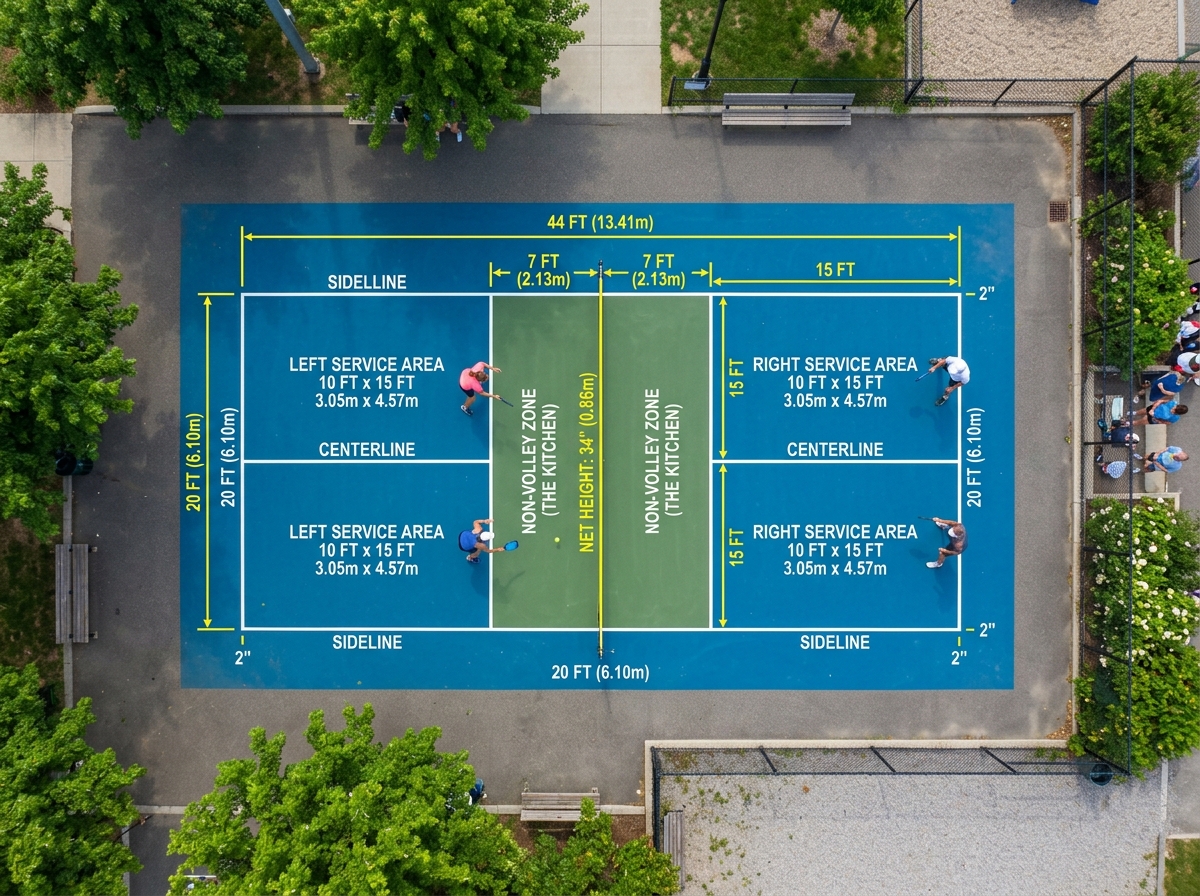
A standard pickleball court measures 20 feet wide by 44 feet long. This is the exact same size as a doubles badminton court. Whether you are playing singles or doubles, the court dimensions remain the same.
The net is hung at 36 inches at the sidelines and drapes slightly to 34 inches in the center. This slight dip is important to remember because it makes “down the middle” shots a bit more forgiving than trying to clear the higher edges of the net.
Essential Equipment
To play legally under the pickleball rulebook for beginners, you need three main things:
- The Paddle: Unlike tennis rackets with strings, pickleball paddles are solid. They are usually made of composite materials like carbon fiber, fiberglass, or graphite. According to the Official USA Pickleball Equipment Standards, the combined length and width of the paddle cannot exceed 24 inches.
- The Ball: We use a perforated plastic ball, similar to a wiffle ball. Indoor balls typically have 26 larger holes and are softer, while outdoor balls have 40 smaller holes and are harder to withstand the wind.
- The Shoes: We cannot stress this enough — wear court shoes! Running shoes are designed for forward motion, but pickleball requires constant side-to-side shuffling. Proper court shoes provide the lateral support needed to prevent ankle rolls.
For those of us who want to dive into the technical nitty-gritty of paddle surfaces and ball compression, check out the official pickleball rules PDF for serious players.
The Kitchen: Navigating the Non-Volley Zone
The most famous part of the court is the Non-Volley Zone (NVZ), affectionately known as “the kitchen.” This is a 7-foot area extending from the net on both sides.
The primary rule is simple: You cannot volley the ball (hit it out of the air) while standing in the kitchen. This includes touching the kitchen line with your toe. The inventors created this rule to prevent tall players from standing right at the net and smashing every ball down into the opponent’s face. It forces a game of strategy rather than just raw power.
The Momentum Rule This is where many beginners get caught. If you hit a volley while standing outside the kitchen, but your momentum carries you into the zone afterward, it is a fault. It doesn’t matter if the ball is already “dead” or if the rally ended before you stepped in. If your movement was part of the act of volleying, stay out of the lava!
Line Calls and Court Ethics
Pickleball is a sport built on a “code of ethics.” In most matches, there is no referee, so we are responsible for our own line calls.
- The Golden Rule of Lines: “Line is in.” If any part of the ball touches the line, it is considered in-bounds.
- The Service Exception: On the serve, the kitchen line is considered “out.” If your serve hits the kitchen line, it’s a fault. All other lines (baseline, sideline, centerline) are “in” on a serve.
- The Benefit of the Doubt: If you aren’t 100% sure a ball was out, you must call it “in.” We should only call a ball out if we can clearly see space between the line and the ball’s contact point.
- Communication: Call the score loudly before you serve so everyone is on the same page. If a ball from another court rolls onto yours, call “Ball on court!” immediately and replay the point for safety.
Starting the Game: Serving and the Two-Bounce Rule
Every rally begins with a serve, but unlike tennis, the serve in pickleball is meant to put the ball in play, not to be an unreturnable “ace.”
How to Serve
To stay within the pickleball rulebook for beginners, your serve must follow these criteria:
- Underhand Motion: The server’s arm must move in an upward arc.
- Contact Point: You must hit the ball below your waist (navel level).
- Paddle Position: The highest part of the paddle head must be below the highest part of your wrist at contact.
- Feet Position: At least one foot must be on the ground behind the baseline. You cannot touch the court or the baseline until you’ve struck the ball.
- Diagonal Delivery: The ball must travel crosscourt and land in the opposite service area, past the kitchen line.
Volley Serve vs. Drop Serve
In recent years, the rules have evolved to allow two different styles of serving.
| Feature | Volley Serve | Drop Serve |
|---|---|---|
| Method | Hit out of the air without a bounce. | Drop the ball and hit after it bounces. |
| Arm Motion | Must be an upward arc. | No restriction on arm motion. |
| Contact Height | Must be below the waist. | No restriction on contact height. |
| Paddle/Wrist | Paddle head must be below wrist. | No restriction on paddle/wrist angle. |
| The Drop | N/A | Must drop from hand or paddle; cannot be “thrown” down. |
The drop serve is often easier for beginners because it removes the strict “below the waist” and “upward arc” requirements, allowing you to focus simply on getting the ball over the net.
Mastering the Two-Bounce Rule in the Pickleball Rulebook for Beginners
This is the rule that confuses new players the most, but it’s the one that makes pickleball work.
The Two-Bounce Rule (or Double-Bounce Rule) states that the ball must bounce once on each side before anyone is allowed to volley.
- Bounce 1: The receiving team must let the serve bounce before returning it.
- Bounce 2: The serving team must let that return bounce before hitting it back.
After these two bounces, both teams can choose to either volley the ball or play it off the bounce. Why does this exist? It prevents the serving team from rushing the net immediately and gaining an unfair advantage. It creates a longer, more strategic rally. If you’re a beginner, a great mental tip is to say “Bounce-Bounce-Play” to yourself during the start of every point.
If you want to master the math behind the game, we have a guide to help you master pickleball scoring.
Scoring Systems and Service Sequences
Scoring is often cited as the “weirdest” part of pickleball. We use a side-out scoring system, which means you can only score a point when your team is serving.
Scoring Basics
- Game Point: Most games are played to 11.
- Win by Two: You cannot win 11-10. If the score is tied at 10-10, play continues until one team leads by two points (e.g., 12-10 or 15-13).
- Switching Sides: In a standard game, teams switch ends of the court when the first team reaches 6 points. This ensures that wind or sun glare doesn’t favor one team for the whole match.
For players looking for age-specific advice on staying mobile while keeping track of these numbers, we recommend you navigate the pickleball rules for beginners over 60.
Doubles Scoring and the Pickleball Rulebook for Beginners
In doubles, the score is called using three numbers: Server Score – Receiver Score – Server Number.
Example: “5 – 3 – 2”
- 5: The serving team has 5 points.
- 3: The receiving team has 3 points.
- 2: The second server on the team is currently serving.
The Starting Sequence (0-0-2) To keep the game fair, the very first team to serve at the start of a game only gets one service turn. To signify this, the first server calls the score as “0-0-2.” When they lose the rally, the serve immediately goes to the other team (“side out”). For the rest of the game, both players on a team will get a turn to serve before a side out occurs.
Server Rotation
- The first serve always starts from the right-hand (even) court.
- If the serving team wins a point, the server moves to the left court and serves again.
- The players only switch sides of the court when they win a point while serving. The receiving team never switches positions.
For a deeper dive into these rotations, check out our article on cracking the code on pickleball scoring.
Singles Play Variations
Singles is a much more athletic version of the game since you have to cover the entire 20-foot width alone. The rules are mostly the same, but the scoring is simpler.
- Two-Number Call: Since there is only one server, you only call two numbers (e.g., “4 – 2”).
- Serving Position: Your position is determined by your own score. If your score is even (0, 2, 4…), you serve from the right side. If your score is odd (1, 3, 5…), you serve from the left side.
Common Faults and Rally Endings
A “fault” is any action that stops play because of a rule violation. When the serving team commits a fault, they lose their serve. When the receiving team commits a fault, the serving team wins a point.
The Most Common Faults:
- Out of Bounds: The ball lands outside the court lines. The line itself is “in.”
- The Net: The ball hits the net and fails to go over. (Note: If the ball hits the net during a rally but still lands in the opponent’s court, it is “live” and play continues).
- NVZ Violation: Volleying while touching the kitchen or the kitchen line.
- Two-Bounce Violation: Failing to let the ball bounce on the serve or the return of serve.
- Double Bounce: The ball bounces twice on one side before a player hits it.
- Body Contact: The ball touches any part of your body or clothing. In pickleball, your paddle is the only thing allowed to touch the ball (though the hand below the wrist is technically considered part of the paddle).
- Net Touch: You, your paddle, or your clothing touches the net or the net posts while the ball is in play.
If you want the definitive list of every possible violation, you can download the USA Pickleball Rulebook PDF.
Frequently Asked Questions about Pickleball Rules
Can you play pickleball on a tennis court?
Yes, we do this all the time! However, you need to make a few adjustments. A tennis court is much larger, so you’ll need to use chalk or tape to mark the 20×44-foot boundaries. You will also need to lower the tennis net to 34 inches in the center (many people use a “center strap” or a “net converter” to do this). Portable net systems are the best option if you want a true pickleball experience on a tennis surface.
What is the “Golden Rule” of pickleball?
While the rulebook is full of technicalities, the “Golden Rule” is sportsmanship. Pickleball was designed as a social game. This means calling the score clearly, giving your opponents the benefit of the doubt on close calls, and always tapping paddles at the net after a match. If you’re not having fun, you’re doing it wrong!
Are there special rules for wheelchair pickleball?
Absolutely. Pickleball is an inclusive sport with specific “Adaptive Play” rules.
- Two-Bounce Allowance: Players in wheelchairs are allowed two bounces to return the ball instead of one. The second bounce can land anywhere (even outside the court).
- The Wheelchair as Body: The wheelchair is considered part of the player’s body, so all rules regarding “player contact” apply to the chair.
- NVZ Modifications: For a wheelchair player, the “kitchen” rules apply only to the front wheels. They can have their rear wheels on or over the line while hitting a volley.
Conclusion
Mastering the pickleball rulebook for beginners is your first step toward joining a community that is taking over parks and recreation centers across the country. We know the scoring feels like a math test and the kitchen rules feel like a “don’t touch the floor” game, but after three or four matches, it will all become second nature.
At Voce Economia, we are dedicated to helping you find the right gear to match your growing skills. Whether you’re looking for your first paddle or the perfect set of beginner balls, we’ve got you covered. The rules provide the structure, but the joy of the game comes from the rallies, the laughs, and the “just one more game” mentality.
Ready to get started? Grab your paddle, find a local court, and start your pickleball journey at Voce Economia today! we’ll see you in the kitchen!
