
The Drill That Makes Every Practice Session Count
The 7 11 pickleball drill is one of the most effective two-player mini-games for building real match skills — and it only takes two people and a single court to run.
Here’s the quick version of how it works:
- Two players — one starts at the kitchen line (non-volley zone), one starts at the baseline
- Uneven scoring — the baseline player wins at 7 points, the kitchen player wins at 11 points
- The baseline player hits a third-shot drop to start each rally and tries to advance to the kitchen
- The kitchen player defends the net, keeping the opponent back and forcing errors
- Switch positions after each game
The scoring gap is intentional. It reflects the real-game disadvantage of being stuck at the baseline — and trains you to fight through it.
With 48.3 million adult Americans now playing pickleball, structured drills like this one are quickly becoming the go-to way to improve faster than just rallying casually. Players who practice the 7-11 drill regularly report noticeable gains in shot accuracy, court awareness, and confidence under pressure.
Whether you’re just picking up a paddle or trying to break through a skill plateau, this drill gives you game-like pressure in a structured format that’s actually fun.
What is the 7 11 Pickleball Drill?
At its core, the 7 11 pickleball drill is a high-intensity mini-game designed to simulate one of the most difficult phases of a pickleball point: the transition from the baseline to the Non-Volley Zone (NVZ), or “the kitchen.” In a standard game, the team at the net has a massive statistical advantage. This drill leans into that reality, creating a “rigged” scenario that forces both players to sharpen their specific positional skills.
For the player at the baseline, the goal is to neutralize the opponent’s advantage using soft drops and resets. For the player at the kitchen, the goal is to maintain offensive control by hitting aggressive volleys and deep dinks. It is a playground for developing mental toughness because it removes the safety net of a standard 11-11 tie; you are either fighting uphill or defending a lead from the very first serve.
The Origin of the Name
The name isn’t just a nod to a famous convenience store; it is a direct reflection of the scoring system. Because the player at the kitchen line has a significant positional advantage, they must reach 11 points to win. The player at the baseline, who is operating from a disadvantageous position, only needs to reach 7 points to claim victory.
This uneven scoring creates a balanced competitive environment. It provides the baseline player with a “handicap” that accounts for how hard it is to win a point from the back of the court. By the time the kitchen player reaches 11, the baseline player has usually had enough “looks” at the kitchen to make a game of it at 7. This setup ensures that every rally feels like a high-stakes point in a tournament.
Who Should Use This Drill?
One of the reasons we love the 7 11 pickleball drill at Voce Economia is its versatility.
- Beginners: It is an excellent way to learn the importance of the “third-shot drop” without the confusion of full-court doubles movement. If you are new, check out our step-by-step guide to learning pickleball to get the basics down before jumping into this drill.
- Intermediate Players: This is the “sweet spot” for this drill. It helps players move past the “banging” stage (where you just hit the ball hard) and into the “soft game” stage.
- Advanced Pros: Even top-tier players use variations of this drill to test their “reset” shots under extreme pressure. It is about refining the “unattackable” ball.
Rules and Scoring: Why the Imbalance Works
The brilliance of the 7 11 pickleball drill lies in its “unfairness.” In a real match, if you are stuck at the baseline while your opponents are at the kitchen, you are probably going to lose that point. This drill acknowledges that reality and uses rally scoring to keep the pace fast.
Every rally results in a point for someone. There is no “side-out” scoring here. This keeps the intensity high and ensures you get the maximum number of “touches” on the ball in a short amount of time.
Scoring for the Baseline Player
The baseline player is the “underdog” in this scenario. Their primary objective isn’t just to win the point, but to successfully transition to the kitchen line. In some variations of the drill, the baseline player actually “wins” a mini-point just by reaching the kitchen line safely, though in the standard competitive version, they simply play the point out.
| Feature | Baseline Player (The Transitioner) | Kitchen Player (The Defender) |
|---|---|---|
| Win Target | 7 Points | 11 Points |
| Starting Position | Behind the Baseline | At the Kitchen Line (NVZ) |
| Primary Goal | Hit a drop and move forward | Keep opponent back / Force errors |
| Key Shot | 3rd Shot Drop / Reset | Volley / Offensive Dinking |
Because you only need 7 points, you are encouraged to take calculated risks. You might try a daring lob or a high-pace drive to see if you can catch the net player off guard.
Scoring for the Kitchen Player
As the kitchen player, you have the “high ground.” You are expected to win more often, which is why your target is 11 points. Your job is to be a wall. You must practice your “blocking” — letting the ball ricochet off your paddle with minimal swing to keep it low and unattackable.
If you let the baseline player reach the net, the advantage disappears, and the point becomes a standard dink battle. The pressure is on you to end the point before they ever get close to that NVZ line.
Mastering the 7 11 Pickleball Drill
To get the most out of this exercise, you can’t just swing wildly. You need a plan. This drill is as much about footwork and body positioning as it is about where you hit the ball. If you want to prepare your body for the movement required, take a look at our training exercises to level up your pickleball game.
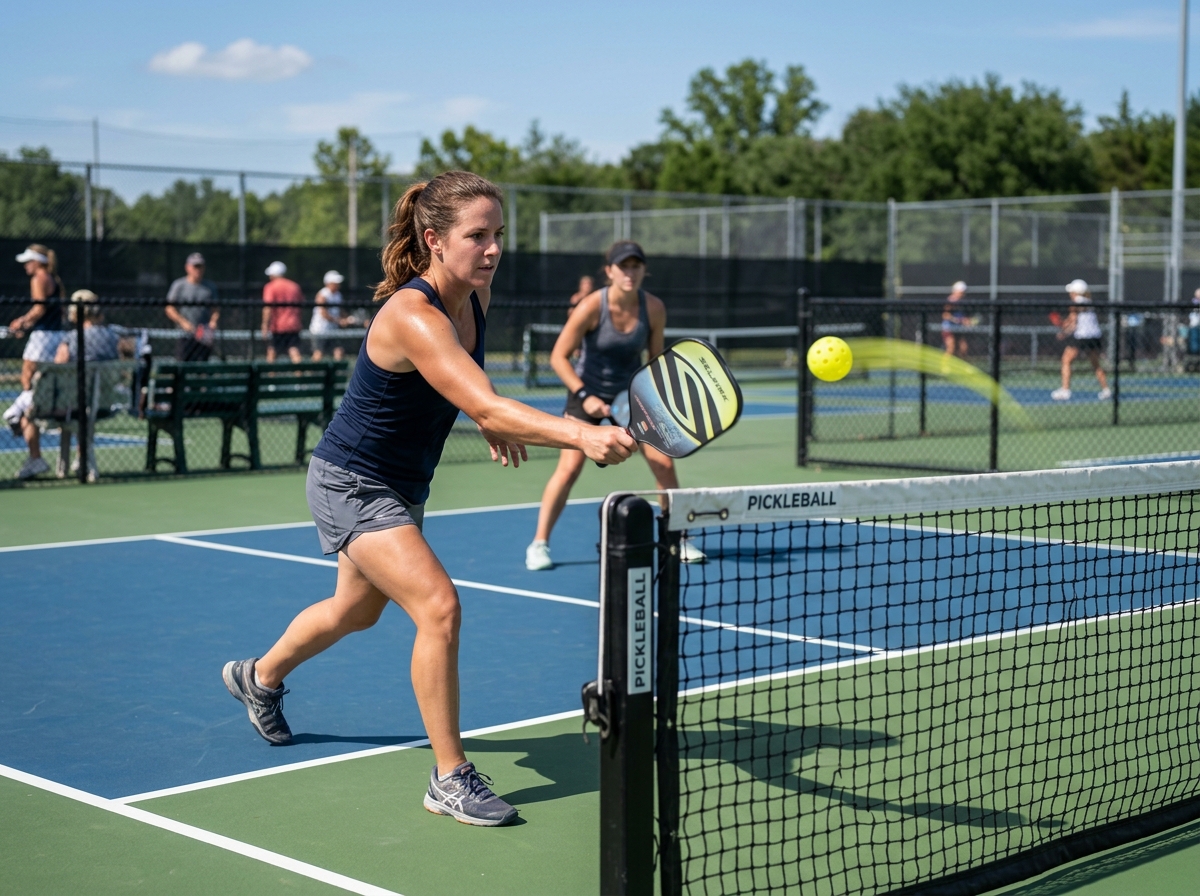
How to Start the 7 11 Pickleball Drill
There are three common ways to initiate the rally, depending on what you want to practice:
- The Deep Serve: The kitchen player serves deep to the baseline player. The baseline player must then hit a “third-shot drop” and move forward.
- The Cooperative Feed: The kitchen player gently tosses or hits a ball to the baseline player to ensure the rally starts with a workable shot. This is best for beginners.
- The Drop Feed: The baseline player starts the rally themselves by dropping the ball and hitting a drop shot, immediately moving into their transition footwork.
We recommend the Deep Serve method for intermediate players because it simulates the pace of a real game.
Transitioning to the Non-Volley Zone
The most common mistake in the 7 11 pickleball drill is what we call the “suicide charge” — running blindly toward the net. Instead, use the “Green Light, Red Light” method:
- Green Light: If you hit a great, low drop shot that lands in the opponent’s kitchen, “go” to the net.
- Red Light: If you hit a “pop-up” or a ball that is too deep, “stop” and get into a defensive stance. You will likely need to hit a “reset” shot (a soft volley that lands in the kitchen) before you can move again.
Mastering this “stop-and-go” movement is what separates 3.0 players from 4.0 players.
Why This Drill Improves Your Match Performance
Statistics show that focused drilling is significantly more effective than “recreational play” for improving specific skills. In fact, players who regularly practice the 7 11 pickleball drill see a 25% improvement in shot accuracy within just a few weeks. Additionally, engaging in community-based drills like this often results in a 15% boost in match performance because you become accustomed to playing under pressure.
Building Mental Toughness
Pickleball is a game of errors. Most points end because someone messed up, not because someone hit a spectacular winner. The 7-11 drill teaches you “patience under fire.” When you are at the baseline and the kitchen player is firing balls at your feet, it is easy to panic. This drill forces you to stay calm, keep your paddle out front, and focus on the “reset.”
By the time you get into a real match, a standard transition will feel easy compared to the “unfair” pressure of the 7-11 scoring system.
Physical Benefits and Conditioning
Don’t let the “mini-game” label fool you; this is a cardiovascular workout. The baseline player is constantly moving forward and backward, while the kitchen player is lunging and reaching to cut off angles. For our older community members, this is a fantastic way to maintain agility. If you are looking for more low-impact options, our drills for senior beginners in pickleball and senior-friendly beginner pickleball drills offer great complementary movements.
Common Mistakes and Advanced Variations
Even the best players can fall into bad habits during the 7 11 pickleball drill. The most frequent error is “staying in No-Man’s Land.” This is the transition zone in the middle of the court where the ball usually lands at your feet. You want to spend as little time here as possible — either stay back or get all the way to the kitchen.
Advanced Variations of the 7 11 Pickleball Drill
Once you’ve mastered the basic version, try these “pro” tweaks:
- Skinny Singles: Only play on half the court (down the line or crosscourt). This forces even higher accuracy.
- Crosscourt Only: This is the most realistic for doubles players, as most third-shot drops are hit crosscourt over the lowest part of the net.
- The “One-Hit” Rule: The baseline player must reach the kitchen in exactly one shot. If they don’t make it to the line before the next ball is hit, they lose the point.
Adapting for Senior Players
For seniors, the focus should be on balance and “soft touch” rather than raw speed. We recommend starting the drill with both players already moving at a “walking pace.” Focus on keeping the ball unattackable rather than hitting it hard. For more tailored advice, see our step-by-step guide to learning pickleball for seniors.
Frequently Asked Questions about the 7-11 Drill
Who has the advantage in the 7-11 drill?
Technically, the kitchen player has the positional advantage, but the scoring advantage goes to the baseline player. Because the baseline player only needs 7 points, they can afford to lose more rallies and still win the game. This creates a “balanced unfairness” that keeps both players engaged.
Can you play the 7-11 drill with four players?
Yes! You can play this in a doubles format where one team starts at the baseline and the other at the kitchen. However, it is most effective as a 1-on-1 drill because it ensures you get a touch on every single ball, which builds muscle memory faster.
How often should I practice this drill to see results?
We recommend incorporating the 7 11 pickleball drill into your routine at least once a week for 20–30 minutes. Spend 10 minutes in each position. You will likely notice a difference in your ability to “reset” the ball in your very next match.
Conclusion
The 7 11 pickleball drill is more than just a practice routine; it is a skill transformation tool. By embracing the strategic imbalance of the court, you learn to handle the pressure of real-game scenarios with grace and consistency. Whether you are aiming to win your local club tournament or just want to stop “popping up” the ball for your opponents to smash, this drill is your ticket to a better game.
At Voce Economia, we believe that the best way to learn is by doing. So, grab a partner, head to the courts, and see if you can reach “Heaven at 7-11.” Don’t forget to Level up your game with more beginner tips to keep your progress moving forward!
